English हिन्दी
Connect with us

India News

PM Modi highlights India’s digital revolution during meeting with Dutch Queen Maxima

PM Narendra Modi discussed India’s Digital Public Infrastructure and financial inclusion initiatives with Queen Máxima of the Netherlands, highlighting how technology is enhancing ease of living.

Published

on

PM Modi

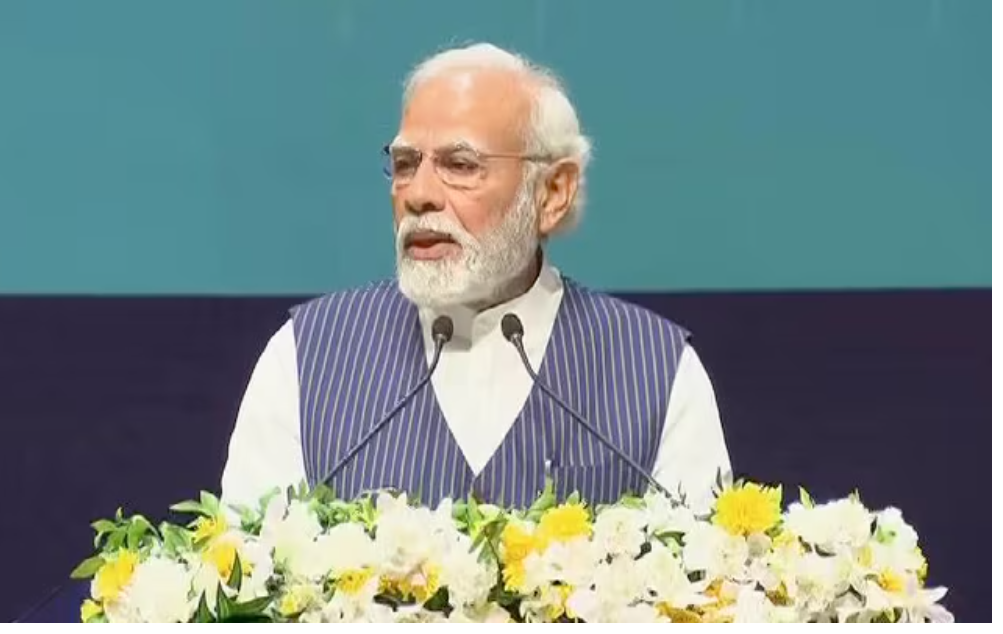
Prime Minister Narendra Modi on Thursday met Queen Máxima of the Netherlands and discussed how India’s Digital Public Infrastructure (DPI) is transforming access to financial services and improving the ease of living for millions.

Queen Máxima, who is also the United Nations Secretary-General’s Special Advocate for Financial Health, held discussions with the Prime Minister on India’s experience in advancing financial inclusion through technology-driven governance.

Sharing details of the meeting on social media platform X, PM Modi said he was pleased to meet Queen Máxima, describing her as a longstanding global advocate for financial inclusion.

The Prime Minister said India’s Digital Public Infrastructure-led transformation has made financial services more accessible and affordable while empowering people on a large scale.

Focus on financial inclusion and digital empowerment

According to PM Modi, the discussions centred on the role of digital public infrastructure in expanding financial access and improving the quality of life for citizens.

“We discussed how India’s Digital Public Infrastructure-led revolution is making financial services more accessible and affordable, while enhancing ‘Ease of Living’ and empowering people at scale,” the Prime Minister said.

He also reiterated India’s commitment to sharing its experience and best practices in digital public infrastructure and financial inclusion with partner countries across the world.

Queen Máxima is on a visit to India in her capacity as the UN Secretary-General’s Special Advocate for Financial Health. Her visit reflects the shared emphasis on promoting financial inclusion and strengthening financial health through innovative digital solutions.

India’s Digital Public Infrastructure ecosystem, which includes platforms enabling digital identity, payments and secure data sharing, has increasingly been showcased globally as a model for inclusive and scalable digital development.

Continue Reading

India News

UPI charges above Rs 2,000 announced with 0.4% merchant fee, consumers unaffected

UPI merchant payments above Rs 2,000 will attract a new charge from October 15, but consumers will continue to use UPI free of cost.

Published

on

UPI down

A new charging framework for certain UPI merchant payments above Rs 2,000 will come into effect from October 15, 2026. However, consumers will continue to use UPI without paying the new charges.

The new UPI Merchant Discount Rate (MDR) framework applies to payments made by consumers to merchants. Under the framework, a 0.4% charge will be levied on eligible merchant transactions above Rs 2,000. The charge will not be passed on to customers, according to the Finance Ministry.

Which UPI transactions will attract charges?

The new framework covers person-to-merchant (P2M) transactions above Rs 2,000. Payments between individuals, or person-to-person (P2P) transactions, will remain free irrespective of the transaction amount.

P2M transactions up to Rs 2,000 will also remain outside the scope of MDR.

For certain merchant categories, including railways, telecom services, insurance and fuel, a flat charge of Rs 5 will apply to UPI payments above Rs 2,000.

Consumers will not have to pay the new fee

The new charges are applicable to merchants and are not meant to be added to the amount paid by customers.

The National Payments Corporation of India (NPCI) said consumers will continue to transact using UPI free of cost. This means that sending money to another person through UPI will remain free, while eligible merchant transactions above Rs 2,000 will come under the new MDR framework.

New UPI framework starts October 15

The revised MDR framework will become effective from October 15, 2026. The changes introduce charges for specified merchant transactions while keeping person-to-person payments and smaller merchant payments outside the MDR framework.

Continue Reading

India News

BJP fields Suvendu Adhikari aide’s mother Hasirani Rath in Nandigram

The BJP has named Hasirani Rath, mother of late Suvendu Adhikari aide Chandranath Rath, as its candidate for the Nandigram Assembly by-election.

Published

on

Suvendu Adhikari

The BJP has named Hasirani Rath as its candidate for the Nandigram Assembly by-election in West Bengal, ending speculation over who would contest the politically significant seat.

Hasirani Rath is the mother of late Chandranath Rath, who had served as a personal assistant to West Bengal Chief Minister Suvendu Adhikari. She is scheduled to file her nomination papers in the presence of Adhikari.

The BJP has also nominated Shakharav Sarkar for the Rejinagar Assembly constituency. The by-elections in Nandigram and Rejinagar are scheduled for October 6, while September 16 is the last date for filing nominations.

BJP picks Chandranath Rath’s mother

Chandranath Rath, a native of Chandipur in East Midnapore, had worked as Suvendu Adhikari’s personal assistant. He was killed on May 6, two days after the West Bengal Assembly election results were declared.

According to the report, Chandranath Rath was shot at close range by motorcycle-borne attackers in Madhyamgram in North 24 Parganas while he was riding pillion. The rider accompanying him was also injured.

After the incident, Suvendu Adhikari met Chandranath Rath’s family and assured them of justice. Hasirani Rath has since continued to express her faith in Adhikari.

Local residents had earlier demanded that Hasirani Rath be fielded from Nandigram. The BJP has now formally nominated her for the constituency, which is listed as Assembly Constituency No. 210.

Hasirani Rath’s political background

Hasirani Rath comes from a middle-class background and has been associated with politics since 1998. She has previously contested panchayat elections and served as a panchayat member for two terms.

Her nomination puts a grassroots political figure at the centre of the BJP’s campaign in Nandigram. The move also follows the party’s recent selection of candidates with personal connections to politically significant events in West Bengal.

Nandigram bypoll on October 6

The Nandigram and Rejinagar Assembly by-elections will be held on October 6, with the nomination process set to close on September 16.

Hasirani Rath said she would accept the responsibility assigned to her by the BJP. She also referred to Suvendu Adhikari as her guardian while speaking about her candidature.

The Nandigram contest is particularly significant for the BJP as the seat was previously held by Suvendu Adhikari, who retained another constituency after winning both seats in the 2026 West Bengal Assembly election.

Continue Reading

India News

Modi-Xi meeting draws global attention, China says India should be partner

Chinese Foreign Minister Wang Yi said the Modi-Xi meeting at the BRICS summit reached a consensus on partnership, border peace and wider cooperation.

Published

on

Chinese Foreign Minister Wang Yi has said Prime Minister Narendra Modi and Chinese President Xi Jinping reached a key consensus during their meeting on the sidelines of the 18th BRICS Summit in New Delhi, with both sides viewing India and China as partners rather than rivals.

The meeting between Modi and Xi took place on September 12 during Xi’s two-day visit to New Delhi for the BRICS summit. According to Wang, the two leaders held a candid and in-depth discussion on strategic, long-term and broader issues concerning India-China relations.

India-China partnership highlighted

Wang said the “most important consensus” reached by the two leaders was that China and India should be partners.

According to the Chinese foreign minister, Xi said the two countries could draw on each other’s strengths, support one another and pursue common development.

Wang also said the Modi-Xi meeting attracted widespread international attention.

He described the recent improvement in China-India relations as a shift from a “restart” towards a “renewed elevation”, while saying that cooperation between the two countries has continued to expand.

Focus on border peace

The two countries agreed to jointly maintain peace and tranquility in their border areas, Wang said.

He added that both sides pledged to strengthen political mutual trust, appropriately manage differences and contradictions, and maintain peace along the border.

During his meeting with Modi, Xi called for mutual respect and understanding to help overcome disruptions in bilateral ties. He also advocated progress on India-China relations and border issues, with the two tracks reinforcing each other.

Wang said Modi responded positively and reaffirmed that India approaches its relationship with China from a strategic and long-term perspective.

Modi says India ready to be China’s partner

According to Wang’s account of the meeting, PM Modi said India was ready to be a partner rather than an adversary to China.

Modi also viewed the development of the two countries as an opportunity rather than a challenge, Wang said.

He added that India remains committed to high-level exchanges with China, stronger strategic communication and broader people-to-people ties based on mutual respect and trust.

Cooperation in BRICS and other forums

The two leaders also agreed to support each other’s BRICS chairmanship, according to Wang.

They discussed stronger coordination through multilateral platforms, including the United Nations, the Shanghai Cooperation Organisation and the G20.

The two sides also agreed to expand cooperation in areas including cultural and people-to-people exchanges and direct air connectivity, Wang said.

Wang said China and India should deepen mutually beneficial cooperation and contribute to cooperation across the Global South.

China calls for implementation of consensus

Chinese Foreign Ministry spokesman Guo Jiakun said China would work with India to implement the understandings reached by Modi and Xi.

Guo said Beijing would seek to expand the areas of cooperation, deepen people-to-people exchanges and strengthen coordination in multilateral forums.

He also said China would continue efforts to improve bilateral ties and support each other’s development, with the aim of contributing to peace and prosperity in the region and beyond.

PM Modi and Xi Jinping reached a key consensus that India and China should be partners, not rivals, Chinese Foreign Minister Wang Yi said after their BRICS meeting.

The two sides also discussed border peace, BRICS cooperation and stronger bilateral ties.

Continue Reading

Trending

© Copyright 2022 APNLIVE.com