English हिन्दी
Connect with us

India News

Total lunar eclipse on March 3: When and how to watch blood moon safely

A total lunar eclipse on March 3 will create a stunning blood moon. Here are the timings, visibility details and safe viewing tips for India and other regions.

Published

on

Lunar Ecliple234

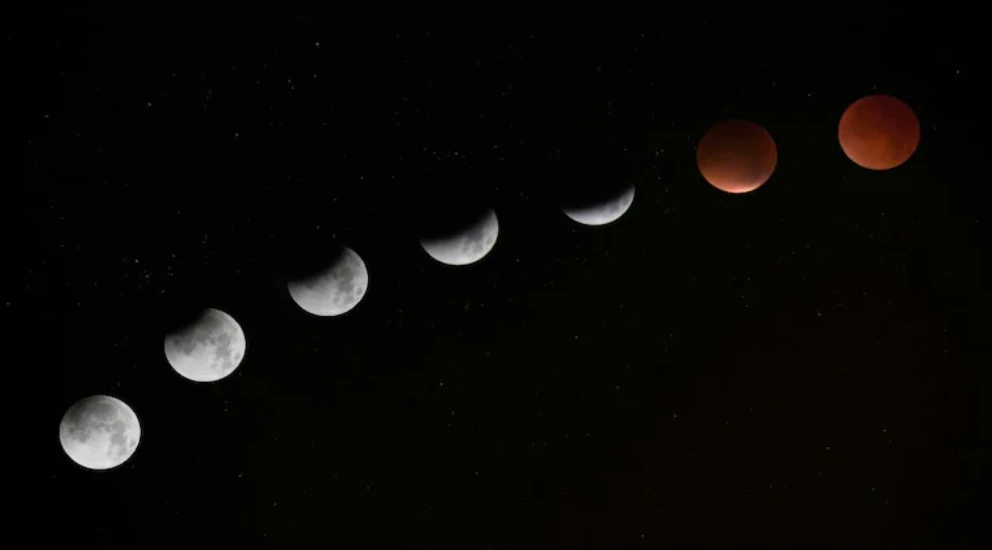
Sky-watchers across several parts of the world are set to witness a spectacular total lunar eclipse on March 3, when the Moon will take on a striking coppery-red hue, popularly known as a “blood moon”.

A total lunar eclipse occurs when the Earth moves directly between the Sun and the Moon, casting its shadow completely over the lunar surface. During this phase, instead of turning dark, the Moon glows in shades of deep red or orange. This phenomenon happens because the Earth’s atmosphere bends and filters sunlight, allowing only red wavelengths to reach the Moon.

Where will the lunar eclipse be visible

The total lunar eclipse will be visible across eastern Asia, Australia, New Zealand, the Pacific region, and parts of North and South America.

In India, only the final phase of the eclipse will be visible around moonrise at sunset. Northeastern states including Assam, Arunachal Pradesh, Meghalaya and West Bengal are expected to have a view of the celestial event, subject to clear weather conditions.

According to official timings shared by the India Meteorological Department, the eclipse schedule in India is as follows:

  • Eclipse begins: 3:20 pm
  • Total phase begins: 4:34 pm
  • Total phase ends: 5:33 pm
  • Eclipse ends: 6:48 pm

Globally, totality will last for approximately 58 minutes, from 6:04 am EST (1104 GMT / 4:34 pm IST) to 7:02 am EST (1202 GMT / 5:32 pm IST).

Is it safe to watch the blood moon

Unlike a solar eclipse, a lunar eclipse is completely safe to observe with the naked eye. There is no need for protective eyewear.

Experts advise choosing a location with a clear and unobstructed view of the eastern horizon for the best experience. While the eclipse can be seen without equipment, binoculars or a small telescope can enhance the view and bring out the Moon’s reddish tones more clearly.

Tips for photographing the blood moon

Those planning to capture the rare event can consider the following tips:

  1. Use a DSLR or mirrorless camera paired with a telephoto lens between 200 mm and 600 mm for closer shots.
  2. Increase the ISO between 400 and 1600 and slow the shutter speed to around 1–2 seconds during totality to capture the dimmer red glow.
  3. Use a tripod to ensure stability and avoid blurred images.

The March 3 total lunar eclipse offers astronomy enthusiasts a unique opportunity to witness one of the most captivating natural spectacles in the night sky.

Continue Reading

India News

Illegal immigration from India to US drops 69% from 2023 peak, says US data

Published

on

By

Fears of harsh treatment, including internment, and tough border legislations under the Donald Trump administration seem to have brought down illegal immigration from India to the United States by almost 69 per cent from the peak recorded in 2023, according to the latest data released by US Customs and Border Protection (CBP). The figures indicate a significant decline in irregular migration through the US land borders.

Trump and his Make America Great Again (MAGA) support base have advocated tougher measures against illegal immigrants such as roving Immigration and Customs Enforcement (ICE) personnel who have picked up immigrants and detain them in camps. ICE personnel have killed several Americans too in the mindless drive against immigrants.

CBP data, which follows the US fiscal year (October to September), shows authorities recorded 20,614 encounters with Indian migrants between October 2025 and May 2026. During the corresponding period in FY2023, when illegal migration from India reached its highest level, the number of encounters stood at 67,212. The latest figures are also lower than the nearly 29,000 encounters recorded during the same period in FY2025.

The sharpest decline has been recorded along the US-Mexico border, where encounters involving Indian migrants fell by nearly 99 per cent, from 30,109 during the October-May period of FY2023 to 417 in FY2026. At the US-Canada border, encounters dropped to 2,250, marking a 91 per cent decline from the comparable period in FY2024.

Migration experts said the decline comes amid tighter US immigration measures, stricter border enforcement and reduced expectations of securing asylum through illegal entry routes. Experts also noted that the high financial cost and risks associated with irregular migration have discouraged many prospective migrants from attempting the journey.

Despite the decline, Indian nationals continue to account for a significant share of migrants intercepted at US land borders, says CBP. Officials from both India and the United States have repeatedly urged people to avoid illegal migration routes and instead use authorised visa and immigration channels.

Continue Reading

India News

Supreme Court urges Centre to reconsider introducing third language for CBSE Class 9

Published

on

By

Supreme Court

The Supreme Court on Thursday orally urged the Centre and the Central Board of Secondary Education (CBSE) to reconsider the introduction of the compulsory third language policy for Class 9, observing that the move could place an unnecessary academic burden on children.

During a hearing of petitions challenging the policy, the bench of Justice B.V. Nagarathna and Justice R. Mahadevan remarked that introducing a new language at the Class 9 level may create additional stress for students and suggested that, if such a policy is necessary, it would be more appropriate to begin it from Class 6, when children have more time to adapt. The court, however, did not pass any interim order staying the policy.

The petitions challenge the CBSE’s three-language policy introduced under the New Education Policy 2020. Under the revised framework, students entering Class 9 are required to study three languages, with at least two being Indian languages. The petitioners argued that the sudden implementation has created difficulties for students, schools and teachers, particularly due to the availability of textbooks, qualified language teachers and the increased academic workload.

During the hearing, the Supreme Court sought responses from the Union Government and the CBSE on the concerns raised in the petitions. The Bench emphasised that while learning languages is valuable, educational reforms should be implemented in a manner that does not place avoidable pressure on students.

The matter will be heard again after the Centre and the CBSE file their replies. The outcome of the case is expected to influence the implementation of the three-language policy in CBSE-affiliated schools across the country, particularly for students entering Class 9 in the current academic session.

Continue Reading

India News

Bank holiday today: Banks closed in Odisha, Uttarakhand and Manipur on July 16 for regional festivals; check details

Banks will remain closed in Odisha, Uttarakhand and Manipur on July 16 for regional festivals, while banking operations continue normally in the rest of India. Here’s the complete holiday schedule.

Published

on

Rath Yatra

India’s banking services will remain partially affected on Thursday, July 16, as banks in select states are closed to observe regional festivals, according to the Reserve Bank of India’s (RBI) holiday calendar for the financial year 2026-27.

Customers in most parts of the country can continue to access banking services as usual, while branches in Odisha, Uttarakhand and Manipur will remain shut for local celebrations.

Banks closed today in these states

Banks will remain closed on July 16 in the following states:

  • Odisha – Rath Yatra
  • Uttarakhand – Harela
  • Manipur – Kang festival

Apart from these states, bank branches across the rest of India are expected to function normally.

How does RBI decide bank holidays?

The Reserve Bank of India prepares a state-wise holiday calendar covering national, religious and regional occasions. Since several festivals are celebrated only in specific states, bank holidays may differ from one region to another.

In addition to these notified holidays, banks across the country remain closed on the second and fourth Saturdays of every month, as well as on all Sundays.

When is the next bank holiday?

According to the RBI’s holiday schedule, the next notified bank holiday falls on July 17, 2026, in Sikkim to mark the Death Anniversary of U Tirot Singh.

Customers are advised to check the holiday schedule applicable to their respective state before planning a visit to a bank branch.

Will online banking services remain available?

Although physical bank branches may remain closed in the affected states, customers can continue using digital banking services. Mobile banking, internet banking, UPI transactions, ATM withdrawals and other online banking facilities are expected to remain available, enabling uninterrupted access to essential financial services.

Continue Reading

Trending

© Copyright 2022 APNLIVE.com