English हिन्दी
Connect with us

India News

Covid-19: Railways record 1,000 cases among staff daily, 1,952 employees have died so far

According to the All Indian Station Masters’ Association (AISMA), Railway has lost its 113 station masters due to coronavirus in the second wave this year. The Railway has lost 50 of their Protection Force men.

Published

on

railway police

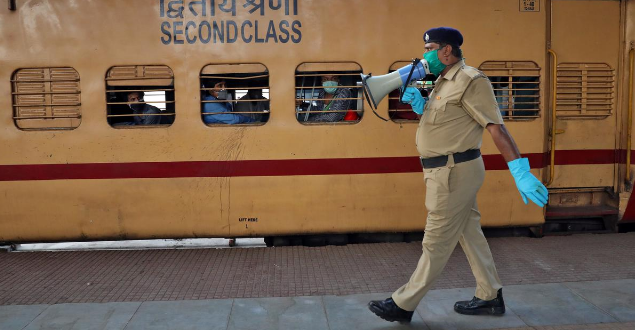
Indian Railway has lost almost 1,952 of its employees like ticket collectors, cleaning staff, station masters since the coronavirus pandemic started. Railways Ministry on Monday said, almost 1,000 railway staff getting affected by Covid on a daily basis.

Railway Board Chairman, Suneet Sharma said, they have almost 4,000 Covid beds, which are occupied by railway staff and their families. He said they are putting extra effort to make their staff members recover as soon as possible. He further said, on May 10 (yesterday), 1,952 of their rail employees have died due to a novel coronavirus infection since March last year.

Sharma said Railway is equal to any other state or territory that is witnessing rising in Covid cases by passing each day. He said Railway is witnessing around 1,000 Covid cases on daily basis. We have increased the number of Covid beds, we have built oxygen plants in rail hospital, we are doing any possible thing to protect our staff and their family from this global pandemic, Sharma added.

According to the All Indian Station Masters’ Association (AISMA), Railway has lost its 113 station masters due to coronavirus in the second wave this year. The Railway has lost 50 of their Protection Force men.
AISMA wrote a letter to Railway Board and rail divisions, demanding special insurance cover of their staff members of Rs 50 lakh for each. It demanded immediate vaccination of their staff front line workers of Railways. Association said, many station masters falling sick and getting infected from the virus, the truncated staff have to work overtime since stations cannot be left without station masters.

Delhi’s Divisional Railway Manager, S.C Jain said their main focus right now is to vaccinate their staff. He said they are in constant coordination with the state governments for the same.

Read Also: Twitter donates $15 million to India amid Covid crisis

According to health ministry data on Monday, with 366,161 fresh covid cases, India has witnessed a significant drop in daily Covid-19 cases, the caseload now stands at 22,662,575, while 246,116 people have lost their life due to the virus. India has 3.75 million active cases.


India News

Delhi air quality plunges to severe as thick smog blankets the capital

Delhi’s air quality deteriorated sharply with AQI entering the ‘severe’ zone across several areas, prompting enforcement of GRAP stage-IV measures.

Published

on

Delhi's air quality

Delhi woke up to hazardous air conditions on Tuesday as dense smog covered large parts of the national capital, pushing the Air Quality Index (AQI) into the ‘severe’ category across several locations. Poor visibility and rising health concerns marked yet another spell of extreme pollution in the city.

Data from the Central Pollution Control Board (CPCB) showed the overall AQI in Delhi touching 413 in the morning, placing it firmly in the ‘severe’ bracket. Several areas across the National Capital Region (NCR) reported alarming pollution levels, indicating a widespread deterioration in air quality.

Pollution hotspots report hazardous readings

Some of Delhi’s major pollution hotspots recorded extremely high AQI levels. Anand Vihar topped the list with an AQI of 466, followed by Ashok Vihar at 444 and Chandni Chowk at 425. These areas remained in the ‘severe’ category, posing serious health risks, especially for children, the elderly and those with respiratory conditions.

Even central parts of the city were not spared. India Gate, Kartavya Path and the Rashtrapati Bhavan area were shrouded in toxic smog, with AQI levels around 384, categorised as ‘very poor’.

GRAP stage-IV measures enforced across Delhi-NCR

In response to the worsening situation, the Commission for Air Quality Management (CAQM) enforced all actions under GRAP Stage-IV across Delhi-NCR. As part of these emergency measures, truck-mounted water sprinklers were deployed to suppress dust and reduce particulate matter in the air.

As per AQI standards, readings between 401 and 500 fall under the ‘severe’ category, while levels above 300 are considered ‘very poor’, highlighting the seriousness of the current conditions.

Delhi government reviews pollution control steps

The Delhi government has reiterated its commitment to tackling rising pollution levels with strict enforcement measures. Chief Minister Rekha Gupta stated that a zero-tolerance policy will be followed against all sources contributing to air pollution in the capital.

A high-level review meeting was held at the Delhi Secretariat to assess existing measures and take further decisions. The meeting focused on enforcing Pollution Under Control (PUC) norms without any relaxation, exploring pooled and shared electric bus services across Delhi-NCR, issuing fresh guidelines for e-rickshaws, and rationalising Delhi Transport Corporation (DTC) bus routes.

Senior officials from the Environment and Transport Departments, the Delhi Pollution Control Committee (DPCC), Public Works Department (PWD) and Delhi Traffic Police, along with Environment Minister Manjinder Singh Sirsa, attended the meeting to finalise immediate and long-term steps to address the pollution crisis.

Continue Reading

India News

Rahul Gandhi alleges institutional bias, questions electoral system during Berlin address

Rahul Gandhi alleged that India’s institutions and electoral system have been weaponised to favour the BJP, remarks that sparked a strong political response.

Published

on

Rahul-Gandhi

Leader of the Opposition in the Lok Sabha, Rahul Gandhi, has said that India’s institutional framework is facing a serious challenge and has been used to favour the ruling BJP. Speaking during an interaction at the Hertie School in Berlin, Gandhi questioned the functioning of key institutions and the electoral machinery, remarks that triggered a sharp political response from the BJP.

Gandhi said the Congress believes there is a problem with the electoral system and alleged that several institutions have been captured. Referring to investigative agencies, he claimed that bodies such as the CBI and the ED have been used as political tools. According to him, cases filed by these agencies overwhelmingly target those opposing the BJP, while leaders from the ruling party face none.

He also pointed to what he described as a stark financial imbalance between the BJP and the opposition, claiming a funding ratio of 30:1. Gandhi said this disparity reflects how institutions are being used to consolidate political power.

Opposition strategy and INDIA alliance

The Congress leader said merely pointing out problems in elections is not enough and stressed the need for the opposition to build a system of resistance that can effectively counter the ruling party. He added that the challenge now goes beyond electoral contests and is about presenting an alternative vision for the country.

On the INDIA alliance, Gandhi said the unity among opposition parties is rooted in their rejection of the ideological position of the RSS. While acknowledging that tactical contests between alliance partners will continue, he said they remain united when it comes to opposing laws they disagree with and working together in Parliament.

BJP hits back at remarks abroad

Gandhi’s comments delivered overseas drew a strong reaction from the BJP. Party president and Union minister JP Nadda accused him of speaking against India while Parliament is in session and claimed that he was undermining the country’s image at a time when the Prime Minister is receiving global recognition.

BJP spokesperson Shehzad Poonawalla also criticised Gandhi, alleging that he routinely travels abroad to defame India. He accused the Congress leader of making misleading claims about the country’s institutions and economic activity while praising China.

Continue Reading

India News

DU VC Prof Yogesh Singh entrusted with additional charge of AICTE Chairman

Published

on

By

Prof. Yogesh Singh, Vice Chancellor of the University of Delhi, has been entrusted with the additional charge of the post of Chairman, AICTE till the appointment of a Chairman of AICTE or until further orders, whichever is earlier.

It is noteworthy that AICTE Chairman Prof. TG Sitharam was relieved of his duties after his term ended on December 20, 2025. According to a letter issued by the Ministry of Education, Government of India, on Monday, Prof. Yogesh Singh’s appointment is until the appointment of a regular AICTE Chairman or until further orders whichever is earlier.

Prof. Yogesh Singh is a renowned academician with excellent administrative capabilities, who has been the Vice-Chancellor of University of Delhi since October 2021. He has also served as the Chairperson of the National Council for Teacher Education. In August 2023, he was also given the additional charge of Director of the School of Planning and Architecture (SPA).

Prof. Yogesh Singh served as the Vice-Chancellor of Delhi Technological University from 2015 to 2021; Director of Netaji Subhas Institute of Technology, Delhi from 2014 to 2017, and before that, he was the Vice-Chancellor of Maharaja Sayajirao University, Baroda (Gujarat) from 2011 to 2014. He holds a Ph.D. in Computer Engineering from the National Institute of Technology, Kurukshetra. He has a distinguished track record in quality teaching, innovation, and research in the field of software engineering.

Continue Reading

Trending

© Copyright 2022 APNLIVE.com