English हिन्दी
Connect with us

India News

Have good equation with Sonia Gandhi, Rahul Gandhi: Sushmita Dev on joining Trinamool Congress

Dev had joined the Trinamool Congress after handing in a letter to Congress chief Sonia Gandhi, offering her resignation. She said she was beginning a new chapter of public service.

Published

on

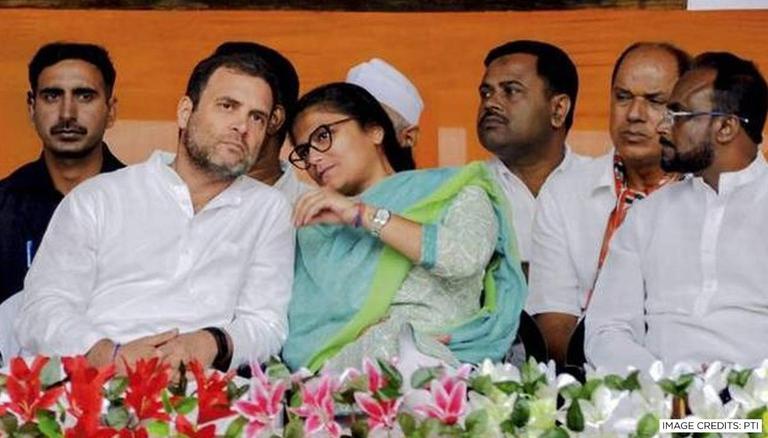
Rahul Gandhi and Sushmita Dev

Sushmita Dev, who recently quit Congress and joined Trinamool Congress on Tuesday said that she has no issues with Congress President Sonia Gandhi and Rahul Gandhi. Refusing to give reasons on quitting the party after three-decade-long period, Dev said she has good equation with both the leaders but has to answer her people, NDTV reported.

On being asked about the matter, the Trinamool leader told reporters that she has explained everything in her resignation letter to the Congress Chief.

Dev, the daughter of Assam Congress stalwart and influential Bengali leader Santosh Mohan Dev said she had a three-decade-long association with the grand old party that gave her a lot of opportunities. She hasn’t demanded anything from the Congress high command in her 30 years in politics. Demanding an apology, Dev said she hopes the Congress president forgives her for her shortcomings, she told NDTV.

Dev had joined the Trinamool Congress after handing in a letter to Congress chief Sonia Gandhi offering her resignation. She said she was beginning a new chapter of public service. Her exit from the Congress came as a surprise for many in the party including Kapil Sibal who blamed it on the party leadership. Sibal was among the G23 senior leaders who wrote a letter to Congress chief Sonia Gandhi last year seeking organisational changes and effective leadership. 

Sushmita Dev Resigns from primary membership of our Party While young leaders leave we ‘oldies’ are blamed for our efforts to strengthen it The Party moves on with : Eyes Wide Shut, Kapil Sibal tweeted.

Meanwhile, National spokesperson of Indian National Congress Manish Tewari tweeted that, if this is true it is most unfortunate. Why @sushmitadevinc? Your erstwhile colleagues & friends especially  the person who was National President of @nsui when you contested your first @DUSUofficial elections back in 1991 deserve a better explanation than this laconic letter?

Read Also: India announces new e-visa to fast-track applications of Afghans for entry

On her rank in the Trinamool Congress, Dev said she will do any work allotted to her and try and fulfill it without any demand.

India News

India announces Rs 40,000 crore boost for semiconductor sector in Union Budget 2026

Union Budget 2026 unveils a Rs 40,000 crore allocation for semiconductor production and research under India Semiconductor Mission 2.0.

Published

on

union budget 2026

Presenting her ninth consecutive Union Budget today, Finance Minister Nirmala Sitharaman announced a Rs 40,000 crore allocation for the semiconductor industry under the newly launched India Semiconductor Mission 2.0. The move aims to build on the momentum of the first semiconductor mission initiated in January 2022.

Sitharaman highlighted that the mission will focus on industry-led research and training centres, as well as the production of equipment and materials for full-stack Indian intellectual property (IP).

“Semiconductor Mission 2.0 will focus on producing equipment and materials designed for full-stack Indian IP,” she said.

The Finance Minister also emphasised that the Budget follows a path of reforms over rhetoric, aiming to position India on the trajectory toward becoming a Viksit Bharat.

Earlier this month, Union Electronics and IT Minister Ashwini Vaishnaw stated that India is on track to begin commercial semiconductor chip production in 2026, in line with the timeline of the original semiconductor mission. Pilot production has already started at three plants in 2025, with four plants expected to begin operations this year.

Analysts note that India, as the world’s fastest-growing major economy, is expected to continue prioritising defence, infrastructure, capital expenditure, power, and affordable housing in fiscal year 2026–27.

Continue Reading

India News

Union Budget 2026 live updates: Nirmala Sitharaman Raises Capex to ₹12.2 Lakh Cr, West Bengal Gets Major Allocation

Finance Minister Nirmala Sitharaman is presenting the Union Budget 2026 in Parliament today. Follow this space for live updates, key announcements, and policy insights.

Published

on

Finance Minister Nirmala Sitharaman arrives to present Union Budget 2026

Finance Minister Nirmala Sitharaman will shortly present the Union Budget 2026 in the Lok Sabha, marking her ninth consecutive Budget. The annual financial statement is expected to outline the government’s policy priorities, reform agenda and spending plans for the coming year. Stay tuned for live updates, key announcements and immediate reactions as the Budget speech unfolds.

Finance Minister Nirmala Sitharaman tabled her ninth Union Budget today, beginning her speech at 11 am.

Nirmala Sitharaman is set to present her ninth Union Budget today, with the finance minister scheduled to begin her speech at 11 am.

Budget 2026 live updates: Presenting the Union Budget for 2026–27, Finance Minister Nirmala Sitharaman said the occasion coincided with Magh Purnima and the birth anniversary of Guru Ravidas. She noted that over the past 12 years, India’s economic journey has been defined by stability, fiscal discipline, sustained growth and moderate inflation.

The budgeted fiscal deficit for fiscal 2026 is estimated at 4.4 per cent of gross domestic product (GDP)

Planned capital expenditure this fiscal year Rs 11.2 lakh crore

Rare earth corrdiors in Odisha and Kerala

Hi-tech tool rooms to be set up by PSUs

Construction equipment scheme to be launched

Container manufacturing scheme for Rs 10,000 crore over 5 years

Rs 10,000 crore SME Growth Fund

Semi-conductor mission to get Rs 40,000 crore

Rs 12.2 lakh crores for infrastructure development

Dedicated RITES to repurpose land of Central PSUs

20 new waterways over next 5 years to be connected

7 high-speed corridors on rail

High-level committee on banking for next phase of Viksit Bharat

Capital expenditure hike of to ₹12.2 lakh crore in Budget 2026, with West Bengal receiving a significant share of allocations.

Mahatma Gandhi Gram Swaraj Initiative aimed at boosting the khadi, handloom, and handicrafts sectors.

High-speed rail corridors: Mumbai-Pune, Pune-Bengaluru, Hyderabad-Bengaluru, Chennai-Bengaluru, Delhi-Varanasi, Varanasi-Siliguri, Pune-Hyderabad

Five university campuses to be established near industrial corridors

Lakpati Didi program expanded in Budget 2026 to reach more beneficiaries across India.

Fiscal deficit for FY26 revised to 4.4%; Budget Estimate for FY27 set at 4.3%.

Continue Reading

India News

Nirmala Sitharaman to present ninth Union Budget with reforms in focus

Nirmala Sitharaman will present her ninth consecutive Union Budget today, with expectations centred on reforms, growth priorities, rural development and capital expenditure.

Published

on

Union budget 2026

Finance Minister Nirmala Sitharaman will present her ninth consecutive Union Budget today, marking another key moment in India’s economic policy calendar. The Budget is expected to lay out measures aimed at sustaining growth in what remains the world’s fastest-growing major economy.

For fiscal 2027, policy priorities are likely to include defence, infrastructure, capital expenditure, power and faster growth in affordable housing, according to expectations ahead of the presentation.

Shift in Budget speech structure

This year’s Union Budget is expected to break with a long-standing tradition in the structure of the finance minister’s speech. Until now, most major policy announcements were typically made in Part A, while Part B focused on taxation. This time, Part B is expected to be used to present a broader vision for India’s economic future.

The finance minister is also expected to outline short-term priorities as well as longer-term goals, positioning India’s economic strategy as the country moves deeper into the 21st century, with emphasis on domestic strengths and global ambitions.

Market backdrop ahead of Budget

Ahead of the Budget presentation, equity markets opened lower. Gold and silver futures also declined sharply on the Multi Commodity Exchange, extending the impact of a severe two-day global sell-off.

India’s economy has so far remained resilient despite punitive tariffs imposed by the United States under President Donald Trump. Growth is forecast at 7.4 per cent for the year ending March 31, supported by government spending on infrastructure and tax measures that boosted consumption.

Focus on rural development and jobs

Rural development and agriculture are expected to be among the top priorities in Union Budget 2026. The finance minister may announce higher allocations for programmes aimed at expanding employment opportunities in rural areas.

The Rural Development Ministry has sought a sharp increase in funding for the new employment guarantee scheme, ‘Viksit Bharat – G Ram G’ or VB-G Ram G, proposing a budget of Rs 1.51 lakh crore, a 72 per cent rise. In comparison, the Mahatma Gandhi National Rural Employment Guarantee Scheme received Rs 86,000 crore in the previous Budget.

Fiscal deficit and capital expenditure

The budgeted fiscal deficit for fiscal 2026 is estimated at 4.4 per cent of gross domestic product. With the government having achieved a consolidation path that brought the deficit below 4.5 per cent, markets will closely watch signals on further debt-to-GDP reduction.

Capital expenditure for the current fiscal year has been budgeted at Rs 11.2 lakh crore. The government is expected to continue prioritising capex, with a possible increase of 10 to 15 per cent, as private sector investment remains cautious.

Investment reforms and global challenges

Further policy changes aimed at attracting domestic and foreign investment are also expected. These may include steps to make it easier for foreign companies to invest in defence firms that already hold licences.

The Union Budget 2026 comes at a time of mixed signals globally. While domestic demand remains steady and inflation has eased from recent highs, uncertainties linked to geopolitics, commodity price volatility and uneven monetary policy easing by major central banks continue to pose challenges.

Continue Reading

Trending

© Copyright 2022 APNLIVE.com