English हिन्दी
Connect with us

Latest world news

Russian tide turns towards Obama

Published

on

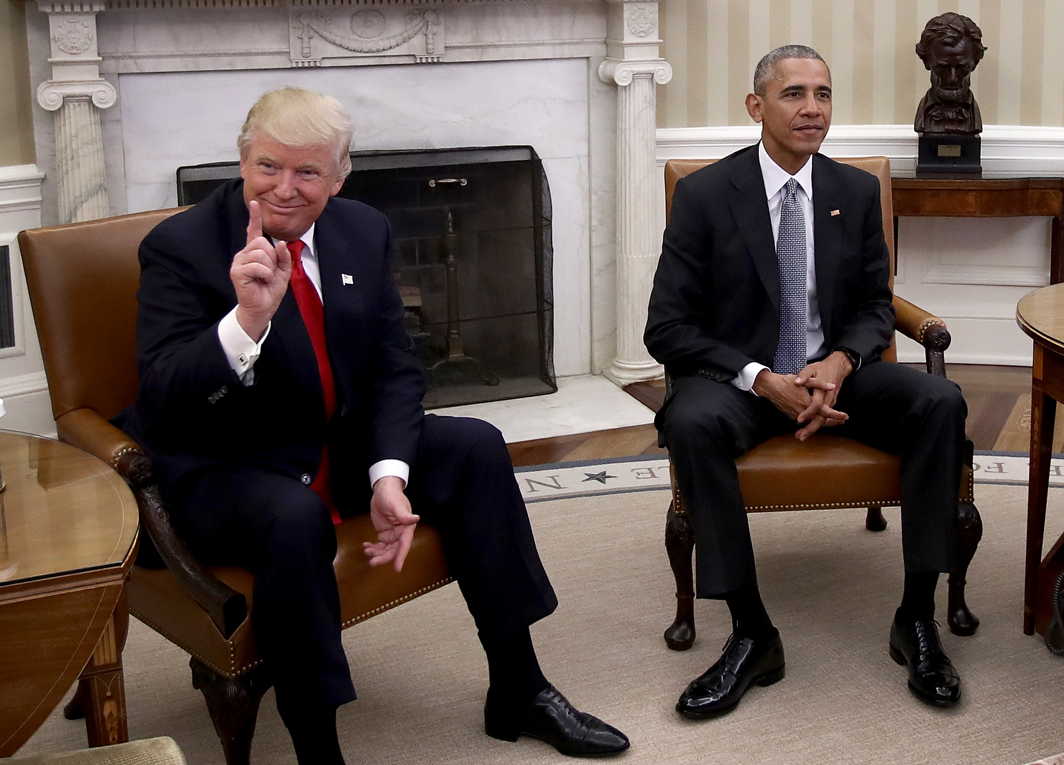
Donald trump and Obama

[vc_row][vc_column][vc_column_text]Trump questions Obama for not acting

President Donald Trump has now taken a sigh of relief. He may, to some extent, get rid of pressures about his election team’s close ties with Kremlin. The breather was recently provided by Washington Post by revealing that CIA had informed former President Barrack Obama about Russia’s attempt to influence 2016 election as early August last year, much before November polls.

Now Trump, who was facing investigation on his links with Russian government,   has questioned as to why Obama did nothing about it.

Trump tweeted “The CIA gave him information on Russia a long time before they even—before the election. And I hardly see it. It’s an amazing thing. To me in other words, the question is, if he had the information. Whey did’nt he do something about it? He should have done something about it. But you don’t read that. It’s quite sad”.

On Friday, Washington Post reported on the Obama administrtion’s efforts to punish Russian President Vladimir Putin for trying to sway presidential election in Trump’s favor, quoting a former Obama official saying the administration “sort of choked.”

The Washington Post report details as to how the CIA’s assessment that Putin was directly involved in a cyber campaign to disrupt and discredit US Presidential election in an effort to help Trump prompted Obama administration to debate dozens of options for deterring or punishing Russia.  The sources disclosed that proposals of cyber attack on Russian infrastructure, the release of CIA gathered material that might embarrass Putin and economic sanctions were discussed.

Much before the elections, Obama administration issued several warnings to Moscow about its activities. Even President Obama had directly mentioned to his Russian counterpart Vladimir Putin in September, it was revealed.

President Obama, however, approved modest punitive measures that include expulsion of a few dozen diplomats, closure of two Russian compounds and some symbolic economic sanctions. Planting of cyber weapons in Russia’s infrastructure, was still in the planning stages when Obama left the white House.

Since the story was broken on Friday, on the eve of the two-day weekend, the issue is expected to come under serious public debate next week. Experts believe that Washington Post has provided a big breather to the Trump administration by giving him an opportunity to question his predecessor Barack Obama for “not doing something” about it. [/vc_column_text][/vc_column][/vc_row]

Latest world news

Suicide bombing at Islamabad imambargah kills 69, over 160 injured

At least 69 people were killed after a suicide bomber detonated explosives at a Shia shrine in Islamabad’s Shehzad Town area, triggering a city-wide emergency.

Published

on

Suicide bombing at Islamabad Shrine

A suicide bombing at a Shia place of worship in Pakistan’s capital Islamabad left at least 69 people dead and more than 160 injured on Friday, according to media reports.

The explosion took place at Tarlai Imambargah, located in the Shehzad Town area, when a suicide bomber detonated explosives near the main gate of the shrine during afternoon hours.

Attacker stopped at entrance, officials say

Security officials were quoted as saying that the attacker was intercepted by guards at the entrance, preventing him from entering the main hall where worshippers had gathered. Despite this, the blast caused extensive damage to the gate and nearby structures.

Visuals from the scene showed shattered windows of surrounding buildings and debris scattered across the road following the explosion.

Emergency declared, injured shifted to hospitals

Following the blast, the Islamabad Inspector General of Police declared a city-wide emergency, as rescue and law enforcement teams rushed to the site amid fears of high casualties.

The injured were shifted to Pakistan Institute of Medical Sciences (PIMS) and Polyclinic Hospital for treatment.

Prime minister condemns attack

Pakistan Prime Minister Shehbaz Sharif expressed deep grief over the attack and strongly condemned the bombing at the Shiite mosque in Islamabad.

In a statement, he said the incident was a tragic act of violence and offered condolences to the families of those killed. Official statements noted that dozens were injured in the attack, with treatment ongoing at city hospitals.

Previous attack referenced

The incident comes less than three months after a suicide blast outside a district and sessions court building in Islamabad on November 11, 2025, in which 12 people were killed and over 30 injured.

Continue Reading

Latest world news

Suicide bombing at Islamabad shrine kills 10, over 20 injured

A suicide bombing at a Shia shrine in Islamabad’s Shehzad Town area killed at least 10 people and injured over 20, prompting a city-wide emergency.

Published

on

Suicide bombing at Islamabad Shrine

At least 10 people were killed and around 20 others sustained injuries after a suicide bomber detonated explosives at a Shia shrine in Pakistan’s capital, Islamabad, on Friday afternoon.

The explosion took place at Tarlai Imambargah, located in the Shehzad Town area, when the attacker set off the device at the main entrance of the place of worship, where devotees had gathered.

Bomber stopped at entrance, say officials

Security officials said alert guards intercepted the attacker at the gate, preventing him from entering the main hall of the shrine. The timely action is believed to have reduced the scale of casualties inside the premises.

However, the blast caused significant damage to the gate structure. Visuals from the site showed shattered windows of nearby buildings and debris scattered across the road following the explosion.

Emergency declared across Islamabad

In the aftermath of the attack, the Islamabad Inspector General of Police declared a city-wide emergency. Rescue teams and law enforcement personnel rushed to the site amid concerns that the casualty count could rise.

The injured were shifted to Pakistan Institute of Medical Sciences (PIMS) and Polyclinic Hospital for treatment.

Recent history of suicide attacks in the capital

The incident comes less than three months after a suicide bombing outside a district and sessions court building in Islamabad on November 11, 2025, which killed 12 people and injured more than 30 others, raising renewed concerns over security in the capital.

Continue Reading

Latest world news

Bangladesh rushes to finalise US trade deal after India secures lower tariffs

Bangladesh is accelerating talks with the US to finalise a trade agreement after India secured lower tariffs, raising concerns over export competitiveness and transparency.

Published

on

Bangladesh is moving quickly to finalise a trade agreement with the United States after India concluded a deal with Washington that lowered tariffs on Indian goods to 18 per cent. The development has triggered concern in Dhaka that Bangladesh could lose market share in the US if it fails to secure comparable or better terms.

The US and Bangladesh are expected to sign the agreement on February 9, just three days before the country’s national election scheduled for February 12. The timing and lack of transparency surrounding the deal have drawn criticism from economists, business leaders and political observers.

Bangladesh’s economy is heavily dependent on ready-made garment exports, which account for nearly 90 per cent of its exports to the US. Any tariff disadvantage compared to India could significantly impact export orders and employment in the sector.

Tariff cuts under negotiation

The proposed agreement follows a series of tariff revisions imposed by Washington. In April 2025, the US imposed a steep 37 per cent tariff on Bangladeshi goods. This was reduced to 35 per cent in July and further lowered to 20 per cent in August.

According to reports, the upcoming deal is expected to bring tariffs down further to around 15 per cent. Officials see this as critical to keeping Bangladeshi exports competitive against Indian products in the US market.

Secrecy around negotiations raises concerns

Concerns have intensified due to the confidential nature of the negotiations. In mid-2025, the interim government led by Muhammad Yunus signed a formal non-disclosure agreement with the US, committing to keep tariff and trade discussions confidential.

No draft of the agreement has been shared with the public, parliament or industry stakeholders. A commerce adviser had earlier stated that the deal would not go against national interests and could be made public with US consent.

Policy experts, however, argue that the lack of disclosure prevents meaningful debate on the agreement’s long-term implications.

Conditions reportedly linked to the deal

Media reports suggest that the agreement may include several conditions. These include reducing imports from China, increasing military procurement from the US, and allowing American goods easier access to the Bangladeshi market.

It is also reported that Bangladesh may be required to accept US standards and certifications without additional scrutiny. Inspections on US vehicle imports and parts could reportedly be eased to facilitate smoother entry into the local market.

A senior policy analyst described the process as opaque, noting that signing the agreement just days before elections could bind the hands of the next elected government.

Garment industry left in the dark

Bangladesh exports garments and textiles worth between $7 billion and $8.4 billion annually to the US, accounting for nearly 96 per cent of its total exports to the American market. In comparison, Bangladesh imports around $2 billion worth of goods from the US.

With India and Bangladesh exporting similar apparel products, lower tariffs for India could shift US buyers towards Indian suppliers. Industry leaders warn that this could put millions of jobs at risk in Bangladesh’s garment sector, which employs 4 to 5 million workers, most of them women.

The sector contributes over 80 per cent of Bangladesh’s export earnings and nearly 20 per cent of its GDP.

A senior garment exporters’ association official said the agreement carries major implications and should ideally have been signed after the election to allow broader political and public discussion.

Political timing draws criticism

Economists and analysts have also questioned why an unelected interim administration is finalising a major trade agreement so close to national elections. They argue that responsibility for implementing the deal will fall on the incoming elected government.

A prominent economist criticised the process as lacking transparency and warned that the country could be pushed into long-term commitments without adequate scrutiny or public consent.

Meanwhile, US diplomats have indicated openness to engaging with various political forces in Bangladesh, including Jamaat-e-Islami, which has been banned multiple times in the country’s history.

Continue Reading

Trending

© Copyright 2022 APNLIVE.com