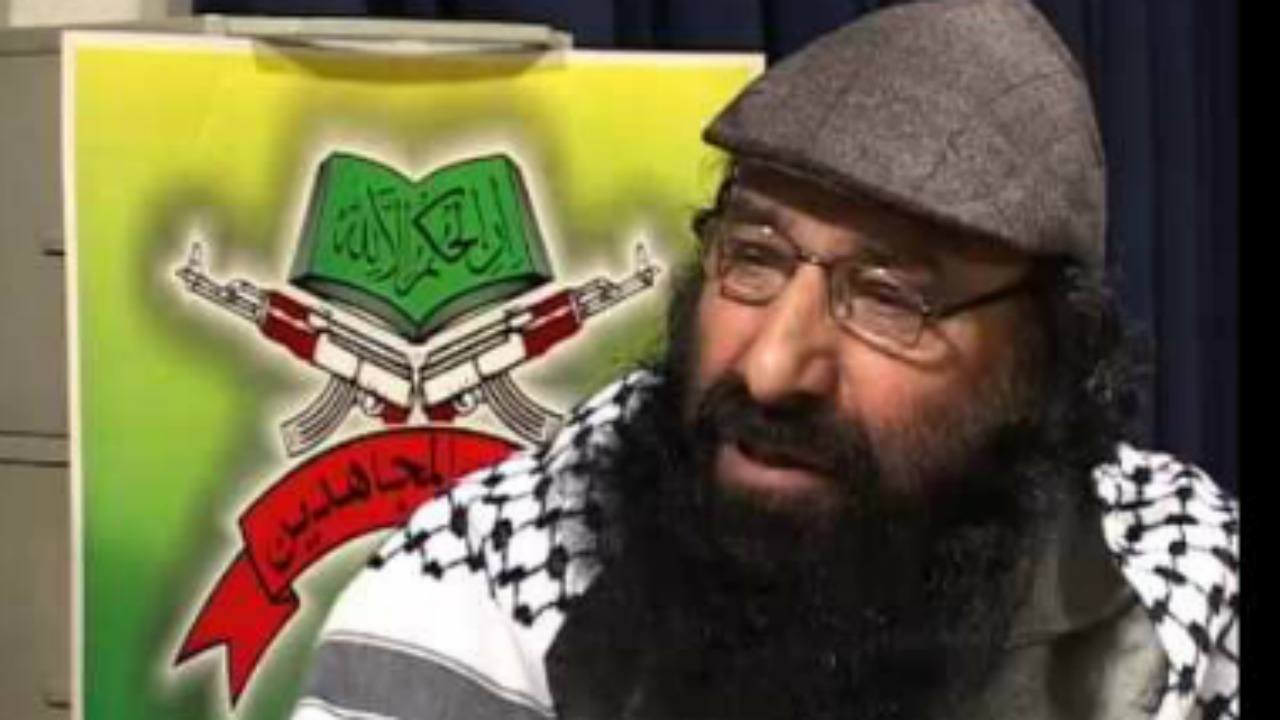
[vc_row][vc_column][vc_column_text]Just about a week after being declared a global terrorist by US, Hizbul Mujahideen chief Syed Salahuddin told Geo TV, a Pakistani TV channel, that he has carried out terrorist attacks in India and he could strike India at any time.
Pakistan had slammed US designation of Salahuddin as a global terrorist, calling it “completely unjustified”. “The designation of individuals supporting the Kashmiri right to self-determination as terrorists is completely unjustified,” it had said.
Salahuddin is wanted in more than 50 terror cases including assassinations, abduction, attacks on security forces, and hawala funding in India. His outfit Hizbul Mujahideen (HM) has claimed responsibility for several attacks in India in the past, including the April 2014 explosives attack in J&K which injured 17 people.
The US designated Salahuddin as a ‘global terrorist’ on June 26, hours ahead of Prime Minister Narendra Modi’s first meeting with US President Donald Trump in Washington. The US State Department had said: “Department of State has designated Mohammad Yusuf Shah, also known as (AKA) Syed Salahuddin, as a Specially Designated Global Terrorist (SDGT) under Section 1(b) of Executive Order (E.O.) 13224, which imposes sanctions on foreign persons who have committed, or pose a significant risk of committing, acts of terrorism that threaten the security of US nationals or the national security, foreign policy, or economy of the United States. .”
The state department’s notification said that Salahuddin-led HM “has claimed responsibility for several attacks” including the April 2014 explosives attack in Kashmir, which injured 17 people. He has also time and again vowed to block any peaceful resolution to the Kashmir conflict and threatened to train more Kashmiri suicide bombers, the state department said.
The US state department’s notification stated that all Americans are now “generally prohibited from engaging in transactions with Salahuddin and all of Salahuddin’s property and interests in property subject to United States jurisdiction are blocked”.
Salahuddin rejected US charges, calling himself a freedom fighter and not a terrorist. He vowed to continue fighting for the ‘liberation’ of Kashmir.
At a rally in Pakistan occupied Kashmir’s (PoK) Muzaffarabad on Saturday, Salahuddin called US President Donald Trump “crazy” for the action against him. He also called the Trump administration “idiotic”, saying it was “a gift to (Indian Prime Minister Narendra) Modi”. “Donald Trump’s decision will be thrown out if anyone challenges it in American courts. No other Western nation has endorsed what this crazy Donald Trump has done,” Salahuddin said.
“The US cannot provide a single example of when I and other Kashmiri fighters committed any act of terrorism,” he said, addressing the media at the Centre Press Club in Muzaffarabad. “Kashmiri freedom fighters have a code of conduct to not harm minorities, the elderly, children and women, and if sometimes the enemy offers a peace deal, we accept it.”
“This (the Trump administration’s) idiocy can neither weaken our courage, nor stop the freedom struggle and the target-oriented actions of freedom fighters,” Salahuddin added
In the interview with Geo TV, Salahuddin said, “Till now our focus was on Indian occupation forces. All the operations that we have done or are underway, we focus only on the installations of these occupational forces.”
Salahuddin described Kashmir as ‘home’, and said Burhan Wani’s death last year has triggered an uprising in the Valley. After Wani was killed in an encounter with security forces last July, Salahuddin had vowed to turn the state into “a graveyard for Indian forces”.
“If we would have taken our operations out of Kashmir at that time, India would get a chance to label Kashmir-e-Tehreek a terrorist organisation. We have support and we can target any place in India, at any time,” he said, during the interview. He explained that the international scene has changed since 9/11.
He added he purchases weapons from the international market.
Cases against Syed Salahuddin:
Hizbul Mujahideen chief Mohammad Yousuf Shah alias Syed Salahuddin, declared a ‘Specially Designated Global Terrorist’ by the US, is wanted in more than 50 terror cases including assassinations, abduction, attacks on security forces, and hawala funding in India.
In some cases, charge sheets have been filed and investigations are on in others but progress in these cases has been tardy since Salahuddin has been absconding, based as he is in PoK since 1993.
According to the police, he has been declared as a proclaimed offender in a Rs 80 crore terror funding case by a special National Investigation Agency (NIA) court in 2013.
There is also an Interpol Red Notice pending against Salahuddin who is also the head of the United Jihad Council, an umbrella group of over a dozen terrorist outfits based in PoK.
He is wanted include the killing of Superintendent of Police Mohammad Amin Khan in August 2012. There were seven accused, including Salahuddin in the case.
Salahuddin’s brush with law began in 1987, the year he contested the Assembly polls, widely believed to have been rigged. He contested elections from Amira Kadal, a constituency in Srinagar, on the ticket of Muslim United Front — an amalgam of different political and religious organisations. He lost to National Conference stalwart late Ghulam Mohidin Shah. Later, he was booked for seditious speech under the Terrorist and Disruptive Act, 1987 (the case was registered in 1987). But by the time the charge sheet for the case was filed in 1997, Salahuddin had crossed over into PoK and had become the HM chief.
Salahuddin is wanted in the 2002 attack on People’s Democratic Party workers in which three cops and one terrorist were killed in Budgam district of central Kashmir. The case has been charge sheeted without any further progress.
Salahuddin is also wanted in the tourist bus attack in 2006 in Srinagar. According to police, grenades were hurled at a tourist bus in Lal Chowk on the instructions of Salahuddin, resulting in injuries to a few tourists.
Police have registered numerous cases against Salahuddin for threatening Panchs and Sarpanchs besides calling for the poll boycott to derail democracy in Jammu and Kashmir.
According to a NIA chargesheet, Salahuddin in 1999 chaired a meeting of Hizbul’s Markazi Majlis-e-Shura, a top body of its decision making, in connivance with the agencies of Pakistan-founded Jammu Kashmir Affectees Relief Trust (JKART) – a frontal organisation of HM. The objective was to raise funds from Pakistan and other countries in the name of relief for rehabilitation of affected persons in Jammu and Kashmir and use it for furthering terrorist activities in India.[/vc_column_text][/vc_column][/vc_row]