English हिन्दी
Connect with us

Latest Politics News

Bihar Minister praises Centre’s free Covid vaccine, says people are alive today because of Narendra Modi

As per the Health Ministry data India’s Covid-19 vaccination coverage has exceeded 204.25 crore (2,04,25,69,509)

Published

on

bihar minister

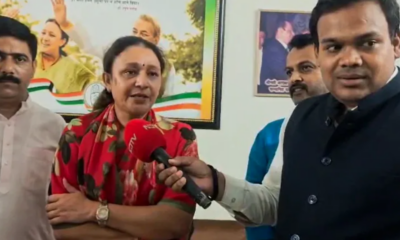
Bihar minister Ram Surat Rai on Friday heaped praise on Prime Minister Narendra Modi for providing free Covid vaccine to all and credited him for saving millions of lives.

Showering praise on PM Modi, the BJP leader also claimed that the people are alive today because of Prime Minister Narendra Modi, under whose leadership India ran the world’s biggest vaccination drive during the Covid-19 pandemic.

Addressing a public gathering in Bihar’s Muzaffarpur, Rai said if Indians are alive, the credit goes to Narendra Modi. PM Modi developed Covid vaccine during pandemic and administered its free doses to people of the country, he said.

Bihar Minister also said several countries are still battling the economic impact of the pandemic, but in India, the work is being done at a fast pace to strengthen the economy.

In his speech, Rai also praised PM Modi and applauded the regulatory reforms and supportive nature of the central government throughout the vaccination drive.

Taking a dig at Pakistan’s vaccination drive, the Bihar Minister said when India’s neighbouring Pakistan was struggling due to Covid-19, PM Modi started vaccination drive in India and provided free vaccines for everyone.

As per the Health Ministry data India’s Covid-19 vaccination coverage has exceeded 204.25 crore (2,04,25,69,509). India crossed the milestone of administering 200 crore Covid vaccination doses on July 17, eighteen months after the vaccination drive began in the country.

Ahead of Independence Day, the Central government has announced a special Covid vaccination drive to provide free vaccines to people aged 18 years and above from July 15 to September 30, 2022.

India News

Karnataka clears internal quota for scheduled castes, cabinet approves revised formula

Karnataka has approved a new internal quota system for Scheduled Castes, redistributing the 15% reservation and enabling recruitment to resume.

Published

on

The Karnataka government has approved a revised internal reservation formula for Scheduled Castes (SCs), marking a significant policy decision aimed at ensuring fair distribution of benefits among sub-groups.

The decision was taken during a special cabinet meeting led by Chief Minister Siddaramaiah. The approved formula redistributes the existing 15% SC reservation into three internal categories.

Under the new structure, 5.25% reservation each has been allocated to the “left-hand” and “right-hand” SC groups, while 4.5% has been earmarked for other Scheduled Caste communities, including nomadic groups.

Recruitment to resume after policy clearance

With the cabinet giving its nod, the government is expected to restart long-pending recruitment processes. Officials indicated that fresh notifications will be issued under the revised quota system, allowing hiring to move forward.

The move is expected to unlock thousands of government job vacancies that had been on hold due to the absence of clarity on internal reservation.

Decision shaped by legal constraints

The revised quota formula has been structured to comply with the Supreme Court-mandated 50% ceiling on total reservations. Earlier, the state had proposed increasing the SC quota to 17% and Scheduled Tribes (ST) quota to 7%, but this could not be implemented due to legal limitations.

As a result, the government retained the SC reservation at 15% and proportionately adjusted the internal distribution among sub-categories.

Shift from earlier quota structure

The new formula replaces the earlier proposed 6:6:5 distribution model. The cabinet revised these figures proportionately to align with the 15% cap, resulting in the current 5.25:5.25:4.5 structure.

The classification divides SC communities into three groups to address disparities in access to reservation benefits across sub-castes.

Aim to ensure equitable representation

The government has said the decision is intended to bring more balance and fairness in reservation benefits among different SC communities. The categorisation is expected to improve representation of relatively underrepresented groups within the SC category.

The cabinet’s approval is seen as a key step in addressing long-standing demands for internal reservation among Scheduled Castes in the state.

Continue Reading

India News

Mamata Banerjee rejects exit polls, claims TMC will win over 226 seats in Bengal

Mamata Banerjee has rejected exit poll predictions for the 2026 West Bengal elections, claiming her party will win over 226 seats and return to power.

Published

on

mamta banerjee

West Bengal Chief Minister Mamata Banerjee has dismissed the exit poll predictions for the 2026 assembly elections, asserting that her party will return to power with a strong mandate of more than 226 seats.

Speaking after voting concluded, Banerjee urged people not to rely on exit poll projections, expressing full confidence in the electoral support for her party. She maintained that the All India Trinamool Congress would secure a decisive victory despite several surveys suggesting a close contest or advantage for the opposition.

Her remarks come at a time when multiple exit polls have indicated a tight race between the Trinamool Congress and the Bharatiya Janata Party, with some projections even pointing towards a potential shift in power.

Confidence vs projections as Bengal awaits results

Banerjee reiterated that exit polls have historically failed to capture the actual mood of voters in West Bengal. She said the final results would reflect the trust people have placed in her government.

The chief minister’s confidence echoes her earlier stance during the campaign, where she repeatedly claimed that her party would secure a comfortable majority and continue its governance in the state.

Meanwhile, exit poll trends released after voting suggested mixed outcomes. Some surveys projected a lead for the BJP, while others indicated a close fight or even a possible hung assembly.

High-stakes battle in West Bengal elections

The 2026 West Bengal assembly elections have been one of the most closely watched political contests in India, with intense campaigning by both the ruling TMC and the BJP.

High voter turnout and strong political mobilisation from both sides have added to the uncertainty surrounding the final outcome. Leaders from both parties have expressed confidence in forming the government once results are declared.

The official results are expected to determine whether Banerjee secures another term or if the state witnesses a political shift.

Continue Reading

India News

Tamil Nadu exit polls favour DMK, Vijay factor may influence margins

Exit polls suggest DMK may retain power in Tamil Nadu, but Vijay’s political debut could influence the final outcome.

Published

on

Actor vijay

Exit polls for the 2026 Tamil Nadu Assembly elections suggest that the ruling Dravida Munnetra Kazhagam (DMK), led by Chief Minister M K Stalin, is likely to return to power, though the final outcome will be confirmed on counting day.

According to multiple projections, the DMK-led alliance is expected to secure a majority in the 234-member Assembly, with estimates placing the party’s tally in the range of around 122 to 145 seats.

Most polling agencies indicate that the ruling alliance has maintained a clear edge over its rivals, particularly the AIADMK-led bloc, in what has been a closely watched contest.

Vijay factor adds new dimension

A significant highlight of this election has been the entry of actor-turned-politician Vijay and his party, Tamilaga Vettri Kazhagam (TVK). His debut has introduced a third force in a state traditionally dominated by the DMK and AIADMK.

Early assessments suggest that while TVK may not secure a large number of seats, it could influence vote shares and outcomes in several constituencies, especially by attracting younger voters and first-time participants.

This has made the electoral contest more complex, with analysts pointing to potential vote-splitting effects that could impact margins for both major alliances.

High turnout and key contest

Polling for all 234 seats was held on April 23, with the state witnessing a high voter turnout of over 84 percent, one of the highest in recent decades.

The election saw a multi-cornered fight involving the DMK alliance, AIADMK-led coalition, and newer players like TVK, alongside other regional parties.

What happens next

Exit polls provide only an early indication of voter trends and are not always accurate. The final results will be declared on May 4, when counting of votes takes place.

Until then, while projections favour a return of the DMK government, the actual impact of the “Vijay factor” and constituency-level dynamics will become clear only after the official results are announced.

Continue Reading

Trending

© Copyright 2022 APNLIVE.com