
Gadgets
The Lunar Eclipse of 31 January : Let us not be frightened of our own shadow!


~By Dr. Niruj Ramanujam
In the evening of 31 January, as we look towards the eastern sky, we will be witness to the dance of shadows that our Solar System regularly conjures up, as our Earth and the Moon move inexorably in their cosmic orbits around the Sun. As the Full Moon passes through the Earth’s shadow, it will be eclipsed for a few hours. What is more, this will be a total lunar eclipse, most of which can be seen from all of India. What is important is that we all go outside and see this majestic spectacle that nature will orchestrate for a few hours, and that we get our friends, family, and our communities to share in it too.
Eclipses have fascinated, awed and frightened humanity for millennia. More than 2000 years ago, when we did not understand what eclipses were, the sight of the Sun or the Moon in the unchanging sky being covered by something unknown must have been scary. In every culture, there are stories of some strange beast swallowing the Sun or the Moon – a dragon in China, a frog in Vietnam, a bird in Hungary, a bear in Siberia, a snake for Mayans, and of course, Rahu and Ketu in India. However, in each of these cultures, as local scientists came to an understanding of eclipses, fear and awe slowly gave way to understanding and appreciation.
In India, the earliest stories involved the demon Svarbhanu, who was later identified with Rahu and the story of the churning of nectar. Ketu, which used to be the name for comets and meteors, also became identified with the eclipse. With the introduction of astrology from the Greeks, this identification was further solidified. It was left to the genius of Aryabhata (476-550 C.E.), born in present day Patna, to correctly explain the cause of eclipses and also give a method for calculating them accurately. His method was refined by other astronomers in India over the next few centuries, and is still used in many parts of the country.
We all learn in school now that a solar eclipse is caused when the Moon’s shadow falls on the Earth, and a lunar eclipse occurs when the Earth’s shadow falls on the Moon. Why then, we often ask, do we not get eclipses every full and new moon? The orbit of the moon around the earth and the orbit of the earth around the sun are not in the same plane, but are tilted at about 5 degrees with respect to each other. Hence, during a typical new moon or full moon, the sun, earth and the moon do not fall exactly in a straight line. For example, during most new moons, the moon passes close to the sun in the sky, but does not come close enough to cover it, and likewise for the full moon.
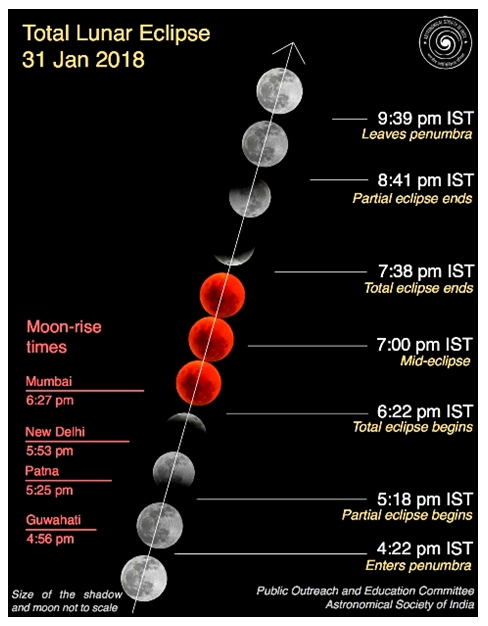
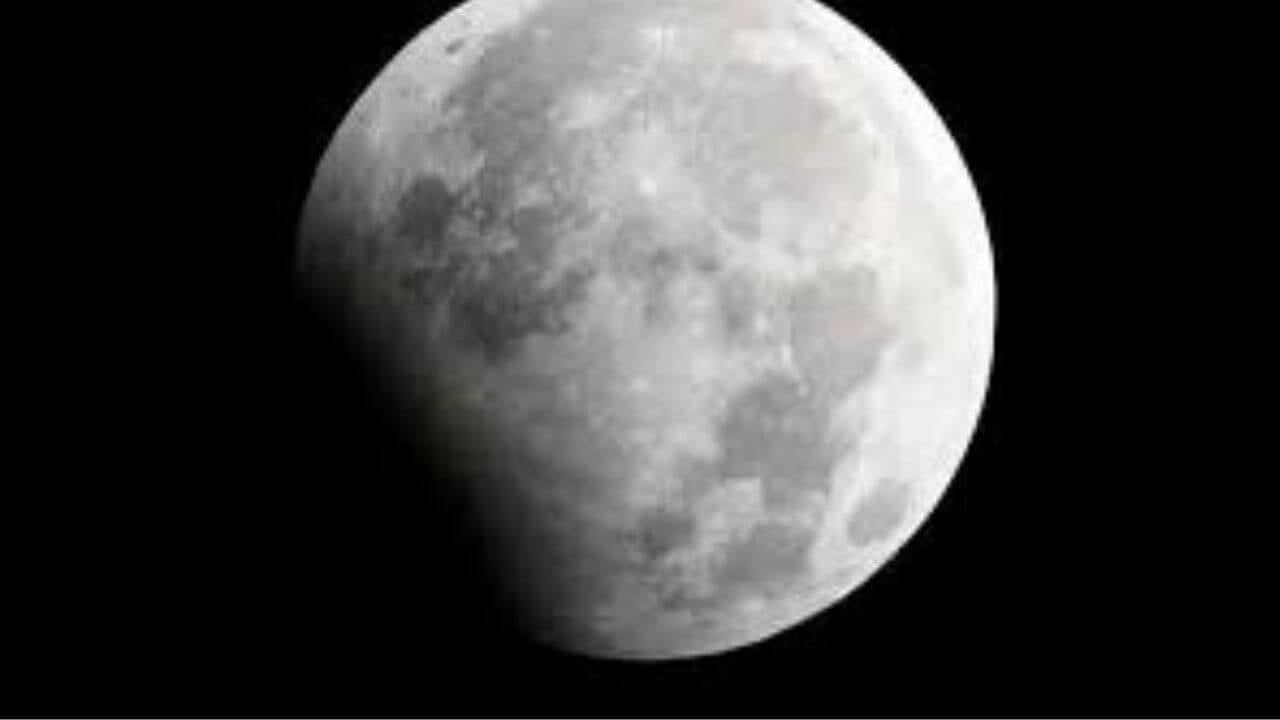
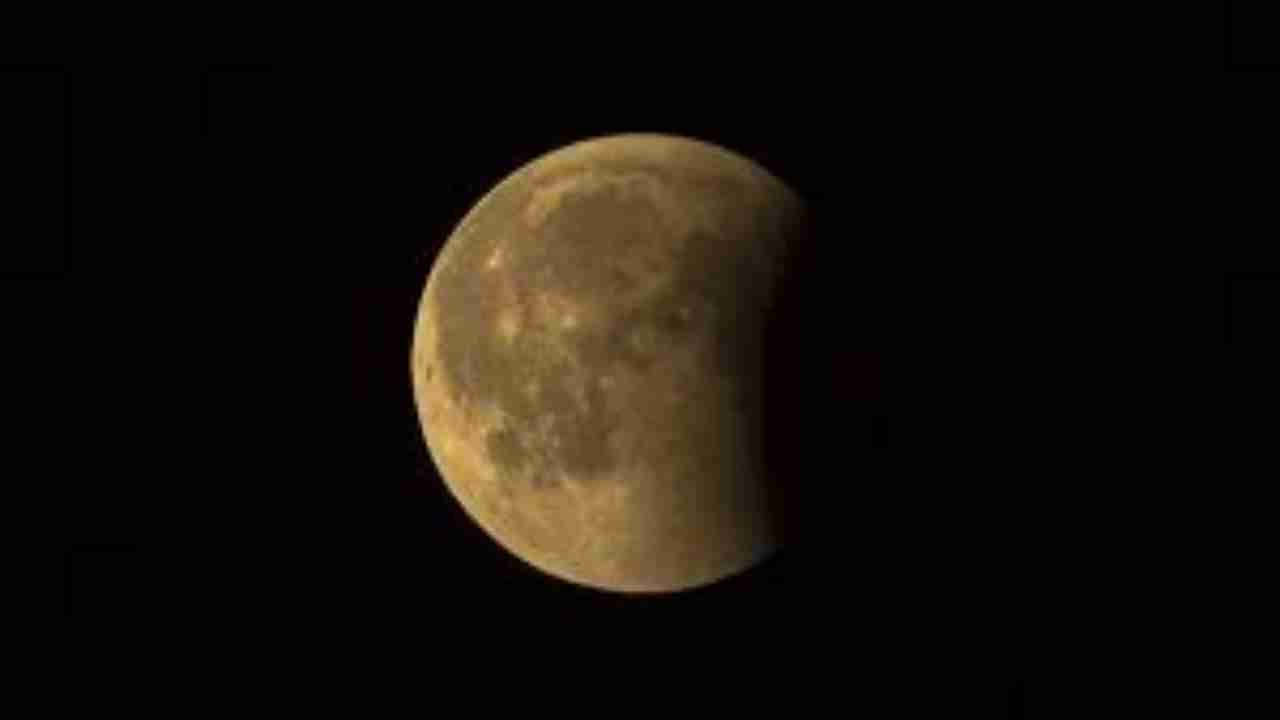
On 31 January, the Sun, Earth and the Moon will once again fall in a straight line, and we will get to see a Total Lunar Eclipse. The shadow of the Earth and the Moon have an umbra, which is the really dark part, and the penumbra, where it is not fully dark. You can understand this by holding an object some distance from a piece of paper and looking at the shadow. In this lunar eclipse, the Full Moon will first enter the penumbral shadow and will appear a bit dimmer. This stage is easy to miss. Then the moon will enter the umbral shadow, the partial eclipse, when we can clearly see the shape of the Earth’s shadow slowly covering the Moon. When the Moon is covered to a larger extent, we will notice that the colour of the Moon turns red. When the Moon is completely eclipsed, it will be quire red in colour, and hence the name blood moon. Then the whole process happens reverse till the Moon completely leaves the Earth’s shadow. On 31 Jan, the partial eclipse starts at 5.18 pm, total eclipse lasts from 6.22 to 7.38 pm, and the partial eclipse ends at 8.41 pm. The penumbral eclipse then ends at 9.39 pm.
Unfortunately, we cannot see the entire eclipse from India – the Moon will rise only when the eclipse has already begun. However, since the Moon rises later as we move westwards, the more east you are, more of the eclipse can be seen from your location. The Moon will rise at 4.47 pm in Itanagar, 5.16 pm in Kolkata, 5.25 pm in Patna, 5.53 pm in Delhi, 6.04 in Chennai and 6.27 in Mumbai. We can then figure out which stages of the eclipse we will be able to see from our location.
This eclipse is being called the ‘Super Blue Blood Moon’. Let us unpack this strange epithet. The Moon goes around the Earth in an elliptical orbit. This means that its distance from us varies periodically as it goes around us, but not by much. During perigee, when it is closest to us, it is only 14% bigger than during apogee, when it is farthest from us.
Perigee of the Moon happens once every 27.3 days. When a perigee coincides with a Full Moon, we call it a Super Moon. This time, the perigee happens on 30 Jan, and hence this eclipse is a ‘Super Moon Eclipse’. However, any increase in size or brightness compared to usual, will not be easily obvious. A Blue Moon is not really blue. When we get two Full Moons in a single month, we call it a blue moon, and we have two such this month. Lastly, since the eclipsed moon is red in colour, we call it the Blood Moon. Nothing strange, as you can see!
It is best to go outside the previous day and locate a spot from where you have an unobstructed view of the eastern sky, where there are no very bright lights. It is also useful to note from which position in the horizon the Moon rises on the previous day. Then, on 31 Jan, take your friends and family, go out, and look for the rising eclipses Moon. Sit down, relax, and watch the glorious spectacle unfold in front of you as the Moon climbs higher in the sky. And don’t forget to eat while doing so – it is perfectly safe to do so too!
There are many myths and beliefs about eclipses in every culture, including in India, which scare people into not seeing eclipses. An eclipse is just a shadow phenomenon. There is no extra radiation during an eclipse. If at all, there is less radiation than usual. There is also no effect due to gravity during an eclipse. The change in gravity due to the lining up of the Sun, Earth and Moon in a line is no larger than standing next to a large hill or next to a multi-storey building. None of the beliefs about the harmful nature of eclipses have any basis in science or on fact. These beliefs can actually be quite harmful, for example, when pregnant women close to delivery refusing treatment during an eclipse, or people with health issues not eating or drinking in this period. Instead, go out with your family and friends, and enjoy the eclipse without fear!
The Public Outreach and Education Committee of the Astronomical Society of India has set up a web-page for the eclipse, where there is information on eclipse timings, maps and animations, articles and videos in English and many Indian languages, as well as a crowd-sourced map of public eclipse parties across India. You can look at this map to locate the nearest eclipse watching event. So far we have more than 100 such events! The website is at http://bit.ly/eclipse31jan
Carl Sagan said, in his book Cosmos, “The reappearance of the crescent moon after the new moon; the return of the Sun after a total eclipse, the rising of the Sun in the morning after its troublesome absence at night were noted by people around the world; these phenomena spoke to our ancestors of the possibility of surviving death. Up there in the skies was also a metaphor of immortality”.
We usually go about our lives, unmindful of our world, let alone our universe. Now and then, the universe steps into our life with an eclipse and makes us aware not just of the sheer vastness of space, but also of how the seemingly unchanging sky is actually a place of constant motion. Such occasions, to be a part of something larger than ourselves, even as large as the entire solar system, come but rarely. Let us not waste it by cowering in our houses, scared of, literally, our own shadow! (India Science Wire)
(Dr Niruj Ramanujam is associated with National Centre for Radio Astrophysics (NCRA-TIFR) and Public Outreach and Education Committee of the Astronomical Society of India)





Gadgets
OnePlus India CEO Robin Liu steps down, shutdown rumours resurface
OnePlus India confirms business continuity after CEO Robin Liu’s resignation sparks shutdown rumours online.


Gadgets
Oppo K14 5G launched in India with 7000mAh battery, starts at Rs 17,999
Oppo has launched the K14 5G in India with a 7000mAh battery, fast charging and durability features, starting at Rs 17,999.

Gadgets
OnePlus Freedom Sale 2026 brings discounts on 15, 15R, 13, Nord 5 and tablets
OnePlus Freedom Sale 2026 begins Jan 16 with discounts on phones, tablets, and audio products across online and offline stores.



MK Stalin attacks Vijay government over hindi signboard in Tamil Nadu

700 detained as Delhi, Mumbai see protests against Gyanesh Kumar

New UP Congress chief Aradhana Mishra backs stronger alliance with SP

CJP announces October 10 Delhi protest against Gyanesh Kumar

India beat Pakistan by 19 runs to win Asian Games cricket gold

Indore voter deletions: 1.36 lakh names, but digital records not maintained

Yogi Adityanath transfers over Rs. 148 crore to 4.60 lakh students

Tariffs, export controls increasingly used for strategic purposes, says PM’s Principal Secretary
India beat Pakistan by 19 runs to win Asian Games cricket gold
New UP Congress chief Aradhana Mishra backs stronger alliance with SP

Afghan Men Try To Hang With The Jet Engine Of The Aircraft in Kabul- Afghanistan News – Kabul News
Trending Top 10 News: 10000 Crore Fine on Flipkart, Apple to Launch Unique Feature, Hdfc Bank Job Ad

Trending Top 10 News: Nokia 6310, Apple sales, Bachpan ka Pyar Video Kid, Dainik Bhaskar IT Raid

Trending Top 10 News: Canada bans Indian flights, Rain in Delhi NCR, AIMIM Twitter hacked, Raj Kundra case

Trending Top 10 News: Shein India, Apple New Service, Pocket Oxygen, Oppo Launched New Phone
-
 India News22 hours ago
MK Stalin attacks Vijay government over hindi signboard in Tamil Nadu
-
 India News22 hours ago
700 detained as Delhi, Mumbai see protests against Gyanesh Kumar
-
 India News9 hours ago
New UP Congress chief Aradhana Mishra backs stronger alliance with SP
-
 India News10 hours ago
CJP announces October 10 Delhi protest against Gyanesh Kumar
-
 Cricket news3 hours ago
India beat Pakistan by 19 runs to win Asian Games cricket gold
-
 India News2 hours ago
Tariffs, export controls increasingly used for strategic purposes, says PM’s Principal Secretary
-
 India News2 hours ago
Yogi Adityanath transfers over Rs. 148 crore to 4.60 lakh students
-
India News43 mins ago
Indore voter deletions: 1.36 lakh names, but digital records not maintained
