English हिन्दी
Connect with us

Top Stories

Kerala cop turns thief after stealing mangoes from street vendor, clip goes viral | WATCH

Published

on

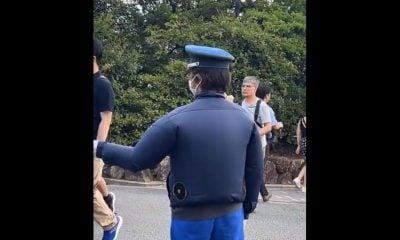
A viral video has been circulating on every social media platform, where a cop who is supposed to keep the community safe, is found stealing mangoes at midnight from Kerala’s Kanjirappally.

The accused was identified as Shihab who was reportedly a police officer at the Idukki AR camp stationed. His offense was recorded on the CCTV camera which was installed in that area. After his video got viral on Internet, area police took charge of the situation and booked him under Section 378 of the IPC.

Read Also: AltNews’ Pratik Sinha and Mohammed Zubair find space in Nobel Peace Prize 2022 list

Take a look at the video of a cop stealing mangoes in Kerala

https://www.youtube.com/watch?v=ihax5B1DI1k&t=8s

In the viral video, the accused cop can be seen on the two-wheeler, completely unaware that he was under CCTV surveillance. He was even seen checking his surroundings before committing the offense. After finding the street empty, he took a few mangoes, put them in his vehicle’s boot space and left the spot on his vehicle.

The report says he has stolen somewhere around 10 to 12 KGs of mangoes.

Police revealed that initially, they were dealing with difficulties in finding the accused’s identity as he was wearing the helmet throughout the video. But after closely monitoring the video, police were able to track him with the help of his scooter’s number, which was quite visible in the video.

Currently, the accused is on the run. Police have already transferred the matter to the concerned team in order to nab him as soon as possible.

This is not the first time such news come into the limelight. Earlier, a cop from Uttar Pradesh’s Bareilly was found stealing apples from a street vendor. Later, on the complaint of the shop owner, he was suspended for a few days from his duty for his actions.

AltNews’ Pratik Sinha and Mohammed Zubair find space in Nobel Peace Prize 2022 list

Uttar Pradesh: Fire in private hospital in Agra, 3 killed | WATCH

India News

Delhi air quality improves slightly but stays in poor category

Delhi’s air quality improved slightly on Friday with the AQI falling to the poor category, though many areas continue to record very poor pollution levels.

Published

on

Delhi's air quality

Delhi witnessed a marginal improvement in air quality on Friday, with the overall Air Quality Index (AQI) slipping into the ‘poor’ category. Official data showed the city’s average AQI at 292, offering limited relief after pollution levels had touched the ‘severe’ mark earlier this week.

The improvement comes days after Delhi recorded an AQI of 412 on December 23, placing air quality firmly in the ‘severe’ category. Over the last two days, pollution levels have shown a gradual decline across multiple monitoring stations in the national capital.

Some stations record moderate air quality

According to data from the Central Pollution Control Board’s Sameer mobile application, three locations reported ‘moderate’ air quality as of early morning. Lodhi Road-IITM recorded an AQI of 160, Lodhi Road-IMD stood at 194, while Najafgarh reported 188.

Several other parts of the city remained in the ‘poor’ category. Areas including Aya Nagar, CRRI Mathura Road, Dr Karni Singh Shooting Range, Dwarka Sector 8, IGI Airport Terminal 3, IIT Delhi, Jawaharlal Nehru Stadium and Mandir Marg recorded AQI values ranging between the low 200s and high 200s.

Very poor air persists in pollution hotspots

Despite the overall improvement, many parts of Delhi continued to struggle with ‘very poor’ air quality. Anand Vihar, Bawana, Jahangirpuri, Narela, Nehru Nagar, Sonia Vihar and Vivek Vihar reported some of the highest AQI readings, with values crossing 350 at several locations.

In view of the easing pollution levels, the Commission for Air Quality Management lifted Graded Response Action Plan (GRAP) Stage-IV restrictions across the Delhi-National Capital Region on December 24. Officials indicated that further relaxations could be considered if the downward trend in pollution continues.

Mixed air quality across NCR

Air quality in neighbouring NCR regions showed mixed trends. In Haryana, Bahadurgarh recorded a ‘very poor’ AQI of 301, while Gurugram’s overall AQI stood at 270, falling in the ‘poor’ category. One monitoring station in Gurugram’s Sector 51 reported ‘very poor’ air quality with an AQI of 375. Dharuhera also remained in the ‘poor’ range.

In Uttar Pradesh, pollution levels stayed elevated. Ghaziabad recorded an overall AQI of 344, with all monitoring stations reporting ‘very poor’ air quality. Greater Noida’s AQI stood at 362, while Knowledge Park-V and Knowledge Park-III recorded AQI levels of 386 and 337 respectively. Noida also remained in the ‘very poor’ category with an AQI of 334.

Authorities have restricted the entry of non-BS 6 vehicles into Delhi, a move that has blocked around 1.2 million older vehicles registered outside the city. Vehicular emissions remain a key contributor to winter pollution, with experts estimating that vehicles account for up to 40 per cent of particulate matter pollution in the NCR.

Continue Reading

Latest world news

Khaleda son Tarique Rahman arrives to rapturous welcome in Bangladesh

Tarique Rahman returned to Bangladesh after 17 years and, in his first speech, invoked Martin Luther King while outlining what he called a plan for the country’s future.

Published

on

Khalida Zia son

Bangladesh Nationalist Party (BNP) acting chairman Tarique Rahman, who returned to Bangladesh on Thursday after 17 years in exile, outlined his political vision in his first public address, drawing a comparison with American civil rights leader Martin Luther King Jr.’s famous “I have a dream” speech.

Addressing a massive gathering in Dhaka, Rahman said that just as Martin Luther King spoke of a dream, he wished to speak of a concrete plan for Bangladesh. He referred to the country as “Beloved Bangladesh” and thanked party leaders, workers and citizens who stood by the BNP during his absence.

Rahman, the son of former President Ziaur Rahman and former Prime Minister Khaleda Zia, said that his plan would succeed only with public support and urged citizens to participate actively in nation-building.

Parallels drawn with 1971 and 2024 movements

In his speech, Rahman linked the 1971 Liberation War with the 2024 uprising against the government of former Prime Minister Sheikh Hasina. He said those who lost their lives in these movements should be honoured by building the country they had envisioned.

“We liberated Bangladesh in 1971, and we liberated it again in 2024,” he said, adding that the events of 2024 were about defending the country’s independence and sovereignty. He stressed the need to “repay the blood debt of the martyrs” through responsible governance.

Emphasis on tolerance, safety and economic rights

Touching upon Bangladesh’s social fabric, Rahman said the country belongs to everyone, irrespective of religion or geography, and underlined the importance of tolerance. He spoke about creating a safe environment where women, men and children can move freely without fear.

He also said the BNP would focus on peace, political reform and strengthening the economy. Referring to student leader Sharif Osman Hadi, Rahman said he had dreamt of a democratic Bangladesh and promised justice in connection with his killing, along with restoring people’s economic rights.

Call to youth and visit to Khaleda Zia

Rahman called upon the younger generation to take responsibility for development and stability, stressing that collective effort would be crucial to implementing his plan for Bangladesh.

After the address, he left to visit his ailing mother, Khaleda Zia, who is undergoing treatment at Evercare Hospital.

Rahman has been living in exile since 2008 following convictions in multiple corruption cases, which he has described as politically motivated. He has also alleged that the previous government attempted to assassinate him through torture.

With the Awami League barred from contesting elections, the political landscape has narrowed significantly. The BNP now holds a dominant position, and Rahman’s return has added fresh momentum and uncertainty to Bangladesh’s political future.

Continue Reading

Latest world news

Tarique Rahman returns to Dhaka after 17 years, massive crowd greets BNP leader

Tarique Rahman returned to Bangladesh after more than 17 years in exile, with thousands of BNP supporters gathering in Dhaka to welcome the party’s acting chairman.

Published

on

Tariq Rahman

Thousands of people poured onto the streets of Dhaka on Thursday as Bangladesh Nationalist Party (BNP) acting chairman Tarique Rahman returned to the country after more than 17 years in self-imposed exile in the United Kingdom. Rahman, who is the son of former prime minister Khaleda Zia, landed in the capital along with his wife Zubaida Rahman and daughter Zaima Rahman.

Supporters and party leaders marched from the Banani Airport Road towards Dhaka airport to welcome him, turning the stretch into a sea of BNP flags and slogans. Rahman was later escorted in a bulletproof vehicle as part of heightened security arrangements for his high-profile return.

Bulletproof convoy and reception in Purbachal

After arriving at the airport, Rahman was received by senior BNP leaders before heading to a large reception organised in the Purbachal area. Party workers and leaders lined both sides of the road to greet him during the journey. According to party expectations, a very large gathering assembled at the venue, where Rahman was scheduled to address supporters.

BNP leaders said only Rahman would speak at the event, while other senior figures remained present on the stage. His return is being closely watched as he has emerged as a key political figure ahead of Bangladesh’s upcoming general elections.

Visit to ailing mother and family residence

Following the public address, Rahman was expected to visit Evercare Hospital to meet his mother, former prime minister Khaleda Zia, who has been undergoing treatment there for over a month. After the hospital visit, the family was scheduled to go to Firoza, the Zia family residence in Gulshan.

Security across Dhaka was tightened during Rahman’s movement, with police deploying additional forces to prevent any untoward incident amid recent political tensions in the country.

Political backdrop of the return

Rahman’s return comes at a time when the BNP is seen to be gaining political ground following the ouster of former prime minister Sheikh Hasina in a student-led uprising last year. Surveys conducted in December indicate the BNP could secure the largest number of seats in the upcoming parliamentary elections, while other parties, including Islamist groups, are also in the fray.

Alongside political developments, personal reasons have also played a role in Rahman’s decision to return, particularly his mother’s prolonged illness, which party sources describe as a key factor behind the move.

Continue Reading

Trending

© Copyright 2022 APNLIVE.com