English हिन्दी
Connect with us

India News

DRDO’s UAV TAPAS 07 A-14 drone crashes in Karnataka’s village | Watch video

Defence officials noted that DRDO is briefing the Defence Ministry about the mishap and an inquiry is being carried out to find the actual reason behind the crash.

Published

on

DRDO's UAV TAPAS 07 A-14 drone crashes in Karnataka's village | Watch video

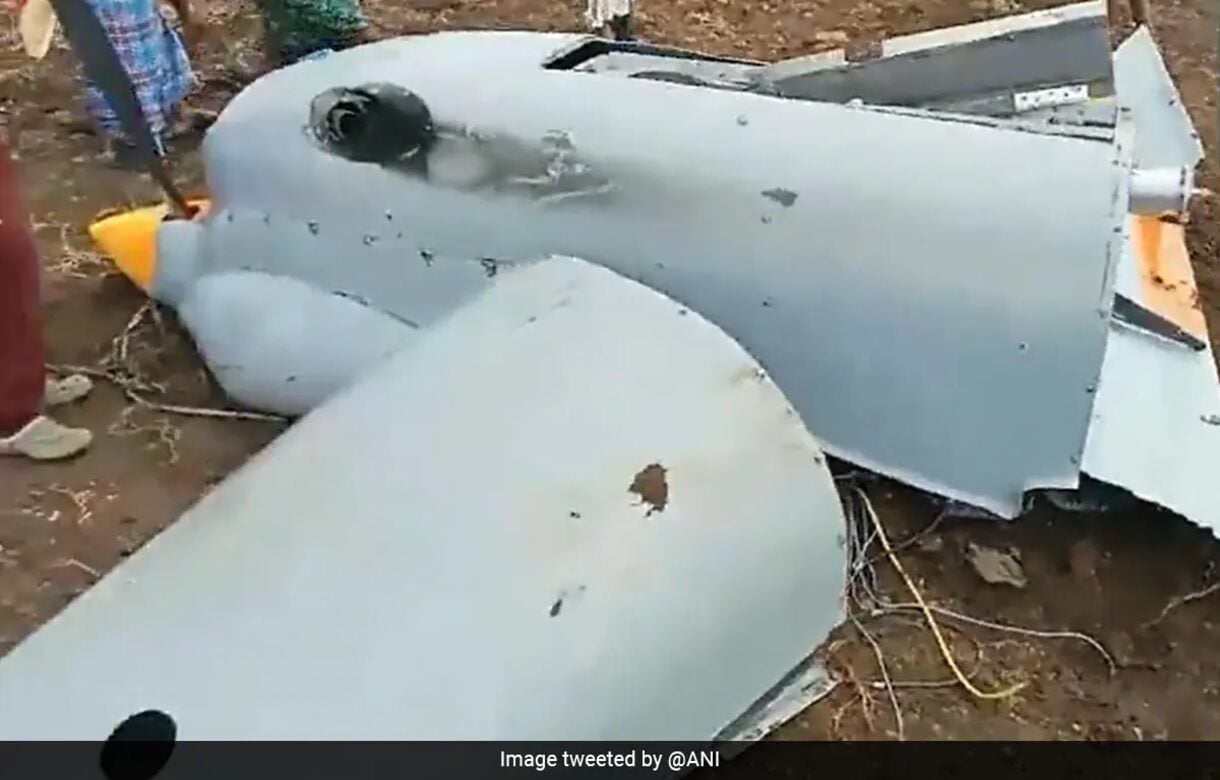
Defence Research Development Organisation (DRDO) developed, unmanned aerial vehicle (UAV) drone crashed in Karnataka’s village’s agricultural fields on Sunday, according to reports. The UAV has been identified as TAPAS 07 A-14 that descended outside Vaddikere village in Hiriyur taluk during a test flight. 

Reportedly, after the loud crash, villagers assembled at the crash site and the local authorities were notified immediately. Visuals and images showed that the UAV is completely broken with its equipment scattered around the agricultural field. Visuals further showed locals surrounding the crashed DRDO drone. 

The Defence Research Development Organisation (DRDO) has yet to issue any official statement on the matter. Speaking to a news agency, Defence officials noted that DRDO is briefing the Defence Ministry about the mishap and an inquiry is being carried out in an attempt to find out the actual reason behind the crash.

According to reports, the unmanned aerial vehicle (UAV) belonging to the Defence Research and Development Organisation (DRDO) crashed during a trial in an agricultural field in Chitradurga district earlier on Sunday morning. 

As far as reports are concerned, TAPAS is DRDO’s solution to address the Intel;ligence, Surveillance, Target Acquisition, Tracking and Reconnaissance (ISTAR) requirements of the armed forces. It has a flight endurance of more than 18 hours and the UAV can also operate at an altitude reaching 28,000 feet. 

TAPAS is reportedly designed to operate autonomously or under remote control based on pre-programmed flight plans. This versatility of TAPAS allows its operation during both daylight and nighttime conditions. 

According to the Defence Research Development Organisation’s website, TAPAS-BH is a MALE UAV, meaning medium-altitude-long-endurance unmanned aerial vehicle with an operating altitude of 30,000 feet. It also has endurance of 24 hours with EO (Electro-optical) and SAR (synthetic aperture radar) payloads and a range of 250 km. The TAPAS drone can also carry a variety of payloads up to a maximum of 350 Kgs. 

India News

Armed Jaish terrorist held by BSF during infiltration attempt in Jammu and Kashmir

A Jaish-e-Mohammed terrorist armed with an AK rifle was arrested by the BSF in Jammu and Kashmir’s Akhnoor sector while attempting to infiltrate across the border.

Published

on

Terrorist arrested

A Jaish-e-Mohammed terrorist carrying an AK rifle was arrested by the Border Security Force in Jammu and Kashmir’s Akhnoor sector while attempting to infiltrate from across the border, according to official sources.

The arrested individual has been identified as Abdul Khalik, a resident of the Budhal area in Rajouri district. Security officials said Khalik was working as an overground worker for a terror network active in the Poonch and Rajouri regions.

Terrorist crossed over to Pakistan for training

Preliminary investigations revealed that Khalik had gone missing from his native area a few years ago and had crossed into Pakistan, where he allegedly received arms training. He was intercepted by alert BSF personnel near the International Border during an infiltration attempt and was subsequently taken into custody.

After his arrest, Khalik was handed over to the local police for further questioning and legal action.

Security agencies on alert along border areas

Officials view the incident as part of a renewed push to revive terror activities in Jammu and Kashmir by sending back local operatives familiar with the region’s terrain. Security agencies have also stepped up vigilance following inputs that multiple launch pads across the border have been reactivated after a prolonged lull.

Authorities said enhanced surveillance and counter-infiltration measures are in place across vulnerable sectors in the Jammu region to prevent further attempts.

Continue Reading

India News

MNREGA may be renamed Pujya Bapu Gramin Rozgar Yojana, proposal sent to Cabinet

The Centre has proposed renaming MNREGA as Pujya Bapu Gramin Rozgar Yojana and increasing guaranteed employment to 125 days, with the proposal now before the Cabinet.

Published

on

The Central government has moved a proposal to rename the Mahatma Gandhi National Rural Employment Guarantee Scheme (MNREGA), one of the country’s largest social security programmes, with the matter now placed before the Union Cabinet for approval. As per the proposal, the scheme could be rebranded as Pujya Bapu Gramin Rozgar Yojana

Preparations are underway to roll out the restructured programme, which is expected to increase the guaranteed employment days for rural households to 125 days per year, up from the current provision of at least 100 days.

Higher allocation and expanded employment guarantee

According to the information shared, the government is working on allocating more than Rs 1.5 lakh crore for the revamped rural employment scheme. The proposed changes are aimed at strengthening income support for poor families living in rural areas.

MNREGA, enacted as a labour law and social security measure, provides unskilled manual work to eligible rural households and legally guarantees the right to employment. At present, around 154 million people are employed under the programme, with women accounting for nearly one-third of the beneficiaries.

Background of the scheme

The employment guarantee programme was launched during the Manmohan Singh-led government and was initially known as the National Rural Employment Guarantee Act. In 2009, it was renamed after Mahatma Gandhi.

A key feature of the scheme is its decentralised structure, with the Panchayati Raj institutions responsible for ensuring 50 per cent of the work. Another crucial provision mandates that if employment is not provided within 15 days of application, beneficiaries are entitled to an unemployment allowance.

The proposal to rename the flagship scheme and expand its scope is currently awaiting Cabinet consideration, after which a formal decision is expected.

Continue Reading

India News

Delhi Metro starts construction of new Golden Line linking Lajpat Nagar and Saket

Delhi Metro has commenced construction of the Lajpat Nagar–Saket G Block Golden Line under Phase-IV, aiming to improve connectivity across South Delhi.

Published

on

Delhi Metro

The Delhi Metro Rail Corporation has formally begun construction work on the Lajpat Nagar–Saket G Block corridor, also referred to as the Golden Line under Phase-IV of the metro expansion. The start of civil work marks a key step in extending metro connectivity in South Delhi.

The ceremonial groundbreaking and first test pile were carried out near Pushpa Bhawan in the Saket area, in the presence of senior DMRC officials. The construction is being executed by Rail Vikas Nigam Limited, which has been assigned the responsibility for this corridor.

Eight elevated stations planned on the corridor

The Lajpat Nagar–Saket G Block stretch will be a fully elevated line with eight stations along the route. These stations will be located at Lajpat Nagar, Andrews Ganj, GK-1, Chirag Delhi, Pushpa Bhawan, Saket District Centre, Pushp Vihar and Saket G Block.

According to officials, the corridor is expected to ease daily travel for residents of densely populated neighbourhoods such as Greater Kailash-1, Saket and Pushp Vihar. Improved access to schools, offices and commercial areas is also among the anticipated benefits once operations begin.

Integration with existing metro lines

The Golden Line will connect with three existing metro corridors, enhancing network integration in South Delhi. Lajpat Nagar will emerge as a triple-interchange station with links to the Violet Line and the Pink Line, while Chirag Delhi will provide interchange access to the Magenta Line.

Trains on the new corridor will have a capacity of about 900 passengers per trip, with each coach designed to carry nearly 300 commuters. Projections indicate that daily ridership on the line could exceed 1.2 lakh passengers by 2041 as train frequency increases and surrounding areas continue to grow.

Continue Reading

Trending

© Copyright 2022 APNLIVE.com