English हिन्दी
Connect with us

India News

Women’s Reservation: Rahul Gandhi says implement Bill now, pushes for caste census, Amit Shah says BJP doesn’t do lip service

Explaining the importance of implementing OBC quota in the Women’s Reservation Bill, Gandhi noted that among the 90 secretaries, who run the Government of India, only 3 are from the OBCs.

Published

on

Women's Reservation: Rahul Gandhi says implement it now, pushes for caste census, Amit Shah says BJP doesn't do lip service

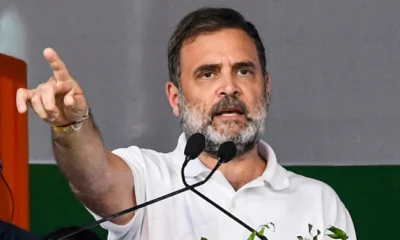
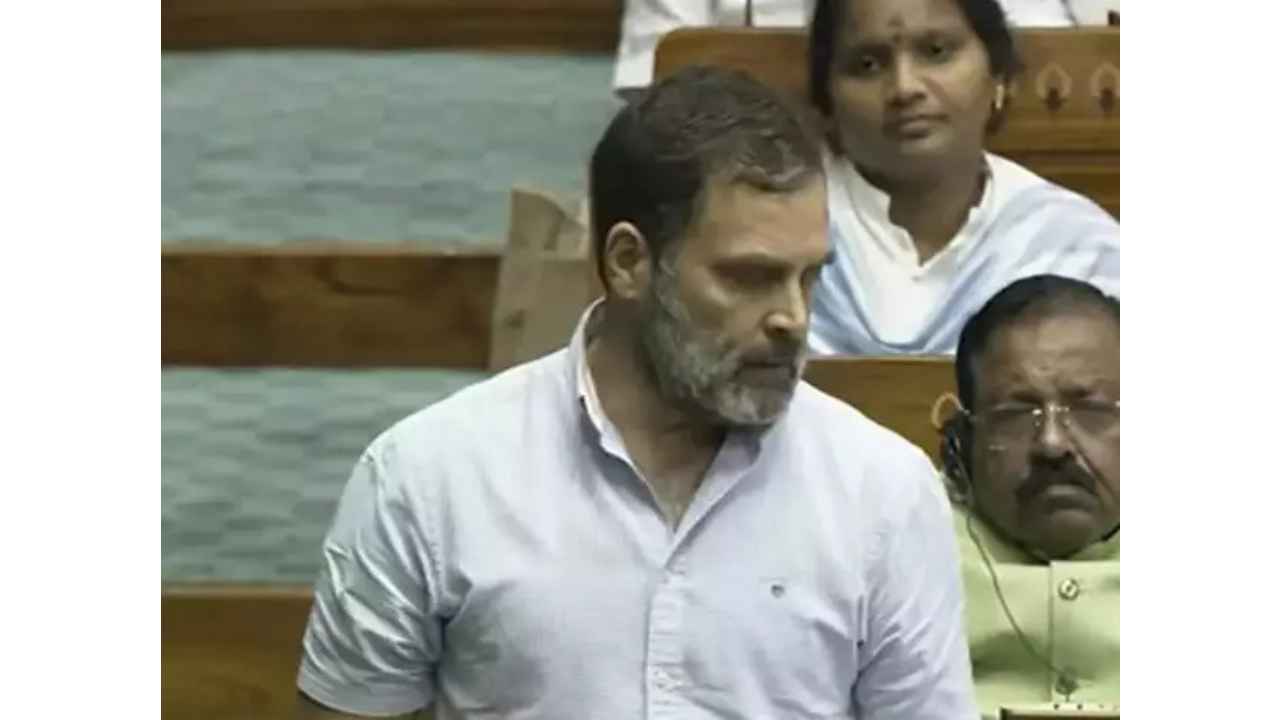
Congress leader Rahul Gandhi on Wednesday said the Women’s Reservation Bill should be implemented with immediate effect and not wait for the delimitation exercise and the Census. Speaking in the Lok Sabha, the Congress MP from Wayanad in Kerala said the Bill can be implemented today by giving 33% quota to women in Parliament and state assemblies. The Congress leader said the BJP likes to distract people from various issues, one of them being the caste census. Gandhi said he would like to see the Other Backward Class (OBC) reservation included in this Bill.

Explaining the importance of implementing OBC quota in the Women’s Reservation Bill, Gandhi noted that among the 90 secretaries, who run the Government of India, only 3 are from the OBCs. He said there should be greater OBC representation among the top government officials for which, he said, a caste census was necessary. The Congress MP took a jibe at the government during the women’s quota bill discussions recalling the absence of President Droupadi Murmu from the inauguration of the new Parliament Building, and said she should have also been invited as the First Citizen of the country.
Rahul Gandhi said he found it strange that the implementation of the Bill would have to now wait for a new census and delimitation. He recalled the Congress’ singular contribution of the panchayati raj system in which women were given reservation thus allowing them into the political arena. This was a huge step, he said, adding the Women’s Reservation Bill was another big step.

Countering the former Congress president, Home Minister Amit Shah conveyed his heartfelt thanks to Prime Minister Narendra Modi for getting this Bill, pending for years, introduced in the Special Session. Shah said women’s empowerment has been nothing but a political tool for the opposition to win votes and claimed it was not a political issue for his party.

Shah said the BJP government’s lifeline has been the protection, respect for and equality for women since its inception. He noted that the benefits of government welfare schemes go directly into the bank accounts of women.

He listed a host of women-centric initiatives of the Modi government including the Ujjwala Scheme, the Jan Dhan Yojana, maternity benefits and health insurance. Shah said the government has brought this bill to amend faults in Indian society and give power and respect to women, Amit Shah said. This amendment came up four times earlier, but it couldn’t be passed. Every time, this House disappointed the country’s women, he said. The Home Minister requested the House to pass the Bill unanimously.

There are only three categories for political representation as of now, the OBCs, the Scheduled Castes and the Scheduled Tribes. This Bill will gives women reservation in all three categories, Amit Shah said. Speaking on the delimitation commission, Amit Shah said such a panel would include a retired Supreme Court judge, senior Election Commission officials and other members of constitutional bodies along with representatives of political parties.

India News

G RAM G bill replacing MGNREGA passes Parliament amid opposition walkout and protests

The G RAM G Bill replacing MGNREGA has been passed by Parliament after overnight debate in the Rajya Sabha, triggering protests and walkouts by opposition parties.

Published

on

Parliament

Parliament has cleared the Viksit Bharat Guarantee for Employment and Livelihood Mission (Rural) Bill, commonly referred to as the G RAM G Bill, paving the way for the replacement of the Mahatma Gandhi National Rural Employment Guarantee Act (MGNREGA). The legislation was passed within two days amid sharp political confrontation, walkouts and overnight protests by opposition parties.

The bill was approved by the Lok Sabha despite repeated disruptions and protests. In the Rajya Sabha, the debate stretched beyond midnight, with voting held around 12.15 am. The bill was eventually passed by a voice vote after opposition members staged a walkout, leaving the ruling alliance members present in the House.

Opposition objects to name change and provisions

The Congress and other opposition parties mounted a strong challenge to the bill, objecting both to the change in the scheme’s name and its revised framework. A key point of contention was the removal of Mahatma Gandhi’s name from the legislation, which opposition leaders said reflected an ideological shift rather than a policy necessity.

Congress president Mallikarjun Kharge launched a sharp attack during the Rajya Sabha debate, urging the government to withdraw the bill and warning that it would harm the rural poor. He accused the government of speaking in the name of welfare while undermining the interests of vulnerable communities, making an emotional appeal to reconsider the legislation.

Several opposition members initially demanded that the bill be referred to a standing committee for detailed scrutiny. When that demand was not accepted, they called for the bill’s withdrawal and later staged a walkout. Members of the Trinamool Congress and other parties subsequently sat on a dharna within Parliament premises.

Heated exchanges in the Upper House

The debate witnessed intense exchanges between the treasury benches and the opposition. Trinamool Congress MP Derek O’Brien linked the passage of the bill with developments in West Bengal, alleging that the Centre’s actions had consequences for the implementation of rural employment schemes in the state. He also referred to the state government’s decision to rename its employment initiative following the Lok Sabha vote.

As Rural Development Minister Shivraj Singh Chouhan rose to reply, opposition members raised slogans demanding the withdrawal of what they termed a “black bill”. When the protests continued, opposition MPs walked out, allowing the bill to be passed without their presence.

Responding sharply, Chouhan criticised the walkout and accused the opposition of refusing to engage in debate. He defended the government’s move, arguing that the earlier scheme had suffered from corruption and inefficiencies, and said the new law was drafted after consultations with stakeholders.

Government defends overhaul of rural employment scheme

The government has maintained that updating the two-decade-old MGNREGA framework was necessary to address structural shortcomings and align it with current rural needs. According to the provisions outlined, the new law increases the guaranteed days of work from 100 to 125 while retaining key elements of the earlier scheme.

However, critics have pointed out that employment under the new framework will be based on pre-approved plans rather than demand-driven applications at the gram panchayat level. The work categories have also been streamlined into four segments—water security, core rural infrastructure, livelihood-related assets, and climate resilience—raising concerns that local flexibility may be reduced.

Opposition leaders have argued that these changes dilute the original spirit of MGNREGA, which was designed as a rights-based, demand-driven employment guarantee programme.

Protests continue after passage

Following the bill’s passage, opposition parties reiterated their charge that the legislation weakens the guarantee, livelihood assurance and social security that formed the core of the original programme introduced in 2005. Despite these objections, the government’s numerical strength ensured the bill’s smooth passage through both Houses.

With parliamentary approval now secured, the G RAM G Bill is set to replace MGNREGA, marking a significant shift in India’s rural employment policy framework amid continuing political debate.

Continue Reading

India News

Priyanka Gandhi meets Nitin Gadkari over Kerala road projects, light moments mark discussion

Priyanka Gandhi met Nitin Gadkari in Parliament to discuss road projects in Kerala, with the meeting marked by humour, political remarks and an informal food tasting.

Published

on

Priyanka Gandhi meets Nitin Gadkari (1)

Congress MP Priyanka Gandhi Vadra on Thursday met Union Road Transport and Highways Minister Nitin Gadkari at his office in Parliament to raise issues related to road infrastructure projects passing through Kerala. The meeting combined formal discussions with lighter moments, including a humorous exchange and an unexpected food tasting session.

Kerala road projects discussed at Parliament meeting

Priyanka Gandhi, the Member of Parliament from Wayanad in Kerala, discussed six road projects that pass through the state. During the interaction, Nitin Gadkari clarified that some of these projects fall under the jurisdiction of the Kerala government and therefore cannot be directly handled by the Centre. However, he assured the Congress leader that the remaining proposals would be examined.

According to those present, the discussion remained cordial, with both sides acknowledging administrative limitations while exploring possible ways forward.

‘Bhai ka kaam ho gaya’ remark draws laughter

The meeting also saw a light-hearted moment when Gadkari referred to a recent interaction with Rahul Gandhi, the Leader of the Opposition in the Lok Sabha. He said Rahul Gandhi had met him earlier regarding road-related concerns in Rae Bareli.

In a humorous remark, Gadkari said that if work was done for the brother but not for the sister, it could lead to complaints. The comment prompted laughter from Priyanka Gandhi and others present in the room.

Congress confident of future action in Kerala

During the conversation, Priyanka Gandhi expressed confidence about the Congress party’s prospects in the upcoming Kerala Assembly elections. She indicated that proposals currently under the purview of the Left Front government in the state would be taken forward once Congress comes to power.

Her remarks reflected political confidence while keeping the focus on infrastructure needs in Kerala.

A homemade dish adds informal touch

Apart from policy discussions, the meeting included an informal culinary moment. Nitin Gadkari had prepared a rice-based dish after learning the recipe from online videos. Visitors to his office were offered rice balls served with chutney.

Gadkari encouraged Priyanka Gandhi to taste the dish, and she, along with Congress leader Deepender Singh Hooda, was seen sampling the food while continuing their conversation with the minister.

Continue Reading

India News

AAP dominates Punjab zila parishad polls, leads in most panchayat samiti zones

AAP has won 201 out of 317 declared zila parishad zones in Punjab so far and is leading in a majority of panchayat samiti seats, with counting still underway.

Published

on

Punjab Zila Parishad Polls

The ruling Aam Aadmi Party (AAP) has recorded a strong performance in the Punjab zila parishad elections and is leading in the majority of panchayat samiti zones, as per results declared so far on Thursday. The counting process is still underway and complete results are awaited, officials said.

Polling for the rural local bodies was held on December 14 to elect representatives across 347 zones of 22 zila parishads and 2,838 zones of 153 panchayat samitis in the state.

AAP secures clear edge in zila parishads

According to the available results, outcomes have been declared for 317 zila parishad zones so far. Of these, the AAP has won 201 zones, placing it well ahead of other parties.

The Congress emerged second with victories in 60 zones, followed by the Shiromani Akali Dal (SAD) with 39 zones. The BJP won four zones, the BSP secured three, while independents claimed 10 zones.

District-wise data shows that the AAP won 22 zones in Hoshiarpur, 19 each in Amritsar and Patiala, 17 each in Tarn Taran and Gurdaspur, and 15 zones in Sangrur. The Congress registered its best performances in Gurdaspur and Ludhiana with eight zones each, followed by Jalandhar with seven zones. The SAD performed strongly in Bathinda with 13 zones, while the BJP managed to win four zones in Pathankot.

AAP leads in panchayat samiti results

In the panchayat samiti elections, trends declared so far indicate that the AAP is leading in a majority of zones. However, officials clarified that counting is ongoing and the final picture will be clear only after all ballot papers are tallied.

Kejriwal, Mann reject opposition allegations

Reacting to the trends, AAP supremo Arvind Kejriwal said the party’s performance reflected strong rural support for the Bhagwant Mann government’s work. Addressing the media in Mohali along with Chief Minister Bhagwant Mann, Kejriwal dismissed allegations of irregularities raised by opposition parties.

He said the elections were conducted in a fair and free manner and claimed that the results so far showed a clear wave in favour of the AAP in rural Punjab. Kejriwal stated that nearly 70 per cent of the zila parishad and panchayat samiti seats had gone in favour of the party.

Congress, SAD question poll conduct

The Congress and the Shiromani Akali Dal, however, accused the ruling party of misusing official machinery. Punjab Congress chief Amrinder Singh Raja Warring alleged that the AAP had “stolen” the rural mandate and claimed that the results did not reflect genuine public support.

Opposition parties had earlier also accused the AAP government of high-handedness during the polling process, allegations that the ruling party has strongly denied.

Continue Reading

Trending

© Copyright 2022 APNLIVE.com