English हिन्दी
Connect with us

India News

Criticising the country is not sedition, free speech implies right to offend: Law Commission

Published

on

Criticising the country is not sedition, free speech implies right to offend: Law Commission

It is time to rethink or even repeal the controversial provision of sedition, Section 124A, from the Indian Penal Code (IPC), the Law Commission has said.

Dissent and criticism of the government or the country are essential ingredients of a robust public debate in a vibrant democracy and an “expression of frustration over the state of affairs cannot be treated as sedition,” the Law Commission has said.

The Law Commission report said that a person should not be charged with sedition for “merely expressing a thought that is not in consonance with the policy of the Government of the day”.

Just a couple of days earlier, the Supreme Court termed dissent as the “safety valve” of a democracy, while hearing a plea against arrests of Dalit and human rights activists and intellectuals over allegations of ‘conspiring against the State’, a move that reignited the public outcry over the Narendra Modi government’s practice of stamping out any criticism and going viciously after anyone who criticizes its policies and politics.

On August 28, human rights activists Sudha Bharadwaj, Arun Ferreira, Vernon Gonsalves, Gautam Navalakha and Varavara Rao were arrested during pan-India raids by the Pune police. While the police had initially claimed that the activists were being arrested for their role in planning the Elgar Parishad event at Bhima-Koregaon in Pune, Maharashtra on December 31 and inciting the clashes between Dalits and upper caste Marathas that broke out the following day, the cops later alleged that the activists were involved in a conspiracy against the Modi government and were also aiding Naxalites.

The activists and their comrades have rubbished these allegations and claimed that they are being hounded by the police at the behest of the BJP government in the state and the Modi regime at the centre for voicing opinions that challenge the political establishment and its claims on governance.

Underlining that “singing from the same book is not a benchmark of patriotism”, the Law Commission, headed by Justice (retired) B S Chauhan said in a consultation paper on sedition law (124A IPC) that the stringent sedition law should be invoked only in cases “where intention” behind the act is to “disrupt public order or to overthrow the Government with violence and illegal means”.

The Law Commission’s consultation paper on the sedition law, thus, comes at a critical juncture.

Sedition cases being slapped against anyone criticizing the Modi government, the Prime Minister or chief ministers of BJP-ruled states, particularly on social media platforms like Twitter and Facebook, has become the order of the day.

“The Commission hopes a healthy debate will take place among the legal luminaries, lawmakers, Government and non-Government agencies, academia, students and above all, the general public, on the above issues, so that a public-friendly amendment could be brought about,” the Commission has said in its paper.

Defending the constitutionally guaranteed right to freedom of speech and expression, the panel said: “In a democracy, singing from the same book is not a benchmark of patriotism. People should be at liberty to show their affection towards their country in their own way. For doing the same, one might indulge in constructive criticism or debates, pointing out the loopholes in the policy of the Government. Expressions used in such thoughts might be harsh and unpleasant to some, but that does not render the actions to be branded seditious. Section 124A should be invoked only in cases where the intention behind any act is to disrupt public order or to overthrow the Government with violence and illegal means.”

In an unambiguous endorsement of a citizen’s right to dissent, or even offend, the Law Commission has said: “For merely expressing a thought that is not in consonance with the policy of the Government of the day, a person should not be charged under the section. Expression of frustration over the state of affairs, for instance, calling India ‘no country for women’, or a country that is ‘racist’ for its obsession with skin colour as a marker of beauty are critiques that do not ‘threaten’ the idea of a nation. Berating the country, or a particular aspect of it, cannot and should not be treated as sedition.”

The consultation paper adds further: “If the country is not open to positive criticism, there lies little difference between the pre- and post-independence eras. Right to criticise one’s own history and the right to ‘offend’ are rights protected under free speech. While it is essential to protect national integrity, it should not be misused as a tool to curb free speech. Dissent and criticism are essential ingredients of a robust public debate on policy issues as part of vibrant democracy. Therefore, every restriction on free speech and expression must be carefully scrutinised to avoid unwarranted restrictions.”

The Commission has invited public opinion on the prospect of either redefining or doing away with Section 124A in the “largest democracy of the world, considering that right to free speech and expression is an essential ingredient of democracy.” Why should India retain sedition when the British, who introduced sedition to oppress Indians, have themselves abolished the law in their country, the Commission asked.

Sedition attracts imprisonment from three years to life.

India News

PM Modi accuses Congress of anti-Sikh bias over Rahul Gandhi’s ‘traitor’ remark

Prime Minister Narendra Modi accused Rahul Gandhi of targeting BJP MP Ravneet Singh Bittu with a ‘gaddar’ remark because of his Sikh identity while speaking in the Rajya Sabha.

Published

on

PM Modi

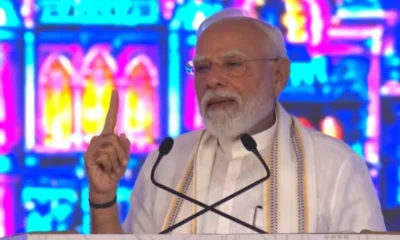
Prime Minister Narendra Modi on Wednesday launched a sharp attack on Leader of the Opposition Rahul Gandhi, alleging that his “traitor” remark against BJP MP Ravneet Singh Bittu reflected the Congress party’s animosity towards the Sikh community.

The Prime Minister made the remarks in the Rajya Sabha while replying to the motion of thanks on the President’s address. Referring to an incident in the Parliament complex a day earlier, Modi said Gandhi’s comment had crossed all limits of political decency.

The controversy stems from a protest by suspended Opposition MPs, during which Ravneet Singh Bittu — a former Congress leader who joined the BJP ahead of the 2024 Lok Sabha elections — allegedly made a remark suggesting the protesters were behaving as if they had won a war.

In response, Rahul Gandhi was heard saying, “A traitor is walking by, look at his face,” before approaching Bittu and extending his hand. Gandhi then reportedly added, “Hello, brother. My traitor friend. Don’t worry, you will come back.”

Bittu refused to shake hands with the Congress leader and instead described him as an “enemy of the country” before walking away from the scene.

While the Congress later clarified that Gandhi’s remark was aimed at Bittu for leaving the party, the BJP seized upon the comment, calling it an insult to the Sikh community. Protests were subsequently held by members of the Sikh community outside the Congress headquarters and at other locations.

Addressing the House, Prime Minister Modi said that many leaders had quit the Congress in the past and that the party itself had split multiple times, but none of those leaders had been labelled a traitor. “He called this MP a traitor because he is Sikh,” the Prime Minister alleged, as treasury bench members raised slogans condemning the remark.

Continue Reading

India News

Manipur Assembly to meet at 4 pm today, floor test likely under new chief minister

The Manipur Legislative Assembly will convene at 4 pm today, with a floor test likely as the new chief minister seeks to prove his majority in the House.

Published

on

Manipur assembly

The Manipur Legislative Assembly will convene at 4 pm on Thursday in Imphal, a day after Yumnam Khemchand Singh was sworn in as the chief minister. A floor test is likely to be held on the first day of the session to establish the majority of the newly formed government.

In the 60-member Assembly, the BJP holds 37 seats, while its ally National People’s Party has six members, giving the ruling combine a clear majority in the House.

Singh chaired the first Cabinet meeting of his government late Wednesday evening, shortly after taking oath as the 13th chief minister of Manipur. The meeting marked the formal start of administrative functioning under the new Council of Ministers.

His appointment came nearly a year after the resignation of former chief minister N Biren Singh, who stepped down following months of ethnic violence between the Meitei and Kuki communities in the state.

After taking oath, Singh thanked Prime Minister Narendra Modi and said he would work with “utmost diligence to advance development and prosperity in Manipur,” aligning the state’s efforts with the vision of Viksit Bharat.

He said the government’s focus would be on inclusive economic growth while preserving Manipur’s cultural heritage, adding that he would discharge his responsibilities with sincerity and dedication, mindful of the trust placed in him.

The summoning of the 12th Manipur Legislative Assembly by Governor Ajay Kumar Bhalla, along with the first Cabinet meeting, signals the resumption of legislative and administrative processes in the state, officially bringing President’s rule to an end.

The sixth session of the 12th Manipur Legislative Assembly was last held from July 31 to August 12, 2024.

Continue Reading

India News

PM Modi skips Lok Sabha reply as protests force repeated adjournments

PM Modi did not deliver his Lok Sabha reply today after sustained Opposition protests led to repeated adjournments over a dispute involving Rahul Gandhi’s proposed speech.

Published

on

PM Modi

Prime Minister Narendra Modi did not deliver his scheduled reply to the Motion of Thanks on the President’s address in the Lok Sabha today after sustained Opposition protests led to multiple adjournments of the House.

The disruption followed an escalation of tensions linked to Congress leader Rahul Gandhi’s proposed speech and the suspension of eight Opposition MPs a day earlier. The situation worsened after remarks made by BJP MP Nishikant Dubey during the proceedings.

Dispute over references to books sparks fresh ruckus

The controversy intensified when Nishikant Dubey responded to Rahul Gandhi’s demand to speak on national security and references to the unpublished memoirs of former Army chief General MM Naravane. Dubey said that while Gandhi wanted to quote from an unpublished book, he himself had brought several books that, according to him, made claims about the Gandhi family.

As Dubey began listing these books and their contents, strong protests erupted from Opposition members. Krishna Prasad Tenneti, who was presiding over the House at the time, cited Rule 349, which restricts members from reading out books, newspapers, or letters unless directly related to parliamentary business. Despite repeated warnings, the matter remained unresolved, leading to another adjournment.

Rahul Gandhi accuses government of silencing debate

Earlier in the day, Rahul Gandhi alleged that he was being prevented from speaking on an issue of national importance. He claimed the government was uncomfortable with references to General Naravane’s memoirs, which he said discussed the handling of the 2020 China border crisis.

In a social media post, Gandhi said he intended to present the Prime Minister with a book authored by the former Army chief, adding that some cabinet ministers had even questioned the existence of the book. He also wrote to Lok Sabha Speaker Om Birla after the suspension of eight Opposition MPs, alleging that parliamentary debate was being curtailed.

After it became clear that the Prime Minister would not speak in the House today, Gandhi posted that PM Modi had avoided Parliament because he was “scared” to face the truth. Congress MP Priyanka Gandhi Vadra echoed the allegation, claiming the Prime Minister was unwilling to enter the House.

Proceedings disrupted throughout the day

Lok Sabha proceedings were first adjourned until 2 pm amid loud protests over the issue linked to Naravane’s memoirs. Even after the House reconvened, disruptions continued, preventing normal business from resuming.

Later, Congress MPs staged a demonstration outside the Parliament complex, demanding that Rahul Gandhi be allowed to speak on the President’s address.

Continue Reading

Trending

© Copyright 2022 APNLIVE.com