English हिन्दी
Connect with us

India News

Sharad Pawar terms Ajit Pawar’s vote or no funds remark inappropriate

Sharad Pawar criticised Ajit Pawar’s ‘vote or no funds’ comment, calling it inappropriate, while also seeking stronger financial relief for affected farmers.

Published

on

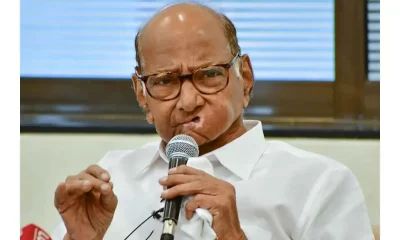
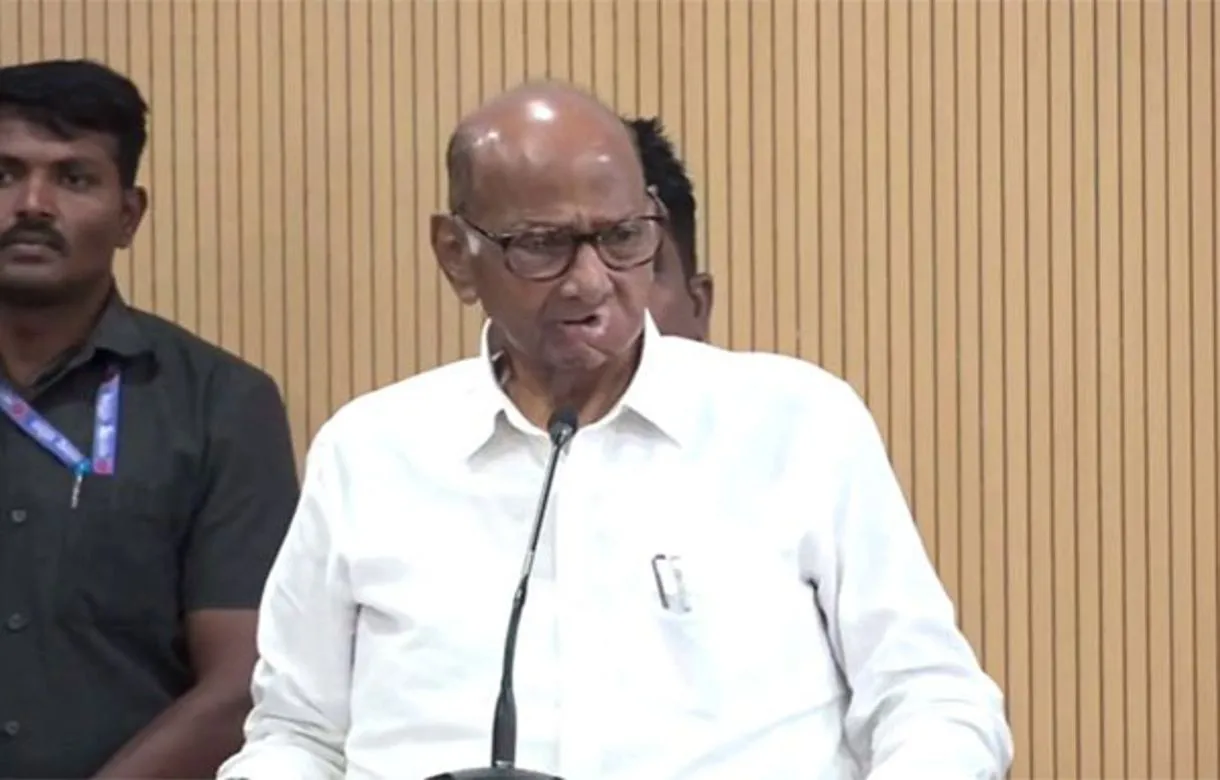
NCP (SP) chief Sharad Pawar on Thursday criticised Maharashtra Deputy Chief Minister Ajit Pawar for urging voters to support his party candidates with the promise of assured development funds. Calling the comment unacceptable, Sharad Pawar said seeking votes on monetary assurances undermines democratic values.

Sharad Pawar questions fund-linked appeal for votes

Speaking to reporters in Baramati, the senior Pawar said it was “not appropriate” to ask people to vote based on financial commitments.
Ajit Pawar had recently told voters in Malegaon, Baramati tehsil, that his party would ensure no shortage of funds if its candidates were elected, but if voters rejected them, he would “reject” too.

Sharad Pawar said, “Instead of asking for votes based on work, the appeal is being made on the basis of financial assurances. This is inappropriate. If the only goal is to win elections using financial factors, then such comments are unnecessary.”

Local body elections across Maharashtra are scheduled for December 2.

Farmers’ aid ‘not enough’, says Pawar

Sharad Pawar also criticised the state government’s response to farmers who suffered damage due to recent heavy rains and floods. He noted that the loan recovery pause for one year may offer temporary relief but will not be effective in the long term.

“Looking at the losses, the state should have provided partial financial aid to farmers. That would have helped adequately,” he said.

India News

Centre’s Sanchar Saathi mandate for phonemakers sparks political backlash

The Centre’s order to pre-install Sanchar Saathi on all mobile phones has led to political uproar, with the Opposition calling it a surveillance tool while the government cites cyber safety benefits.

Published

on

sanchar sathi app logo

The Centre’s direction asking mobile phone manufacturers to pre-install the Sanchar Saathi app on all new and imported devices has triggered a sharp political confrontation, with Opposition parties alleging that the move paves the way for state surveillance. The government, however, maintains that the directive is meant to strengthen citizen protection against cyber fraud and assist in recovering lost or stolen devices.

What Sanchar Saathi offers

Sanchar Saathi is a Central digital safety platform that provides several citizen-oriented services through its app and web portal. One of its key features, Chakshu, allows users to report suspected cyber fraud or commercial spam calls. The platform also helps flag malicious website links, phishing attempts, device cloning, and fraudulent communication received via SMS, RCS, iMessage and social media platforms including WhatsApp and Telegram.

The website associated with the app states that such proactive reporting aids the Department of Telecommunications in preventing misuse of telecom resources for cybercrime and financial fraud.

What the Centre has mandated

The Department of Telecommunications, under the Ministry of Communications led by Jyotiraditya Scindia, has instructed mobile phone manufacturers to pre-install Sanchar Saathi in all devices produced or imported in India within 90 days from November 28. The notice also directs companies to ensure the app is visible during initial device setup and that its functions cannot be disabled.

For phones already manufactured, the app must be added through software updates. The government has warned that non-compliance will attract action.

Opposition raises privacy concerns

Political criticism intensified soon after the directive was issued. Congress leader KC Venugopal termed the move “beyond unconstitutional”, asserting that a pre-loaded government application that cannot be removed infringes on citizens’ right to privacy under Article 21. He argued that such an app could enable monitoring of individual activities and demanded an immediate rollback.

Shiv Sena (UBT) MP Priyanka Chaturvedi also criticised the decision, describing it as “another BIG BOSS surveillance moment”. She said such measures would be opposed, arguing that the government should focus on stronger grievance-redressal systems instead of creating surveillance mechanisms.

Industry concerns surface

A report by media suggests the directive may lead to friction with major phonemakers, particularly Apple, which has previously resisted similar requirements citing user privacy and security. Apple, Samsung and Xiaomi did not respond to queries, nor did the Communications Ministry.

Two industry sources told media that manufacturers were not consulted before the order was issued.

According to figures displayed on the Sanchar Saathi website, the platform has enabled the blocking of 42 lakh stolen phones and helped in recovering 26 lakh devices. The app has recorded over 1 crore downloads on Android and nearly 10 lakh on iOS.

Continue Reading

India News

EC terms Bengal’s mass voter deletion allegations false in affidavit to Supreme Court

The Election Commission has told the Supreme Court that claims of mass voter deletions in West Bengal are “false” and part of a political narrative, asserting that the ongoing Special Intensive Revision is a constitutionally mandated process with safeguards.

Published

on

The Election Commission has dismissed accusations of large-scale voter removal in West Bengal, calling them “false”, “fabricated”, and politically motivated. In an affidavit submitted to the Supreme Court, the poll body said claims of mass deletion were being circulated as a “narrative” in the media to gain political mileage.

EC defends SIR, calls process constitutional

Responding to a petition filed by Trinamool Congress MP Dola Sen on the Special Intensive Revision (SIR) exercise, the Election Commission said the ongoing revision is a routine, constitutionally mandated process. It highlighted that rapid migration and urbanisation have made additions and deletions common, making an accurate voter roll essential.

According to the affidavit, 99.77% of voters have received forms under the SIR, and 70.14% have already submitted the required details. The Commission stressed that no voter’s name can be removed without proper legal procedure.

Opposition questions deletions, EC cites safeguards

Opposition parties in Bengal, including the ruling Trinamool Congress, have alleged that SIR is being misused to disenfranchise their supporters. The EC countered by noting that revisions of this scale have been conducted several times since the 1950s — in 1962-66, 1983-87, 1992, 1993, 2002 and 2004.

The poll body added that SIR guidelines include safeguards to ensure an “inclusive” exercise. Officials have been instructed to assist elderly, disabled and vulnerable voters. Under the rules, if a house is found locked, officials must issue three notices and voters can also submit forms online or through family members.

A bench of Chief Justice of India Surya Kant and Justice Joymalya Bagchi is set to hear the petitions challenging the West Bengal SIR on December 9.

Continue Reading

India News

Stubble burning sees 90% drop in Punjab, Haryana, Centre updates Parliament

The Centre informed Parliament of a 90% drop in stubble burning in Punjab and Haryana, citing extensive residue management measures, even as Delhi’s pollution levels worsened again.

Published

on

Stubble burning

The Centre has informed Parliament that incidents of stubble burning across Punjab and Haryana have fallen sharply by 90% during the 2025 paddy harvesting season compared to 2022. The update comes at a time when Delhi-NCR continues to struggle with deteriorating air quality despite a significant reduction in farm fires.

Stubble burning declines, but Delhi pollution persists

Union Environment Minister Bhupendra Yadav, responding to a question by Congress MP Charanjit Singh Channi, said that while stubble burning contributes to winter pollution, Delhi’s toxic air is shaped by several factors. These include vehicle emissions, industrial activities, construction dust, waste burning and unfavourable weather patterns.

The government noted that Delhi has still recorded its best average AQI levels in eight years. The number of “good” air quality days has risen to 200 in 2025, up from 110 in 2016. “Very poor” and “severe” days have also dropped from 71 in 2024 to 50 in 2025.

Measures behind the decline

The Centre attributed the drastic reduction in farm fires to coordinated steps such as:

  • Distribution of over 2.6 lakh crop residue management (CRM) machines
  • Free rental access to CRM equipment for small and marginal farmers
  • Mandatory use of paddy-straw biomass pellets in brick kilns
  • Action against officials failing to curb stubble burning

The Commission for Air Quality Management has further directed Punjab and Haryana to ensure brick kilns outside NCR districts use paddy straw-based pellets or briquettes, creating sustained demand for crop residue and deterring burning.

Thirty-one CPCB flying squads were deployed this season to monitor priority districts.

Delhi air quality dips again

After marginal improvement on Sunday, Delhi’s air quality slipped back into the “very poor” category on Monday, with AQI numbers rising beyond 300.

Rahul Gandhi seeks debate on pollution crisis

Leader of Opposition Rahul Gandhi reiterated the need for a detailed parliamentary discussion on Delhi’s worsening pollution. He questioned Prime Minister Narendra Modi’s silence, calling the situation a “health emergency”. Gandhi also interacted with mothers concerned over their children’s exposure to toxic air and shared a video of the meeting on X, urging government action.

Continue Reading

Trending

© Copyright 2022 APNLIVE.com