English हिन्दी
Connect with us

India News

PM Modi inaugurates India’s first nature-themed airport terminal in Assam

Prime Minister Narendra Modi inaugurates the new nature-themed terminal at Guwahati airport, the largest in Northeast India, built around bamboo, orchids and regional heritage.

Published

on

PM modi in Assam

Prime Minister Narendra Modi is set to inaugurate the new terminal building of Lokapriya Gopinath Bordoloi International (LGBI) Airport in Guwahati today, marking a major milestone for aviation infrastructure in the Northeast. Built at an estimated cost of around Rs 4,000 crore, the facility is being projected as the largest airport terminal in the region and a key boost to connectivity, tourism and economic activity in Assam.

The Prime Minister is scheduled to arrive in Guwahati around 3 pm as part of his two-day visit to the state.

Northeast’s largest airport terminal takes shape in Guwahati

The newly constructed terminal is nearly seven times larger than the existing one and has been designed to cater to the region’s rapidly growing air traffic. Once fully operational, it is expected to handle up to 13.1 million passengers annually by 2032.

Officials said the terminal is planned as a regional connectivity hub, with a focus on strengthening air links between India and Southeast Asia. The airport will be capable of handling up to 34 air traffic movements per hour, the highest capacity among airports in the Northeast. The facility will also be equipped with one of the most advanced Instrument Landing Systems to support safer and more efficient operations.

Nature-inspired design rooted in Assam’s identity

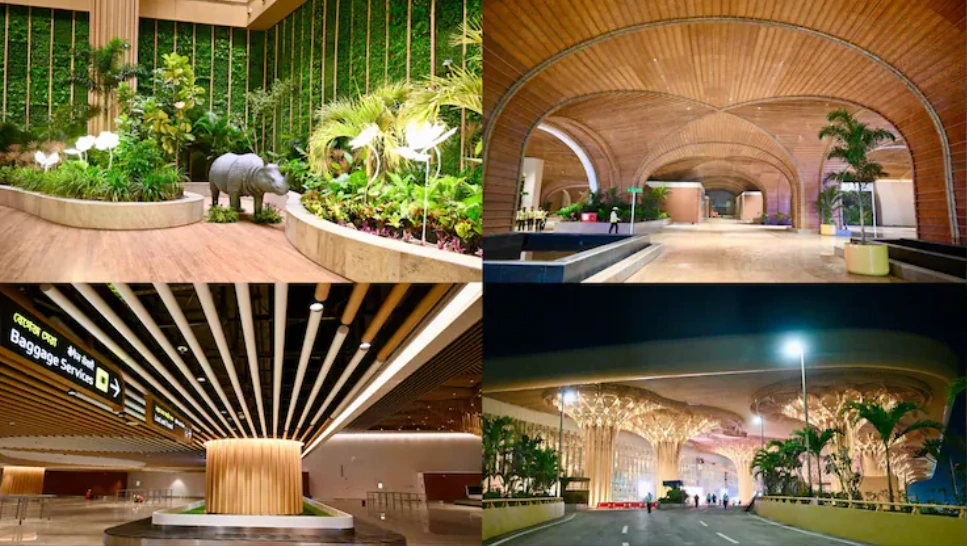
What sets the Guwahati terminal apart is its distinctive nature-themed architecture. Conceptualised under the theme “Bamboo Orchids”, it is being described as India’s first airport terminal inspired entirely by natural and cultural elements.

The interiors draw from the landscapes of Northeast India, with design elements reflecting indigenous orchids, locally known as Kopou Phool, and the flow of the Brahmaputra river. The terminal incorporates more than 2,000 species of plants, includes a dedicated zone inspired by Kaziranga National Park, and features artefacts representing Majuli Island.

A key architectural highlight is the expansive bamboo vault, created using around 140 metric tonnes of locally sourced bamboo. The space has been envisioned as a multifunctional cultural centre aimed at encouraging community interaction and showcasing the region’s heritage. Design elements such as japi motifs, the iconic rhino symbol and 57 orchid-inspired columns further reinforce the cultural narrative.

Arriving passengers will also experience a unique “Sky Forest”, featuring nearly one lakh plants of indigenous species, designed to create an immersive forest-like ambience within the terminal.

Focus on digital integration and passenger convenience

Spread over nearly 1.4 lakh square metres, the integrated new terminal has been designed to handle around 1.3 crore passengers annually. It is supported by significant upgrades to the runway, airfield systems, aprons and taxiways.

The terminal places strong emphasis on digital integration, with 14 entry points, including four DigiYatra gates, aimed at easing passenger movement. Facilities such as full-body scanners for non-intrusive security checks, automated baggage handling systems, fast-track immigration and AI-driven airport operations have been incorporated to ensure smoother travel experiences.

Other engagements during PM Modi’s Assam visit

During his two-day stay, the Prime Minister will also lay foundation stones for multiple development projects and address public gatherings. He is scheduled to visit the Swahid Smarak Kshetra to pay tribute to the martyrs of the historic Assam Movement.

Later in the day, PM Modi will perform the bhoomipujan for a new brownfield Ammonia-Urea Fertiliser Project at Namrup in Dibrugarh district, within the existing premises of the Brahmaputra Valley Fertiliser Corporation Limited.

India News

Assam train accident: Eight elephants killed after Rajdhani Express derailment in Hojai

Eight elephants were killed after the Rajdhani Express collided with a herd in Assam’s Hojai district, causing multiple coaches to derail and disrupting train services.

Published

on

assam train accident

At least eight elephants were killed and a calf was injured after a herd collided with the Sairang–New Delhi Rajdhani Express in Assam’s Hojai district, leading to the derailment of the locomotive and five coaches early Saturday. Railway officials confirmed that no passengers were injured in the incident.

Forest department officials said the collision occurred when the New Delhi-bound Rajdhani Express struck a herd of elephants on the tracks. The impact caused multiple coaches to derail, disrupting rail traffic on the busy route connecting the Northeast with the national capital.

Train services hit, passengers shifted to other coaches

Following the derailment, rail movement towards Upper Assam and other parts of the Northeast was affected due to damaged coaches and elephant remains scattered on the tracks. Accident relief trains and senior railway officials rushed to the site to restore services.

Passengers travelling in the affected coaches were temporarily accommodated in vacant berths in other coaches of the same train. Officials said that once the train reaches Guwahati, additional coaches will be attached to ensure all passengers can continue their journey.

Collision occurred outside designated elephant corridor

According to officials, the accident took place at a location that is not marked as a designated elephant corridor. The loco pilot reportedly applied emergency brakes after spotting the herd on the tracks, but the elephants ran into the train, resulting in the collision and derailment.

Forest authorities confirmed that eight elephants died on the spot, while one injured calf was rescued. Local residents said the herd consisted of around eight elephants at the time of the accident.

Elephant deaths in train accidents remain a concern

The incident comes amid continued concerns over wildlife deaths on railway tracks. Data shared by the Environment Ministry in Parliament earlier showed that at least 79 elephants have died in train collisions across India over the past five years, based on reports from states and Union Territories.

The ministry has said that several preventive steps are being taken in coordination with the Railways, including speed restrictions in elephant habitats, use of sensor-based detection systems, and construction of underpasses, ramps and fencing at vulnerable locations. Guidelines and capacity-building programmes have also been introduced to reduce human-animal conflict along railway lines.

Continue Reading

Entertainment

Bharti Singh, Haarsh Limbachiyaa welcome second child after she’s rushed to hospital mid-shoot

Comedian Bharti Singh and her husband Haarsh Limbachiyaa welcomed their second child after she was rushed to hospital during a television shoot.

Published

on

Bharti

Popular comedian and television personality Bharti Singh and her husband, writer-host Haarsh Limbachiyaa, have welcomed their second child. The baby was born on Friday after Bharti was taken to the hospital following a sudden medical emergency earlier in the day, according to media reports.

Emergency during television shoot led to hospitalisation

As per available information, Bharti Singh was scheduled to shoot for the television show Laughter Chefs on Friday morning when her water broke unexpectedly. She was immediately rushed to a nearby hospital, where she later delivered her second child. No further details about the baby have been shared publicly so far.

The news of the delivery comes weeks after the couple announced Bharti’s second pregnancy on social media.

Pregnancy announcement and maternity shoot

Bharti Singh and Haarsh Limbachiyaa had revealed the pregnancy during a family vacation in Switzerland. A few weeks ago, Bharti also shared pictures from her maternity photoshoot, where she was seen wearing a blue silk gown with white floral patterns.

Sharing the photos online, Bharti wrote, “2nd Baby Limbachiya coming soon,” along with a baby emoji.

Family background

Bharti Singh and Haarsh Limbachiyaa became parents for the first time in 2022, when they welcomed their son, Lakshya.

The couple is among the most well-known faces on Indian television. Bharti is widely recognised for her comic timing and distinctive on-screen persona, while Haarsh has made his mark as a writer and host. Apart from their television work, the two also co-host a podcast together.

Continue Reading

India News

Renaming MGNREGA removes core spirit of rural employment law, says Shashi Tharoor

Published

on

Shashi Tharoor

Congress MP Shashi Tharoor has strongly criticised the renaming of the Mahatma Gandhi National Rural Employment Guarantee Act (MGNREGA), saying the move strips the rural employment programme of its core essence. His remarks came after Parliament cleared the Viksit Bharat Guarantee for Rozgar and Ajeevika Mission (Gramin) Bill, also referred to as the VB-G RAM G Bill.

Speaking to media, Tharoor said the decision to remove Mahatma Gandhi’s name from the scheme “takes out the heart” of the rural employment programme that has been in place for years. He noted that the identity and philosophy associated with Mahatma Gandhi were central to the original law.

Tharoor also objected to the way the new name was framed, arguing that it unnecessarily combined multiple languages. He pointed out that the Constitution envisages the use of one language in legislation, while the Bill’s title mixes English and Hindi terms such as “Guarantee”, “Rozgar” and “Ajeevika”, along with the conjunction “and”.

‘Disrespect to both names’

The Congress leader said that inserting the word “Ram” while dropping Mahatma Gandhi’s name amounted to disrespecting both. Referring to Mahatma Gandhi’s ideas, Tharoor said that for Gandhi, the concepts of Gram Swaraj and Ram Rajya were inseparable, and removing his name from a rural employment law went against that vision.

He added that the name of Lord Ram could be used in many contexts, but questioned the rationale behind excluding Mahatma Gandhi from a programme closely linked to his philosophy of village self-rule.

Protests over passage of the Bill

The VB-G RAM G Bill was passed by the Lok Sabha on December 18 and cleared by the Rajya Sabha in the early hours of December 19 amid protests from Opposition members. Several MPs opposed the manner in which the legislation was pushed through, with scenes of sloganeering and tearing of papers in the House.

Outside Parliament, members of the Trinamool Congress staged a sit-in protest near Samvidhan Sadan against the passage of the Bill. Congress also announced nationwide protests earlier this week, accusing the government of weakening rights-based welfare schemes.

Despite opposition criticism, the government has maintained that the new law will strengthen rural employment and livelihood security. The Bill raises the guaranteed employment from 100 days to 125 days per rural household and outlines a 60:40 cost-sharing formula between the Centre and states, with a higher central share for northeastern, Himalayan states and certain Union Territories.

Continue Reading

Trending

© Copyright 2022 APNLIVE.com