English हिन्दी
Connect with us

Latest world news

Trump warns of escalation as Iran signals counter-strategy amid Hormuz blockade tensions

As the US-Iran ceasefire nears its end, tensions escalate over the Hormuz blockade with strong warnings from both sides.

Published

on

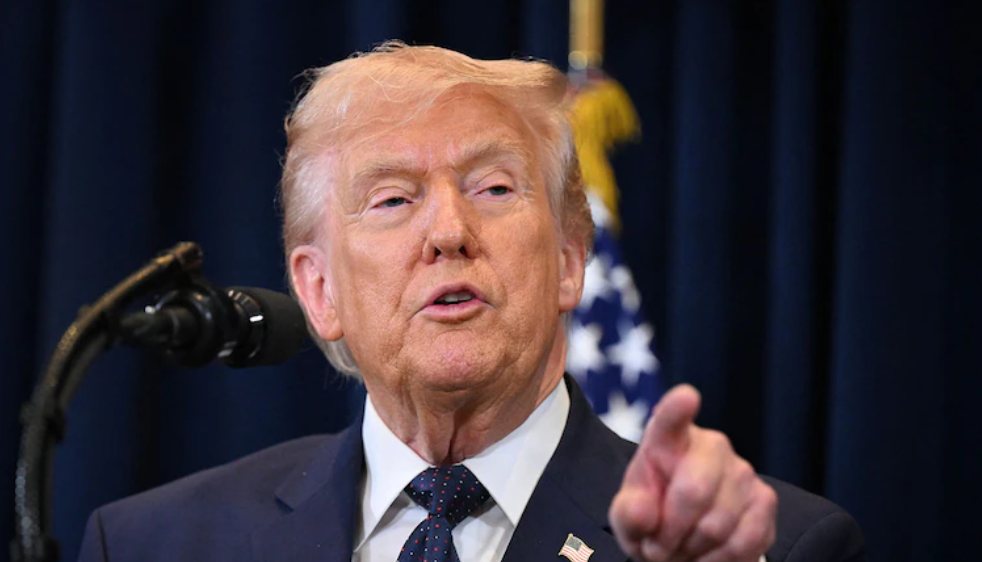
Donald Trump statement

Ceasefire between US and Iran nears deadline as both sides trade sharp warnings over blockade and military response

Tensions between the United States and Iran have intensified as a fragile ceasefire approaches its deadline, with both sides issuing strong warnings amid ongoing disputes over the Strait of Hormuz.

US President Donald Trump has cautioned that severe military action could follow if negotiations fail, signalling that “bombs will go off” in the absence of a deal. His remarks come as Washington continues a naval blockade targeting Iranian oil exports and maritime movement, a move Tehran has strongly opposed.

Iran, on the other hand, has indicated it is prepared with what it described as “new cards,” suggesting a potential shift in its strategy if the situation escalates further. The standoff reflects deep mistrust between the two sides, even as diplomatic efforts continue in the background.

The current crisis is centred around the Strait of Hormuz, a critical global oil transit route. The United States imposed the blockade after talks failed to produce a breakthrough, aiming to restrict Iran’s oil shipments and increase economic pressure.

Tehran has accused Washington of violating the ceasefire by maintaining the blockade and taking aggressive actions, including the seizure of vessels near the strategic waterway. These developments have further complicated efforts to sustain peace.

A temporary ceasefire, agreed earlier this month, had paused hostilities for two weeks following threats of major escalation. However, with the truce nearing its end, uncertainty looms over whether it will be extended or collapse into renewed conflict.

The situation has also raised concerns globally, as disruptions in the Strait of Hormuz can significantly impact oil supply and international markets. Analysts warn that prolonged tensions could lead to economic instability and further geopolitical strain.

Diplomatic channels remain open, but the sharp rhetoric from both Washington and Tehran indicates that the path to a lasting agreement remains uncertain.

Latest world news

Japan earthquake triggers tsunami warning after strong 7.4 magnitude tremor off northern coast

A powerful earthquake off northern Japan triggered tsunami warnings and evacuation alerts as authorities monitored waves and aftershocks.

Published

on

A powerful earthquake of magnitude 7.4 struck off the northern coast of Japan on Monday evening, prompting authorities to issue a tsunami warning and urge residents in coastal areas to move to safer locations.

According to officials, the earthquake occurred in the Pacific Ocean near the northeastern region of the country at around 4:53 pm local time. The tremors were strong enough to be felt across a wide area, including parts of Tokyo.

Following the quake, Japan’s meteorological agency issued a tsunami warning for several coastal regions, cautioning that waves of up to 3 metres could hit affected areas.

Initial tsunami waves were recorded shortly after the earthquake, with water levels reaching around 70 to 80 centimetres at some ports in northern Japan. Authorities warned that subsequent waves could be larger and more dangerous.

Emergency alerts were broadcast across the region, urging residents to evacuate coastal zones and move to higher ground. Visuals showed ships leaving ports and emergency messages being displayed on television screens.

As a precautionary measure, bullet train services in parts of northern Japan were temporarily halted, while authorities began assessing the situation and monitoring for aftershocks.

There were no immediate reports of major damage or casualties, but officials said the situation remained under close observation, with warnings still in place for coastal communities.

Japan, located along the seismically active “Ring of Fire,” frequently experiences earthquakes, making rapid response systems and tsunami alerts critical for public safety.

Continue Reading

Latest world news

US Navy fires on, seizes Iranian-flagged ship in Strait of Hormuz

US Navy fires on and seizes Iranian-flagged vessel in Strait of Hormuz after it failed to respond to warnings, raising tensions.

Published

on

Strait of Hormuz

The United States Navy fired on and seized an Iranian-flagged vessel near the Strait of Hormuz, according to reports.

The vessel was intercepted by US naval forces after it did not respond to repeated warnings. It was subsequently disabled and boarded, with US personnel taking control of the ship.

Details regarding the vessel’s cargo and the circumstances leading to the interception have not been fully disclosed.

Iran has condemned the incident, calling it a violation of international norms.

The Strait of Hormuz is one of the world’s most important shipping routes, and such incidents often raise concerns over maritime security and global energy flows.

Continue Reading

Latest world news

Strait of Hormuz open but Iran’s Guards impose new transit conditions

Iran has reopened the Strait of Hormuz during a ceasefire, but new restrictions by the Revolutionary Guards limit how vessels can pass.

Published

on

Strait of Hormuz

The Strait of Hormuz has been declared open for commercial shipping during the ongoing ceasefire, but fresh conditions imposed by Iran’s Revolutionary Guards have raised questions over how unrestricted the passage actually is.

Iran’s Foreign Minister Abbas Araghchi announced that the crucial waterway would remain “completely open” for commercial vessels for the duration of the ceasefire. However, a separate statement from the Islamic Revolutionary Guard Corps (IRGC) clarified that ships must comply with specific operational requirements while transiting the strait.

According to the IRGC, all vessels must obtain prior permission before entering the strait. Additionally, civilian ships are required to follow designated routes set by Iranian authorities, while military vessels continue to be prohibited from passing through.

The Guards described these measures as part of a “new order” aligned with ceasefire terms, though these details were not explicitly mentioned in the foreign minister’s initial announcement.

The differing messages have also triggered reactions within Iran, with some state-backed outlets criticising the earlier statement for lacking clarity and potentially creating confusion around the reopening of the strait.

Meanwhile, global attention remains focused on the strategic waterway, which handles a significant share of the world’s oil shipments. The reopening announcement led to a sharp drop in crude prices, reflecting expectations of improved supply flows.

US President Donald Trump also confirmed that the strait is open for passage, though he indicated that the American naval blockade targeting Iran would continue until broader negotiations are completed.

Despite the reopening, analysts suggest that the situation remains fragile, with ongoing restrictions, geopolitical tensions, and security concerns continuing to affect maritime movement through one of the world’s most critical energy corridors.

Continue Reading

Trending

© Copyright 2022 APNLIVE.com