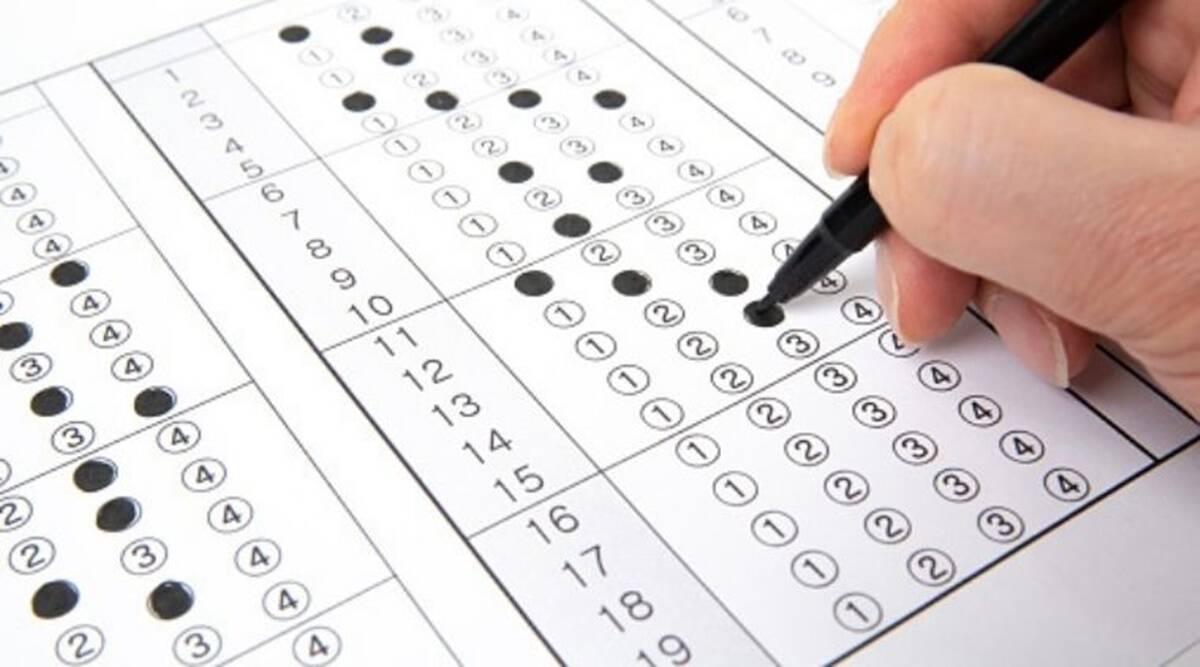
With few days left for the Common Entrance Test (CAT) 2021, conducted by IIM, the authorities have issued few guidelines including the dress code. IIM aspirants are not allowed to wear jewellery, thick-soled shoes and garments having large button on an exam day. Candidates are required to wear plain pullover, sweaters, cardigans and socks but without pockets. Also, as per the latest guidelines, candidates may also be asked to remove their shoes outside the exam lab.
The exam will be held on 28th November 2021 at specific centres across country. In another major update, the exam authorities have also informed the candidates about how to answer the paper.
Guidelines on how to give an answer
According to another significant update students should use the mouse to select the correct Option as an answer to an MCQ and the on-screen Keyboard to answer a non-MCQ.
The authorities have informed the candidates that the keyboard should not be used as it can lead your test getting locked.
Just after 40 minutes, the timer would automatically be reset to zero and the current section would be auto-submitted and the candidate will be moved to the next part
The timer would reset to zero after 40 minutes, the current portion would be auto-submitted, and the candidate would be transferred to the next part. After that, the candidate can begin answering the next section.
Dress code for CAT 2021
No jewellery or any other item containing metal.
No garments wih large buttons.
No footwear/shoes with thick soles.
Socks, pullovers, cardigans, sweaters but without any pockets.
Students must not also carry mobile phones or any kind of electronic gadgets, watches, calculators, stationery items, pens, wallets, and goggles.
Candidates should also print their admit cards and familiarise themselves with all guidelines so that there are no uncertainties on exam day. The admit card must be printed on A4-size paper, ideally on a laser printer, by those who are taking the test. Only if the candidate’s signature and photograph are legibly printed on the hall ticket will it be regarded valid.
Before turning the admission card over to the exam centre for verification, candidates must affix their photograph in the area specified on the card. The photo must match the one you submitted throughout the application process. The electronic version of the admission card also features a Google map link to help you find the exam centre. Candidates must also remember to carry their original ID proof.
The reporting time will be sent to candidates through SMS and email the day before the test; however, students must arrive not later than 8:15 a.m. for the morning session, 12:15 p.m. for the afternoon session, and 4:15 p.m. for the evening session. Before the exam, CAT 2021 candidates must go through an admit card verification process. They’ll also have to go through a thermal screening process.
Candidates for the test will be given a pen and a scribbling pad. After the exam, students must deposit their admission cards, pen, and scribbling pad (with all pages intact) in the boxes provided at all exam centres.
CBSE makes three languages mandatory for Classes 9 and 10 from July 1
CBSE has announced that students in Classes 9 and 10 must study three languages from July 1, 2026, though no board examination will be conducted for the third language during the initial rollout.
The Central Board of Secondary Education has announced that students in Classes 9 and 10 will be required to study three languages from July 1, 2026, as part of the implementation of the National Education Policy (NEP) 2020 and the National Curriculum Framework for School Education (NCFSE) 2023.
Under the revised structure, students will study languages under the R1, R2 and R3 format. The board has clarified that two of the three languages must be Indian languages.
However, CBSE has stated that there will be no Class 10 board examination for the third language, also referred to as R3, during the initial phase of implementation.
What the new language structure means
According to the updated curriculum framework, students will choose three different languages. The same language cannot be selected at more than one level simultaneously.
The board has explained the structure as:
R1: Any language offered by CBSE
R2: A language different from R1
R3: A third language different from both R1 and R2
The move is aimed at promoting multilingual education in line with NEP 2020 recommendations.
No board exam for third language initially
CBSE has clarified that although the third language will become mandatory for Classes 9 and 10, students will not immediately face a board examination for R3 in Class 10.
Reports said the full implementation of the three-language board examination structure is expected to happen gradually over the coming years.
Schools asked to prepare for rollout
The board has already directed schools to finalise language options and upload details on the OASIS portal to ensure smooth implementation of the revised policy.
CBSE has also indicated that temporary textbook arrangements and interim measures for language teacher shortages may be introduced during the transition phase.
The National Testing Agency (NTA) has announced that the NEET UG 2026 re-examination will be conducted on June 21 following the cancellation of the earlier exam amid allegations of a paper leak.
The original NEET UG 2026 examination, held on May 3, was scrapped after investigative agencies flagged concerns regarding the integrity of the exam process. The matter is currently under investigation by the Central Bureau of Investigation (CBI).
NTA issues fresh schedule
According to the official announcement, candidates who had registered for the cancelled examination will not be required to submit fresh applications for the re-test. Existing registrations will remain valid for the June 21 examination.
The agency has also advised students and parents to rely only on official NTA communication channels for updates related to admit cards, examination centres and other examination-related notifications.
Paper leak investigation underway
The NEET UG paper leak case has triggered a nationwide probe, with the CBI making multiple arrests in connection with the alleged leak network. Investigators are examining how question papers were allegedly circulated before the examination.
Reports have suggested that handwritten copies of the question paper were allegedly scanned and circulated through messaging networks and intermediaries ahead of the examination.
Students await admit cards and city slips
The NTA is expected to release fresh city intimation slips and admit cards ahead of the June 21 examination date. Candidates have been advised to regularly check the official NEET website for updates regarding examination centres and instructions.
CBSE Class 12 result 2026 declared: 85.20% students pass, direct link and official websites to check scorecard
CBSE has declared the Class 12 result 2026 with an overall pass percentage of 85.20%. Students can check results online using official websites and apps.
The Central Board of Secondary Education (CBSE) has officially declared the Class 12 board examination results for 2026. This year, the overall pass percentage stands at 85.20%, marking a key academic milestone for lakhs of students across India.
Students who appeared for the examination can now check and download their scorecards from the official CBSE result portals and other designated platforms.
Official websites to check CBSE Class 12 result 2026
Candidates can access their results through the following official websites:
cbseresults.nic.in
results.cbse.nic.in
cbse.gov.in
cbse.nic.in
Apart from these websites, students can also use DigiLocker and the UMANG app to download their digital marksheets.
How to download CBSE Class 12 scorecard
To view and download the result, students need to:
Enter roll number, school number, and admit card ID
Submit details to view scorecard
Download and save the marksheet for future use
Digital marksheet availability
CBSE has also made digital marksheets available through DigiLocker, allowing students to securely access their academic documents online. These digital records can be used for admission and verification purposes.
Key highlight of CBSE result 2026
Overall pass percentage: 85.20%
Result released for Class 12 board exams 2026
Multiple online platforms activated for result access
APN News is today the most watched and the most credible and respected news channel in India. APN has been at the forefront of every single news revolution. The channel is being recognized for its in-depth, analytical reportage and hard hitting discussions on burning issues; without any bias or vested interests.