
Gadgets
Global sea level is rising at an accelerating rate, says NASA study


[vc_row][vc_column][vc_column_text]Global sea level rise has been accelerating in recent decades, according to a new study based on 25 years of NASA and European satellite data.
The rate of sea level rise has risen from about 2.5 millimeters (0.1 inch) per year in the 1990s to about 3.4 millimeters (0.13 inches) per year today. These increases have been measured by satellite altimeters since 1992, says the study.
This acceleration has been driven mainly by increased ice melting in Greenland and Antarctica, and it has the potential to double the total sea level rise projected by 2100, according to lead author Steve Nerem, a scientist at the Cooperative Institute for Research in Environmental Sciences (CIRES) and the University of Colorado.
If things continue to change at the observed pace, sea level will rise 65 centimeters (26 inches) by 2100, enough to cause significant problems for coastal cities. The team—comprised of scientists from NASA’s Goddard Space Flight Center, the University of Colorado, the University of South Florida, and Old Dominion University—recently published their work in the journal Proceedings of the National Academy of Sciences.
“This is almost certainly a conservative estimate,” said Nerem, who is a member of NASA’s Sea Level Change team. “Our extrapolation assumes that sea level continues to change in the future as it has over the last 25 years. Given the large changes we are seeing in the ice sheets today, that is not likely.” 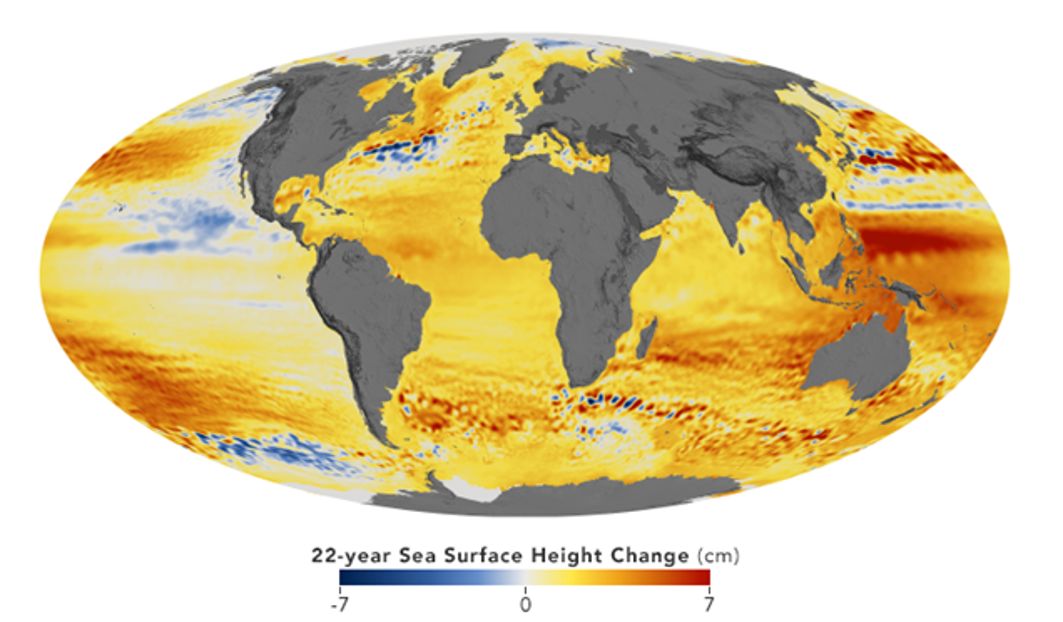
Rising concentrations of greenhouse gases in Earth’s atmosphere increase the temperature of air and water, which causes sea level to rise in two ways. First, warmer water expands, and this “thermal expansion” of the ocean has contributed about half of the 7 centimeters (2.8 inches) of global mean sea level rise that has been observed over the past 25 years, Nerem said. Second, the water from melting land ice flows into the ocean, which also increases sea level around the world.
The rate of sea level rise has risen from about 2.5 millimeters (0.1 inch) per year in the 1990s to about 3.4 millimeters (0.13 inches) per year today. These increases have been measured by satellite altimeters since 1992, including the TOPEX/Poseidon, Jason-1, Jason-2, and Jason-3 missions, which have been jointly managed by NASA, France’s Centre national d’etudes spatiales (CNES), the European Organisation for the Exploitation of Meteorological Satellites (EUMETSAT), and the U.S. National Oceanic and Atmospheric Administration (NOAA).
“The TOPEX/Poseidon/Jason altimetry missions have been essentially providing the equivalent of a global network of nearly half a million accurate tide gauges, providing sea surface height information every 10 days for over 25 years,” said Brian Beckley of NASA Goddard. “As this climate data record approaches three decades, the fingerprints of Greenland and Antarctic land-based ice loss are now being revealed in the global and regional mean sea level estimates.”
Even with a 25-year data record, it can be challenging to detect acceleration. Episodes like volcanic eruptions can create variability; for instance, the eruption of Mount Pinatubo in 1991 decreased global mean sea level just before the TOPEX/Poseidon satellite launch. In addition, global sea level can fluctuate due to climate patterns such as El Niño and La Niña, which influence ocean temperature and global precipitation patterns.
Nerem and the research team used climate models and other data sets to account for the volcanic effects and to determine the El Niño /La Niña effects, ultimately uncovering the underlying rate and acceleration of sea level rise. They also compared their results to tide gauges on Earth’s surface. “Tide gauge measurements are essential for determining the uncertainty in the global mean sea level acceleration estimate,” said co-author Gary Mitchum of the University of South Florida. “They provide the only assessments of the satellite instruments from the ground.”[/vc_column_text][/vc_column][/vc_row][vc_row][vc_column][vc_raw_html]JTNDaWZyYW1lJTIwd2lkdGglM0QlMjI4NTQlMjIlMjBoZWlnaHQlM0QlMjI0ODAlMjIlMjBzcmMlM0QlMjJodHRwcyUzQSUyRiUyRnd3dy55b3V0dWJlLmNvbSUyRmVtYmVkJTJGVlluUmVMTkxBWjAlMjIlMjBmcmFtZWJvcmRlciUzRCUyMjAlMjIlMjBhbGxvdyUzRCUyMmF1dG9wbGF5JTNCJTIwZW5jcnlwdGVkLW1lZGlhJTIyJTIwYWxsb3dmdWxsc2NyZWVuJTNFJTNDJTJGaWZyYW1lJTNF[/vc_raw_html][/vc_column][/vc_row]





Gadgets
OnePlus Freedom Sale 2026 brings discounts on 15, 15R, 13, Nord 5 and tablets
OnePlus Freedom Sale 2026 begins Jan 16 with discounts on phones, tablets, and audio products across online and offline stores.


Gadgets
Oppo Reno 15 likely to launch in India soon with upgraded camera and performance features
Oppo is preparing to launch the Reno 15 series in India, focusing on camera improvements, performance stability and a refined design. Here’s what to expect from its pricing and features.


Gadgets
Samsung Galaxy S25 FE India price leak suggests launch similar to S24 FE
Samsung Galaxy S25 FE India price has surfaced online, hinting at a similar launch price as the S24 FE. The phone brings a 6.7-inch AMOLED display, Exynos 2400 chip, triple rear cameras, and a 4,900mAh battery.


Fire near Dubai International Airport after drone incident, flights temporarily suspended

Arvind Kejriwal moves Supreme Court against Delhi High Court order in excise policy case

Fire in ICU at SCB medical college hospital in Cuttack kills 10 patients

Rajya Sabha elections Voting begins for 37 seats across 10 states

BJP releases first list of 47 candidates for Kerala assembly polls
BJP releases first list of 47 candidates for Kerala assembly polls
Fire in ICU at SCB medical college hospital in Cuttack kills 10 patients
Arvind Kejriwal moves Supreme Court against Delhi High Court order in excise policy case
Rajya Sabha elections Voting begins for 37 seats across 10 states
Fire near Dubai International Airport after drone incident, flights temporarily suspended

Afghan Men Try To Hang With The Jet Engine Of The Aircraft in Kabul- Afghanistan News – Kabul News
Trending Top 10 News: 10000 Crore Fine on Flipkart, Apple to Launch Unique Feature, Hdfc Bank Job Ad

Trending Top 10 News: Nokia 6310, Apple sales, Bachpan ka Pyar Video Kid, Dainik Bhaskar IT Raid

Trending Top 10 News: Canada bans Indian flights, Rain in Delhi NCR, AIMIM Twitter hacked, Raj Kundra case

Trending Top 10 News: Shein India, Apple New Service, Pocket Oxygen, Oppo Launched New Phone
-
 Latest world news17 hours ago
Fire near Dubai International Airport after drone incident, flights temporarily suspended
-
 India News17 hours ago
Arvind Kejriwal moves Supreme Court against Delhi High Court order in excise policy case
-
 India News17 hours ago
Fire in ICU at SCB medical college hospital in Cuttack kills 10 patients
-
 India News17 hours ago
Rajya Sabha elections Voting begins for 37 seats across 10 states
-
 India News7 hours ago
BJP releases first list of 47 candidates for Kerala assembly polls
