
Gadgets
Human-Machine Interface: Devices That Can Be Controlled Through An Eye Blink


~By Dinesh C Sharma
Imagine being able to switch on a television set or open an electronic lock just with blink of your eyes. Indian scientists have developed a man-machine interface that can be operated using electric signals generated during eye blink. The system could potentially be used for persons with locomotive and other disabilities for performing day-to-day activities.
When you blink your eyes, the brain produces signals which can be captured from the scalp in the form of electroencephalography or EEG signals. These signals can be processed using a microcontroller and based on how it is programmed, it can take a decision to perform desired tasks by actuating a corresponding device from several devices connected to it.
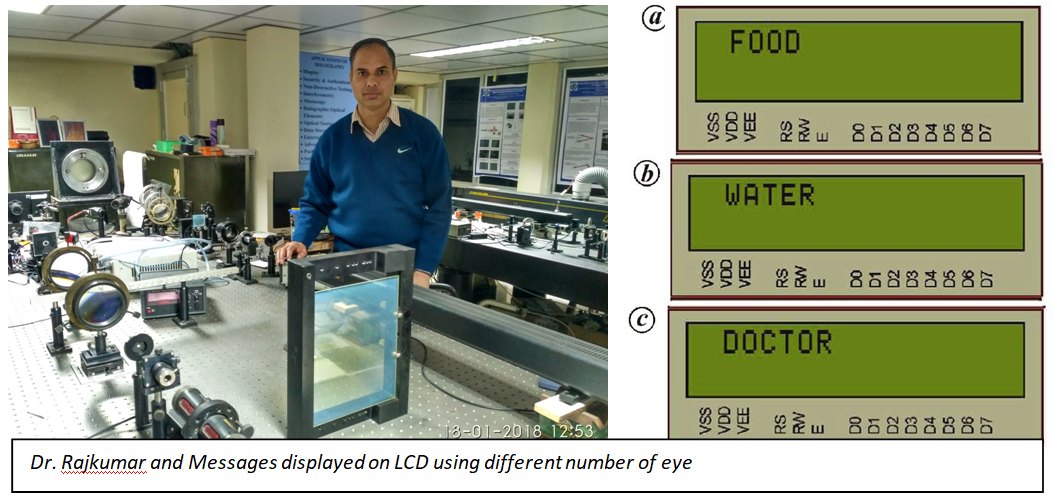
This concept has been demonstrated in laboratory by a team of researchers from Central Scientific Instruments Organization (CSIO), Chandigarh, using EEG signals generated during intentional eye blinks. They say that such a system can be deployed to developed eye blink-controlled devices. Initial findings of the research have been published in the latest issue of scientific journal Current Science.
“This concept can easily be implemented for device development. In fact, we have used it in our laboratory to control devices like speed of a DC motor and results have been highly encouraging,” Dr Raj Kumar, scientist at the Holography Group, Optical Devices Systems Division at CISO, told India Science Wire.
An important feature of the system is that it can be adapted to particular needs of the user and can be attached or detached for actuation of different appliances according to one’s requirements, he added.
Since human brain works like a processor for body control, scientists have been exploring the use of electrical signals from the brain in the form of EEG and EOG (electrooculogram) to facilitate human–machine interface.
Simple tasks like switching on or off lighting systems or moving an assisted wheelchair can be performed by tracking eye-generated signals. Since eye movement is frequent and mounting electrodes directly on eyelids is rather difficult, scientists have been looking for other options. Signals emerging from the eye movement also get mixed with those generated by movement of facial muscles. Therefore, acquiring EEG signals in a non-invasive manner is critical, as done in the present study.
The new concept is based on intentional eye blinks and can eliminate the possibility of false detection. “Two consecutive intentional eye blinks are likely to be of the same amplitude. To actuate a device, if the subject blinks twice intentionally, followed by another unintentional blink as an after effect, then the difference in amplitude between the intentional and unintentional blinks will be significant. If the difference in amplitude between the two signals surpasses one-third of the prior blink, then it would be considered as a false signal and will be rejected by the system. This eliminates almost all detections which occur due to unintentional eye blink,” researchers have explained in the study.
The signals generated in the brain due to eye blinks are acquired by electrodes fixed on the scalp. They are then fed to a filtering block so that useful signal and random signal can be separated. The processed signals are then moved to ‘feature extraction block’ where, the number of blinks are extracted from the signals received. “Rejection of false signal is an important issue which we have addressed successfully and this makes the system more reliable. Even after thresholding, EEG signals can have some false detection due to involuntary blinks. So, rejection filter has been introduced to detect these false signals. The output signal is then fed to the actuator for any movement,” explained Dr Rajkumar.
In the laboratory setup, tasks were assigned for different number of blinks to demonstrate and validate functioning of the system. For instance, the system was programmed to convert one blink in display of word ‘water’ on an LCD panel; two blinks meant the person needed food, while three intentional blinks denoted the patient needed to consult a doctor. Similar programming was done to switch on and control the speed of a DC motor in the lab. In the same way, different number of eye blinks can be assigned to different functions of a wheelchair such as ‘left turn’, ‘right turn’, ‘forward move’, ‘backward move’, etc. Execution of particular function depends on the device that is connected to the system.
“These experiments clearly demonstrate that the system is suitable for human–machine interface and may be used for the development of devices that are helpful for persons with disabilities. The system allows a person freedom to control devices using his brain signals without any extensive training session,” the study says.
“Now we are looking for industry partners having interest, capability and track record of manufacturing related systems,” Dr Rajkumar said.
The research team included Dr Raj Kumar (Central Scientific Instruments Organization) and two research scholars -Subhra Sankha Sarma and Piyush Kant. The research was funded by the Council of Scientific and Industrial Research (CSIR). (India Science Wire)


Gadgets
OnePlus India CEO Robin Liu steps down, shutdown rumours resurface
OnePlus India confirms business continuity after CEO Robin Liu’s resignation sparks shutdown rumours online.

Gadgets
Oppo K14 5G launched in India with 7000mAh battery, starts at Rs 17,999
Oppo has launched the K14 5G in India with a 7000mAh battery, fast charging and durability features, starting at Rs 17,999.

Gadgets
OnePlus Freedom Sale 2026 brings discounts on 15, 15R, 13, Nord 5 and tablets
OnePlus Freedom Sale 2026 begins Jan 16 with discounts on phones, tablets, and audio products across online and offline stores.



Punjab strike hits public services as 3 lakh employees and roadways workers protest

Two election commissioners complained against senior poll officer, RTI reveals

Om Prakash Mathur sworn in as Keralam Governor

PM Modi to inaugurate Rs 169-crore RBI data centre in Odisha on October 25

Delhi High Court rejects Neha Bora’s plea against peace bond notice

MEA responds after ITBP chief flags ongoing face-offs with China in Arunachal
Delhi High Court rejects Neha Bora’s plea against peace bond notice
PM Modi to inaugurate Rs 169-crore RBI data centre in Odisha on October 25
Om Prakash Mathur sworn in as Keralam Governor
Two election commissioners complained against senior poll officer, RTI reveals

Afghan Men Try To Hang With The Jet Engine Of The Aircraft in Kabul- Afghanistan News – Kabul News
Trending Top 10 News: 10000 Crore Fine on Flipkart, Apple to Launch Unique Feature, Hdfc Bank Job Ad

Trending Top 10 News: Nokia 6310, Apple sales, Bachpan ka Pyar Video Kid, Dainik Bhaskar IT Raid

Trending Top 10 News: Canada bans Indian flights, Rain in Delhi NCR, AIMIM Twitter hacked, Raj Kundra case

Trending Top 10 News: Shein India, Apple New Service, Pocket Oxygen, Oppo Launched New Phone
-
 India News18 hours ago
Punjab strike hits public services as 3 lakh employees and roadways workers protest
-
 India News18 hours ago
Two election commissioners complained against senior poll officer, RTI reveals
-
 India News7 hours ago
Om Prakash Mathur sworn in as Keralam Governor
-
 India News6 hours ago
PM Modi to inaugurate Rs 169-crore RBI data centre in Odisha on October 25
-
 India News5 hours ago
Delhi High Court rejects Neha Bora’s plea against peace bond notice
-
 India News5 hours ago
MEA responds after ITBP chief flags ongoing face-offs with China in Arunachal
