English हिन्दी
Connect with us

India News

As expected, Parrikar rules the floor

Published

on

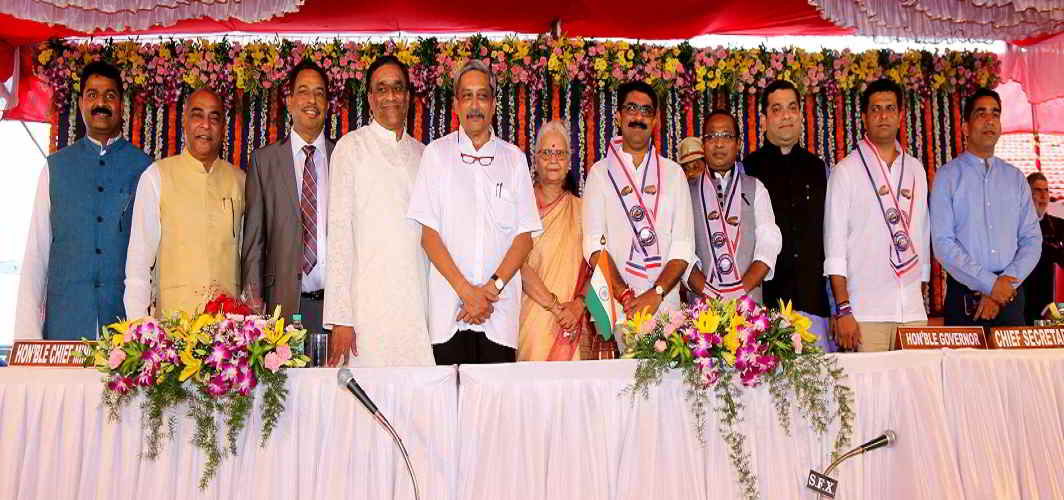
BACK IN OFFICE: Parrikar with the governor and his own ministers

[vc_row][vc_column][vc_column_text]But the smaller parties to have supported the BJP have extracted their pound of flesh in the form of plum cabinet posts 

By Sujit Bhar

Manohar Parrikar won the floor test with 22 MLAs paraded on March 16 and is now the legitimate chief minister of Goa. The Congress, for all practical purposes, sat dejected, having virtually given up hope.

This is the age of expecting the unexpected and then getting it. Parrikar headed a BJP jamboree to 13 seats in the recent assembly elections, while the Congress was the largest party on show with 17 in the 40-seat assembly.

It was natural and expected that the governor would call the Congress first to form government. It was also expected that it would be a cakewalk for the Congress to seek out four more MLAs to support them and take then to the magic figure of 21.

The unexpected happened, both times. Governor Mridula Sinha returned the call of Parrikar and BJP, while waiting for the Congress to show up, quickly installed the former defence minister as the chief minister. She seemingly was satisfied with the BJP’s claim to strength.

Technically the Congress was to blame. It failed to even present its case to governor. In the heated atmosphere of Goa, and with 131 years of rigorous political experience to fall back on, the Congress sat on its hands. The BJP did not. By nightfall on March 11 (the day election results were announced), it has sewn up alliances that would see them through any test.

It was not clear what the Congress was doing, but the rumour is that it was trying to settle internal disputes as to who would be the boss. Digvijay Singh, Congress’ boss-man responsible for Goa, was totally lost. Now he has to listen to a sarcastic jab from Parrikar, who commented after the floor test: “That’s what happens if you come to Goa for a holiday.”
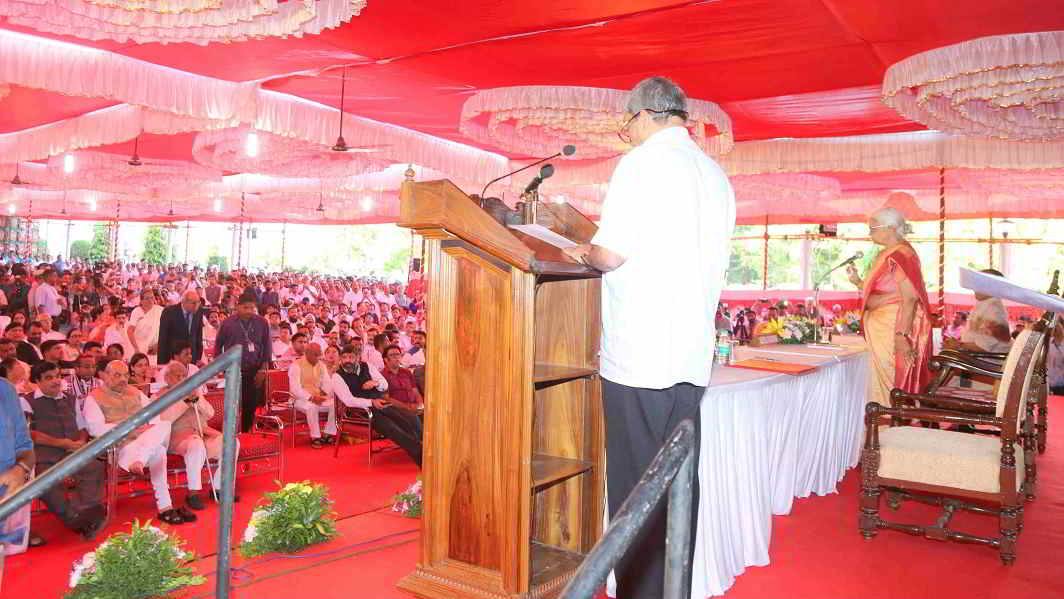
CM ONCE MORE: Parrikar takes oath of office

CM ONCE MORE: Parrikar takes oath of office

The Congress had huffed and puffed its way to the Supreme Court on the issue of the governor calling Parrikar and neglecting Congress. The Supreme Court is on vacation, but considering the seriousness of the issue, Chief Justice JS Khehar quickly formed a three-judge bench and heard out Congress counsel Abhishek Manu Singhvi.

Singhvi had later said sarcastically: “Let Parrikar be a do-din ka Sultan if he wants to be.” Actually, the joke was on Singhvi and the Congress. The Supreme Court had openly rebuked the Congress, with Justice Khehar saying: “You saw them saying they have the majority. But you never said you have the majority nor have you mentioned in this petition. You have not brought the affidavits of these people who are with you. You failed to show that the people who are mentioned in their list are with you.” 
The court added: “If you had the numbers, you would have held a dharna at the Governor’s house.”

When Singhvi cried “It’s constitutionally and legally wrong,” Justice Gogoi gave him a lesson in realpolitik. : “Healthy constitutional practice should be followed, not the just the convention of calling the largest party.”

FLOOR TEST

The body language of the Congress on the morning of March 16 was one of despondency. They seemed to have given up trying. It was soon clear that the smaller parties to have supported the BJP—three independents, the Goa Forward Party (GFP, 3) and Maharashtrawadi Gomantak Party (MGP, 3)—have extracted their pound of flesh in the form of plum cabinet posts.

The problem was that Parrikar is a local man, a former high-powered cabinet minister and close to Prime Minster Narendra Modi. What chance did the Congress—whose leader Rahul Gandhi himself is in the dock for huge losses—have against such an opponent?

The bigger problem for the Congress will be the new legislators who are frustrated and have said so. Will the flock stay with leaders who live in Delhi? Congress’ demand for the pro-tem speaker’s post also failed to cut ice.[/vc_column_text][/vc_column][/vc_row]

India News

PM Modi takes aim at critics with Dimagi Naxal remark at SRCC centenary address

PM Modi revived his dimagi Naxal remark at SRCC’s centenary celebrations and spoke about India’s development journey.

Published

on

PM Modi

Prime Minister Narendra Modi revived his ‘dimagi Naxal’ remark while addressing the centenary celebrations of Shri Ram College of Commerce (SRCC) in Delhi on Saturday, using the term to criticise his opponents.

Speaking to students at the Delhi college, PM Modi described the phrase as a “homeopathic pill” and said it had prompted those he described as “dimagi Naxals” to come forward and reveal their views.

The prime minister also used his address to speak to Gen-Z about India’s development journey and asked students to consider the challenges the country had faced in the past.

PM Modi recalls past crises

During his speech, PM Modi referred to the 2013 Kedarnath disaster and the 2008 global financial crisis while criticising the handling of national emergencies by previous governments.

He said the government at the time of the Kedarnath disaster was shaken and questioned its ability to respond to the crisis.

Referring to the 2008 banking crisis, PM Modi alleged that the government of the time failed to effectively deal with the situation and claimed that India’s banking system was pushed close to collapse.

Prime minister lists challenges faced by his government

PM Modi also highlighted several major global crises that occurred during his government’s tenure.

He mentioned the COVID-19 pandemic, the Russia-Ukraine war, disruptions to global trade and supply chains, and the crisis in West Asia.

The prime minister said there had been concerns that India would struggle during these crises but argued that the country had continued to move forward.

PM Modi’s earlier SRCC visit

PM Modi had earlier visited SRCC in 2013, when he was the chief minister of Gujarat. His speech at the college received significant attention, particularly on social media, ahead of the 2014 Lok Sabha election.

His latest visit came during the college’s centenary celebrations, where his address focused on young people, India’s development ambitions and the challenges faced by the country.

Continue Reading

India News

India Metro Rail Network May Overtake US in 2 Years

India’s metro rail network has reached 1,170 km across 26 cities. Union minister Manohar Lal said the country could overtake the US in network length within two years.

Published

on

Manohar Lal Khattar

India is on track to become the country with the second-largest metro rail network in the world after China, with Union Minister Manohar Lal saying the country could overtake the United States within the next two years.

India’s metro rail network has now expanded to 1,170 km across 26 cities. The network is only 216 km shorter than the US metro rail network, which stands at 1,386 km, according to figures cited by the minister.

India’s metro network expands rapidly

Speaking after the inauguration of an extended metro service in Indore, Manohar Lal highlighted the pace at which metro connectivity has grown in India.

He said metro services were operational across just 245 km in five cities when Prime Minister Narendra Modi assumed office in 2014. The network has since expanded to 1,170 km across 26 cities.

The minister said India could overtake the US in terms of metro rail network length in the next two years and become the world’s second-largest country in this segment after China.

China currently has around 8,000 km of metro rail lines, according to the figures cited by the minister.

Indore metro extension inaugurated

The minister made the remarks after inaugurating an extended section of the Indore metro. The project was built at a cost of around Rs 2,850 crore.

The Indore metro was earlier operating commercially on a six-km stretch between Gandhi Nagar and Super Corridor-3 stations. Following the extension, the service will operate on a 17-km route between Gandhi Nagar and Malviya Nagar Chauraha.

Madhya Pradesh Chief Minister Mohan Yadav said the metro service would mark a new phase in Indore’s development. He also said the network would eventually be extended to Ujjain and other nearby areas.

India’s metro rail network: Key figures

  • India currently has 1,170 km of operational metro rail network.
  • Metro services are operational across 26 cities.
  • The US has around 1,386 km of metro rail network.
  • India is currently 216 km behind the US.
  • China has around 8,000 km of metro rail lines.
  • India’s operational network stood at 245 km across five cities in 2014.

Continue Reading

India News

PM Modi returns to SRCC after 13 years, revisits 2013 glass full speech

PM Narendra Modi returned to SRCC after 13 years for its centenary celebrations, revisiting themes from his landmark 2013 address.

Published

on

PM Narendra Modi

Prime Minister Narendra Modi returned to Delhi University’s Shri Ram College of Commerce (SRCC) on Saturday, 13 years after his previous visit to the institution as Gujarat chief minister. 

His latest visit came as SRCC marked its centenary celebrations. Modi’s 2013 address at the college had attracted significant attention as he spoke about India’s youth, governance and the country’s demographic potential.

In 2013, Modi was Gujarat chief minister and had not yet been named the BJP’s prime ministerial candidate. He returned to the same campus this year as Prime Minister, having completed 12 years as Prime Minister and serving his third consecutive term. 

What PM Modi said at SRCC in 2013

The 2013 lecture was titled Emerging Business Models in the Global Scenario. The address also covered governance and India’s young population.

He described India’s youth as a source of national strength rather than simply a group of new-age voters. He also highlighted India’s demographic advantage and argued that the country needed to make better use of its young population.

One of the notable moments from the speech involved a glass of water.  Modi contrasted the conventional descriptions of a glass as half full or half empty and said he viewed it as full, with half containing water and the other half air.

The speech also included his remarks on technology and young Indians. Referring to an anecdote from a visit to Taiwan, Modi used the phrase “mouse-charmers” to describe Indians using computers and suggested that young Indians had the ability to influence the world through technology.

‘Minimum government, maximum governance’

Modi’s 2013 address also touched on governance. He spoke about the role of government and the need for better governance.

He also spoke about India’s potential in the 21st century. 

Modi returns as PM for SRCC centenary

The September 5 visit coincided with Teachers’ Day and SRCC’s 100th anniversary. The Prime Minister’s Office had announced that Modi would participate in the college’s centenary celebrations and address the gathering. SRCC was established in 1926 by industrialist and philanthropist Sir Shri Ram.

Earlier this year, Modi also met the SRCC governing body at his residence in April in connection with the college’s centenary celebrations and released a commemorative postage stamp marking the occasion. 

The return to SRCC came 13 years after his 2013 appearance at the college, when he addressed students as Gujarat chief minister.

Continue Reading

Trending

© Copyright 2022 APNLIVE.com