English हिन्दी
Connect with us

India News

India becomes Major Defense Partner with U.S

Published

on

Modi and trump

[vc_row][vc_column][vc_column_text]Trump supports India’s Pak policy

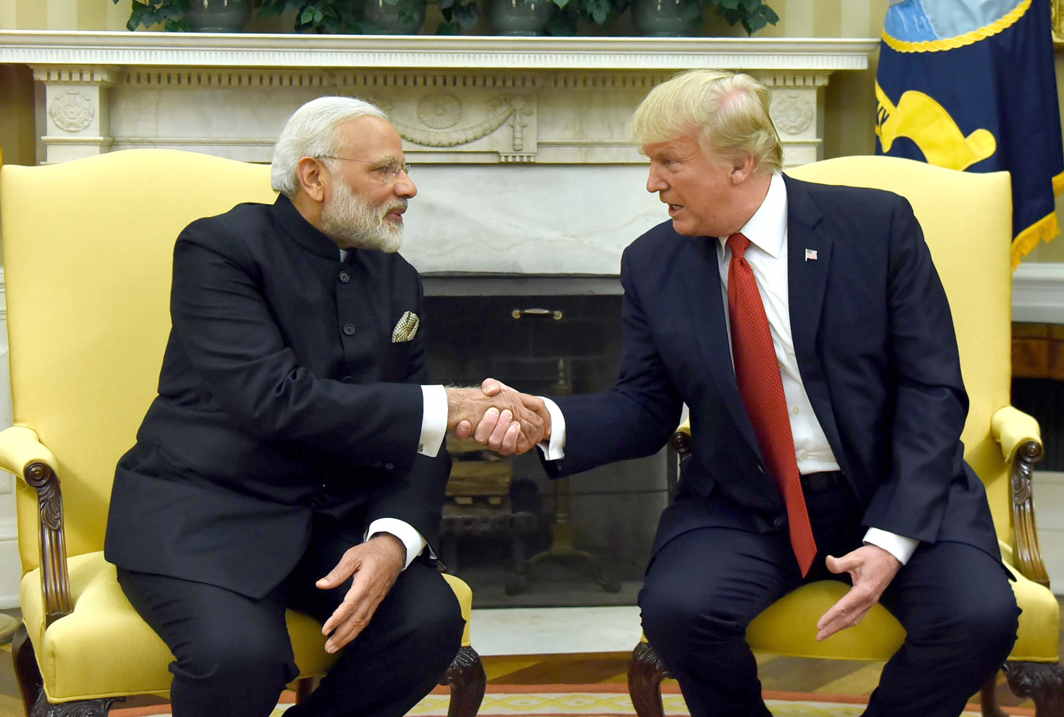
Prime Minister Narendra Modi and US President Donald Trump have resolved to expand and deepen strategic partnership and advance common objectives, especially combating terrorism, promoting stability across Indo-Pacific region, promoting free and fair trade and strengthening energy linkages.

Prime Minister, while briefing the media persons after his meeting with Donald Trump, said, “With regard to security related challenges, our enhanced and growing defense in security cooperation is extremely important. We have spoken at length on this subject as well. The strengthening of India’s defense capabilities with the help of USA is something that we truly appreciate. We have also decided to enhance maritime security cooperation.”

President Trump said that he “always had admiration of your country, people, culture, heritage and traditions”. He was also quoted as saying, “the relationship between India and the USA has never been stronger, better, both nations will always be together in friendship and respect”.

While speaking about the growing defense ties he said, “Our militaries are working every day to enhance cooperation between our military forces and next month they will join together with the Japanese navy to take part in the largest maritime exercise ever conducted in the vast Indian Ocean.”   

India also won Donald Trump administration’s approval for its Pakistan policy. The two leaders called on Pakistan to ensure that its territory should not be used to launch terrorist attacks on other countries (read India). Trump supported India’s demand that Pakistan should expeditiously bring to justice the perpetrators of the 26/11 Mumbai, Pathankot and other cross border terrorist attacks perpetrated by Pakistan based groups.

Both the leaders resolved to fight against terrorism, a global scourge, and strengthen cooperation against Al-Qaeda, ISIS, Jaishe-Mohammad, Lashkar-e-Tayyiba, D-Company and their affiliates. India appreciated US designation of Hizbul Mujahideen leader Syed Salahuddin as global terrorist.

The two countries also committed their support for bolstering regional economic connectivity through the transparent development of the infrastructure and the use of responsible debt financial practices and called upon the nations in the region to ensure respect for the sovereignty and territorial integrity, rule of law and the environment.

According to joint statement issued at the end of their meeting at White House, the two countries will provide strong leadership to address global challenges and build prosperity for their citizens. They committed to set common principles for the region according to which sovereignty and international law are respected.

For achieving the common goal, the two leaders reiterated the importance of respecting freedom of navigation, over flight and commerce throughout the region. They called upon nations to resolve territorial and maritime disputed peacefully and in accordance with the international law.

President Donald Trump appreciated India’s contribution to promote Afghanistan’s democracy, stability, prosperity and security. The two leaders committed to continue close consultations and cooperation in support of that country. They welcomed commencement of the exchange of information on known and suspected terrorists for travel screening.

In another major breakthrough US recognized India as a Major Defense Partner, while pledging deepening of defense and security cooperation and working together on advanced defense equipment and technology equal to that of “closest allies and partners” of the US.

US also cleared the sale of predator Guardian drones to India for two billion dollars, which is considered to be a force multiplier for the Indian Navy. “Reflecting the partnership, the US has offered for India’s consideration the sale of the Sea Guardian Unmanned Aerial Systems, which would enhance India’s capabilities and promote shared security interests,” the joint statement said. The drone can stay in the air for up to 27 hours and fly at maximum altitude of 50,000 feet.

In a separate statement at night, the White House, while referring to defense deals with India, said completion of these sales would increase bilateral defense trade to nearly 19 billion dollars, supporting thousands of US jobs. It further said that if selected, US offer to sell F-16 and F/A-18 fighter aircraft to India would represent the most significant defense cooperation between the US and India to date. [/vc_column_text][/vc_column][/vc_row]

India News

Amit Shah counters delimitation concerns, says southern states to gain Lok Sabha seats

Amit Shah assures Parliament that southern states will gain Lok Sabha seats after delimitation, countering opposition criticism during the women’s reservation debate.

Published

on

Amit Shah

Union Home Minister Amit Shah on Thursday addressed concerns over the proposed delimitation exercise, asserting in the Lok Sabha that southern states will not lose representation but instead see an increase in their number of seats.

His remarks came during a heated debate linked to the implementation of women’s reservation, where opposition parties have raised fears that population-based delimitation could reduce the political weight of southern states.

Shah rejected these claims, calling them misleading, and said the proposed framework ensures fairness while expanding the overall strength of the Lok Sabha.

Seat count to rise with expansion of Lok Sabha

The government has indicated that the total number of Lok Sabha seats could increase significantly as part of the delimitation process. In this expanded House, the combined representation of southern states is expected to rise from 129 seats at present to around 195 seats.

Shah emphasised that no state will lose seats in absolute terms, and the exercise is designed to reflect population changes while maintaining balance across regions.

State-wise projections shared in Parliament

During his address, Shah also provided indicative figures for individual southern states, suggesting notable increases in representation. According to the projections:

  • Tamil Nadu could see its seats rise substantially
  • Kerala, Telangana, and Andhra Pradesh are also expected to gain additional seats
  • Karnataka’s representation may increase as well

These figures were presented to counter the argument that delimitation would disproportionately favour northern states.

Political debate intensifies over linkage with women’s quota

The delimitation exercise has been closely linked to the rollout of women’s reservation, which proposes one-third seats for women in Parliament and state assemblies.

Opposition leaders have questioned this linkage, arguing that tying reservation to delimitation could delay its implementation and raise federal concerns. Some leaders have also warned that the move could impact national unity if apprehensions among states are not addressed.

The government, however, maintains that the reforms are necessary to ensure equitable representation and to align the electoral system with demographic realities.

Centre dismisses ‘false narrative’ on southern states

Shah reiterated that concerns about southern states losing influence are unfounded. He said the delimitation process will increase representation across regions and described the criticism as a “false narrative” aimed at creating confusion.

The issue is expected to remain a key flashpoint as Parliament continues discussions on the women’s reservation framework and related legislative changes.

Continue Reading

India News

PM Modi assures no discrimination in women’s quota, delimitation debate intensifies in Parliament

PM Narendra Modi has assured that women’s reservation will be implemented without discrimination, amid a heated debate over delimitation in Parliament.

Published

on

PM modi

Prime Minister Narendra Modi has assured that there will be no discrimination in the implementation of women’s reservation, as Parliament witnessed a sharp debate over the proposed linkage between the quota and delimitation exercise.

During the ongoing special session, the government reiterated its commitment to ensuring fair representation while addressing concerns raised by opposition parties regarding the timing and structure of the legislation.

The proposed framework aims to reserve 33 percent of seats for women in the Lok Sabha and state assemblies. However, its implementation is tied to a fresh delimitation exercise, which is expected after the next census.

Opposition questions timing and intent

Opposition leaders have raised concerns that linking the women’s quota to delimitation could delay its implementation. They argue that the process of redrawing constituencies may push the actual rollout further into the future.

The issue has triggered a broader political confrontation, with multiple parties questioning whether the move could alter representation across states.

Some critics have also alleged that the delimitation exercise could disproportionately benefit certain regions based on population, a charge the government has rejected.

Government reiterates commitment to fair implementation

Responding to these concerns, the Centre has maintained that the reforms are necessary to ensure accurate and updated representation based on population data.

Leaders from the ruling side have repeatedly emphasized that the process will be carried out transparently and without bias. The assurance that there will be “no discrimination” is aimed at addressing fears among states and opposition parties.

The debate marks a key moment in Parliament, with both sides engaging in intense exchanges over one of the most significant electoral reforms in recent years.

Continue Reading

India News

Give all tickets to Muslim women, Amit Shah says, attacking Akhilesh Yadav on sub-quota demand

A sharp exchange between Amit Shah and Akhilesh Yadav in Parliament over sub-quota for Muslim women highlights key divisions on women’s reservation implementation.

Published

on

A heated exchange broke out in Parliament during discussions on the women’s reservation framework, with Union Home Minister Amit Shah and Samajwadi Party chief Akhilesh Yadav locking horns over the demand for a sub-quota for Muslim women.

The debate unfolded as the government pushed forward key legislative measures to implement 33% reservation for women in the Lok Sabha and state assemblies.

Akhilesh Yadav argued that the proposed reservation must ensure representation for women from marginalised communities, including Other Backward Classes (OBCs) and Muslim women. He said that without such provisions, large sections could remain excluded from political participation.

He also questioned the timing of the bill, alleging that the Centre was avoiding a caste census. According to him, a census would lead to renewed demands for caste-based reservations, which the government is reluctant to address.

Government rejects religion-based quota

Responding to the demand, Amit Shah made it clear that reservation based on religion is not permitted under the Constitution.

He stated that any proposal to provide quota to Muslims on religious grounds would be unconstitutional, firmly rejecting the idea of a separate sub-quota for Muslim women within the broader reservation framework.

The government has maintained that the existing framework already includes provisions for Scheduled Castes (SC) and Scheduled Tribes (ST) women within the overall reservation structure.

Wider political divide over implementation

The issue of sub-categorisation within the women’s quota has emerged as a major flashpoint, even as most opposition parties broadly support the idea of women’s reservation.

Samajwadi Party leaders reiterated that their support for the bill depends on inclusion of OBC and minority women, while the government continues to defend its constitutional position.

The debate is part of a broader discussion during the special Parliament session, where multiple bills linked to delimitation and implementation of the women’s quota are being taken up.

Continue Reading

Trending

© Copyright 2022 APNLIVE.com