English हिन्दी
Connect with us

India News

JNU students intensify protest over mandatory attendance rule

Published

on

JNU students intensify protest over mandatory attendance rule

The demands of the protesting JNU students included the immediate withdrawal of the minimum attendance circular issued by the administration on February 9.

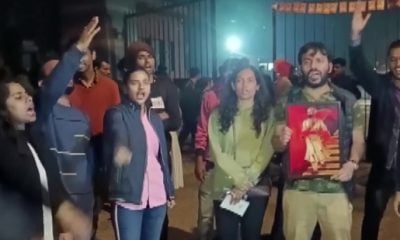
Demanding an immediate rollback of the new rule of minimum attendance issued by the JNU administrations, students of the Jawaharlal Nehru University (JNU) on Thursday intensified their protest at the university campus.

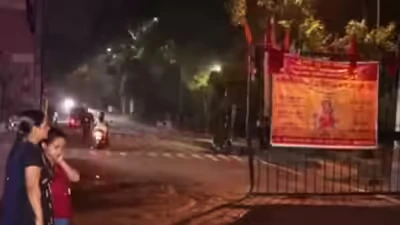
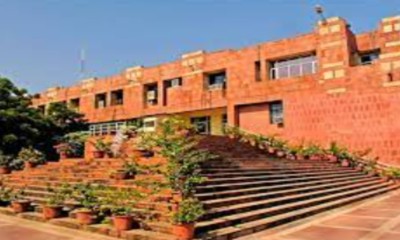
To protest against the new rule to make 75 percent attendance compulsory in an academic year to avail scholarships and fellowships, large number of students gathered outside the JNU administrative block to raise their demands with the JNU vice chancellor Jagadesh Kumar. Reportedly, students formed a human chain near the main entrance of the administration block and stopped Rectors Chintamani Mahapatra and Rana Pratap Singh and other staff members from leaving the building.

The demands of the protesting JNU students included the immediate withdrawal of the circular issued by the administration on February 9, which stated that the students might be denied of fellowship and debarred from examinations if they didn’t fulfill the minimum attendance requirement.

The students reportedly ramped up their protest after a meeting of the JNU academic council – which was scheduled to be held on February 23 – was postponed indefinitely.

However, claiming that the movement of any official on the campus was not restricted, JNU Students Union said in a statement, “Students have been peacefully waiting to meet JNU VC and raise questions about compulsory attendance.”

Further alleging that the administration is trying to evade dialogues, JNSU said, “All university officials freely moved into and out of administration building. No one was stopped and students have not blocked any entrances and are peacefully waiting to meet the VC. Ironically, JNU VC has taken to Twitter to say we are violating High Court judgment but has he forgotten that the same HC has asked him to meet the students and union and resolve the issues?”

Also claiming that the “compulsory attendance policy was never part of Academic Council agenda”, a JNU student said, “He (JNU VC) has threatened to take away hostels, cancel studentship, stop fellowships, which, for him to do, is illegal. This is clearly against JNU statutes. By threatening and not meeting students, the VC has forced students to come to the admin block to meet him and question him. However, he has been running away from meeting the students like he did from holding a declared academic council meeting.”

Reacting at the students protest at the university campus, Vice-Chancellor Jagdeesh Kumar, over a series of posts in Twitter said, “As you can see from my past tweets, JNU administration including the VC, regularly meets the students for their inputs. Students can meet with appointment or can meet every first Monday of the month in the afternoon without any appointment. Even after JNU administration has promised to meet the JNUSU officer bearers, see how they have mistreated and shouted at the two rectors. All this against the attendance in University? Shouldn’t such behaviour be condemned?”

“JNUSU led students have confined top officials of JNU in admin building since 11 AM. When they tried to go out of admin building, they were shouted at and forced to go back into the building. Unbecoming of students. Shouldn’t such behaviour be condemned? Taking the university to ransom by JNUSU led students and confining the top officials in admin building since morning is highly condemnable. Let us raise our voice against such unwelcome behaviour. You can see the pictures to realize how they are bent upon creating unrest in JNU,” he added.

Extending support to the students, the JNU Teachers Association in a statement released on Monday, said, “JNUTA has serious reservations regarding the new system of mandatory attendance. Procedural lapses that have taken place in implementation of the new rules were in contrast to the democratic decision making processes of the university. After the general body meeting, several Centres and Schools, in addition to JNUTA, have expressed their grievances. However, instead of taking cognizance of these reservations, the JNU Administration has repeatedly sought to impose its decisions through coercion. Therefore, JNUTA urges the JNU administration to immediately start a dialogue with students and teachers.”

India News

Congress, BJP attack Bhagwant Mann over remarks on Punjab blasts

Congress and BJP have jointly criticised Punjab CM Bhagwant Mann after he linked recent blasts near defence sites to political motives, triggering a controversy.

Published

on

Bhagwant Mann

A political row has erupted in Punjab after Chief Minister Bhagwant Mann linked recent blast incidents to political motives, drawing sharp criticism from both the Congress and the Bharatiya Janata Party (BJP).

The controversy follows two low-intensity explosions reported within a short span of time — one near the Border Security Force (BSF) headquarters in Jalandhar and another close to an army cantonment area in Amritsar. The incidents raised concerns over security, particularly given the sensitive nature of the locations.

In response, Mann suggested that the blasts could be part of a larger political strategy. His remarks triggered a strong backlash, with opposition parties accusing him of politicising a serious security issue.

Leaders from the Congress criticised the Chief Minister’s statement, calling it inappropriate and alleging that such comments undermine the gravity of the situation. They stressed that matters related to national security should be handled with caution and responsibility.

The BJP also joined the criticism, questioning the basis of Mann’s claims and urging the state government to focus on investigation and law enforcement instead of making political allegations.

The developments have led to an unusual moment where both Congress and BJP appear aligned in their criticism of the Aam Aadmi Party-led government in the state.

Meanwhile, the blasts themselves have intensified concerns over safety in border regions, with authorities continuing their investigation into the incidents. No casualties were reported, but the proximity to defence establishments has made the issue particularly sensitive.

The episode has further escalated political tensions in the state, with security and accountability emerging as key points of debate.

Continue Reading

India News

Himanta Biswa Sarma resigns as Assam chief minister, oath ceremony likely after May 11

Himanta Biswa Sarma resigns as Assam Chief Minister after BJP-led NDA’s victory. He will continue as caretaker CM until the new government is sworn in after May 11.

Published

on

Himanta sharma

Assam Chief Minister Himanta Biswa Sarma resigned from his post on Wednesday, paving the way for the formation of a new government after the BJP-led NDA secured a decisive victory in the 2026 Assembly elections.

Sarma submitted his resignation to Governor Lakshman Prasad Acharya at Lok Bhawan in Guwahati. The Governor accepted the resignation and asked him to continue as the caretaker Chief Minister until the new government takes charge.

The resignation comes after the NDA’s strong electoral performance, where the alliance won a clear majority in the 126-member Assembly, ensuring its return to power for another term.

Oath ceremony expected after May 11

Speaking to reporters after submitting his resignation, Sarma said the swearing-in ceremony for the new government is likely to be held after May 11.

He indicated that Prime Minister Narendra Modi has been invited to attend the ceremony but is unavailable until May 11, which has influenced the tentative schedule.

Decision on next chief minister soon

Sources suggest that central observers, including senior BJP leaders, are expected to arrive shortly to oversee the selection of the legislature party leader. The newly elected MLAs will then decide on the next Chief Minister.

Despite the formal resignation, party sources indicate that Sarma is likely to continue in the role for another term, given the BJP’s strong mandate in the state.

The move marks the beginning of the government formation process in Assam following the election results declared earlier this week.

Continue Reading

India News

Rahul Gandhi and Vijay alliance took shape through backchannel talks, early signals from Congress leaders

Congress outreach and political calculations led to Rahul Gandhi and Vijay coming together after the Tamil Nadu 2026 election results.

Published

on

The coming together of Rahul Gandhi and actor-politician Vijay in Tamil Nadu after the 2026 Assembly elections was not sudden, but the result of behind-the-scenes political manoeuvring and early signals within the Congress.

According to media reports, some leaders in the Tamil Nadu Congress had already sensed the scale of Vijay’s surge during the campaign, anticipating what was later described as a “wave” in favour of his party.

After the results, where Vijay’s Tamilaga Vettri Kazhagam (TVK) emerged as the single largest party but fell short of a majority, communication channels between the Congress leadership and Vijay quickly became active.

A key moment in this evolving political equation was a phone call from Rahul Gandhi to Vijay, congratulating him on the party’s strong performance. The conversation was seen as more than a courtesy, signalling the possibility of cooperation at a time when government formation required additional support.

Reports indicate that discussions within Congress weighed the political benefits of supporting Vijay, especially given the shifting dynamics in the state where traditional dominance by major Dravidian parties has been challenged.

With TVK needing allies to cross the majority mark, Congress emerged as a potential partner, leading to a broader political realignment in the state. This development also triggered tensions within opposition alliances, highlighting the strategic importance of the decision.

The evolving partnership reflects a mix of electoral pragmatism and changing voter sentiment, particularly the growing influence of younger voters, which leaders acknowledged as a key factor in the election outcome.

Continue Reading

Trending

© Copyright 2022 APNLIVE.com