English हिन्दी
Connect with us

India News

Kerala win win w-649 lottery result 2022: First prize Rs 75 lakh | Here’s how to claim prize money

On Monday, January 3, the Kerala state lottery department has started announcing the results for Win-Win W-649. The lucky draw is being held at Gorky Bhavan, near Bakery Junction in Thiruvananthapuram. 

Published

on

kerala lottery result

On Monday, January 3, the Kerala state lottery department has started announcing the results for Win-Win W-649. The lucky draw is being held at Gorky Bhavan, near Bakery Junction in Thiruvananthapuram. The draw is overseen by a panel of independent judges. WZ 169230 has been selected as the winner of the first prize of Rs 75 lakh.

THE WINNING NUMBER FOR 1ST PRIZE OF RS 75 LAKH IS: WZ 169230

THE WINNING NUMBER FOR 2ND PRIZE OF RS 5 LAKH IS: WW 130200

WINNING NUMBERS FOR 3RD PRIZE OF RS 1 LAKH ARE:

WN 528981 WO 372461

WP 484419 WR 635577

WS 927083 WT 702195

WU 649512 WV 343170

WW 779236 WX 748573

WY 857283 WZ 776200

WINNING NUMBERS FOR CONSOLATION PRIZE OF RS 8,000 ARE:

WN 169230 WO 169230

WP 169230 WR 169230

WS 169230 WT 169230

WU 169230 WV 169230

WW 169230 WX 169230

WY 169230

WINNING NUMBERS FOR 4TH PRIZE OF RS 5,000 ARE:

1246 1342 1872

2247 3157 3217

3291 4000 4752

6185 6380 6456

6940 8410 8747

8770 9079 9462

WINNING NUMBERS FOR 5TH PRIZE OF RS 2,000 ARE:

0637 0849 1701

2360 4557 6349

6848 7514 9054

9944

WINNING NUMBERS FOR 6TH PRIZE OF RS 1,000 ARE:

0005 0129 1227

2161 2904 4169

4684 5926 6376

6499 7184 7450

7529 8465

WINNING NUMBERS FOR 7TH PRIZE OF RS 500 ARE:

0022 0173 0244

0456 0589 0691

0946 1036 1084

1117 1138 1152

1175 1224 1229

1272 1455 1538

1639 1686 2223

2610 2807 2902

2909 3192 3220

3315 3638 3827

3833 3947 3982

4052 4216 4240

4250 4420 4421

4463 4741 4944

5072 5203 5264

5464 5581 5867

5868 5994 6084

6094 6209 6254

6311 6357 6362

6459 6555 6793

6815 6845 7256

7309 7353 7415

7480 7548 7758

7776 7805 7826

8099 8593 8929

9293 9342 9402

9430 9530 9936

9962

WINNING NUMBERS FOR 8TH PRIZE OF RS 100 ARE:

1011 6266 7373 7286

4568 9056 7836 0168

9580 1365 3543 1644

0076 8849 0536 2633

8459 9651 3091 2757

4156 8820 0980 8458

7922 6749 6460 9436

8408 3560 7355 4565

7467 3559 1547 9323

7283 0889 2423 7235

0034 2823 6707 0512

1761 5428 0696 0619

1549 7749 2887 7616

0357 0954 5846 3828

9167 4991 9784 1391

0155 6025 4260 5415

1358 7559 7778 8322

8397 5578 4033 6558

5579 4019 1073 3563

2637 2580 8940 2146

6889 9416 1243 3024

8296 6213 5409 0675

2569

How to check Kerala Win-Win W-649 result 2022?

Participants in Win-Win W-649 can also check their results by checking the Kerala Lottery Department’s official website,  keralalotteryresult.net. These results are also published in the Kerala Government Gazette in addition to the website.

Candidates who are interested can participate in the lottery by purchasing tickets from any Taluk lottery office in the state, which cost Rs 40 each. Punalur (Kollam district), Kattappana (Idukki district), and Thamarassery (Thamarassery district) are among Kerala’s three lottery offices (Kozhikode district).

Here’s how to claim prize money?

Read Also: Covid-19 tracker: India reports 33,750 cases, 123 deaths in last 24 hours, Omicron tally reaches to 1,700 | Check state-wise list

  • Winners of the Win-Win W-649 lucky draw must check the Kerala lottery results published in the Kerala Government Gazette to verify their winning tickets.
  • They must report to the Kerala lottery office in Thiruvananthapuram with their tickets and identification proof within 30 days if they find their ticket number in the published gazette.
  • The verification process should be completed within 30 days of the results being announced.
  • Those who have won a prize of less than Rs 5,000 can claim it at any lottery shop in Kerala.
  • Those who have won more than Rs 5,000 must present their tickets to a bank or government lottery office with identification proofs in order to make a claim.

India News

India Metro Rail Network May Overtake US in 2 Years

India’s metro rail network has reached 1,170 km across 26 cities. Union minister Manohar Lal said the country could overtake the US in network length within two years.

Published

on

Manohar Lal Khattar

India is on track to become the country with the second-largest metro rail network in the world after China, with Union Minister Manohar Lal saying the country could overtake the United States within the next two years.

India’s metro rail network has now expanded to 1,170 km across 26 cities. The network is only 216 km shorter than the US metro rail network, which stands at 1,386 km, according to figures cited by the minister.

India’s metro network expands rapidly

Speaking after the inauguration of an extended metro service in Indore, Manohar Lal highlighted the pace at which metro connectivity has grown in India.

He said metro services were operational across just 245 km in five cities when Prime Minister Narendra Modi assumed office in 2014. The network has since expanded to 1,170 km across 26 cities.

The minister said India could overtake the US in terms of metro rail network length in the next two years and become the world’s second-largest country in this segment after China.

China currently has around 8,000 km of metro rail lines, according to the figures cited by the minister.

Indore metro extension inaugurated

The minister made the remarks after inaugurating an extended section of the Indore metro. The project was built at a cost of around Rs 2,850 crore.

The Indore metro was earlier operating commercially on a six-km stretch between Gandhi Nagar and Super Corridor-3 stations. Following the extension, the service will operate on a 17-km route between Gandhi Nagar and Malviya Nagar Chauraha.

Madhya Pradesh Chief Minister Mohan Yadav said the metro service would mark a new phase in Indore’s development. He also said the network would eventually be extended to Ujjain and other nearby areas.

India’s metro rail network: Key figures

  • India currently has 1,170 km of operational metro rail network.
  • Metro services are operational across 26 cities.
  • The US has around 1,386 km of metro rail network.
  • India is currently 216 km behind the US.
  • China has around 8,000 km of metro rail lines.
  • India’s operational network stood at 245 km across five cities in 2014.

Continue Reading

India News

PM Modi returns to SRCC after 13 years, revisits 2013 glass full speech

PM Narendra Modi returned to SRCC after 13 years for its centenary celebrations, revisiting themes from his landmark 2013 address.

Published

on

PM Narendra Modi

Prime Minister Narendra Modi returned to Delhi University’s Shri Ram College of Commerce (SRCC) on Saturday, 13 years after his previous visit to the institution as Gujarat chief minister. 

His latest visit came as SRCC marked its centenary celebrations. Modi’s 2013 address at the college had attracted significant attention as he spoke about India’s youth, governance and the country’s demographic potential.

In 2013, Modi was Gujarat chief minister and had not yet been named the BJP’s prime ministerial candidate. He returned to the same campus this year as Prime Minister, having completed 12 years as Prime Minister and serving his third consecutive term. 

What PM Modi said at SRCC in 2013

The 2013 lecture was titled Emerging Business Models in the Global Scenario. The address also covered governance and India’s young population.

He described India’s youth as a source of national strength rather than simply a group of new-age voters. He also highlighted India’s demographic advantage and argued that the country needed to make better use of its young population.

One of the notable moments from the speech involved a glass of water.  Modi contrasted the conventional descriptions of a glass as half full or half empty and said he viewed it as full, with half containing water and the other half air.

The speech also included his remarks on technology and young Indians. Referring to an anecdote from a visit to Taiwan, Modi used the phrase “mouse-charmers” to describe Indians using computers and suggested that young Indians had the ability to influence the world through technology.

‘Minimum government, maximum governance’

Modi’s 2013 address also touched on governance. He spoke about the role of government and the need for better governance.

He also spoke about India’s potential in the 21st century. 

Modi returns as PM for SRCC centenary

The September 5 visit coincided with Teachers’ Day and SRCC’s 100th anniversary. The Prime Minister’s Office had announced that Modi would participate in the college’s centenary celebrations and address the gathering. SRCC was established in 1926 by industrialist and philanthropist Sir Shri Ram.

Earlier this year, Modi also met the SRCC governing body at his residence in April in connection with the college’s centenary celebrations and released a commemorative postage stamp marking the occasion. 

The return to SRCC came 13 years after his 2013 appearance at the college, when he addressed students as Gujarat chief minister.

Continue Reading

India News

Supreme Court judge calls police assault on CJP protesters very distressing

Supreme Court judge Justice Ujjal Bhuyan criticised alleged police assaults on CJP protesters and raised concerns over excessive force.

Published

on

Supreme Court

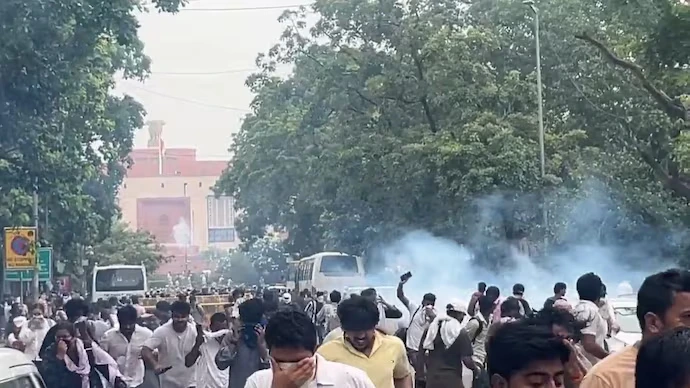
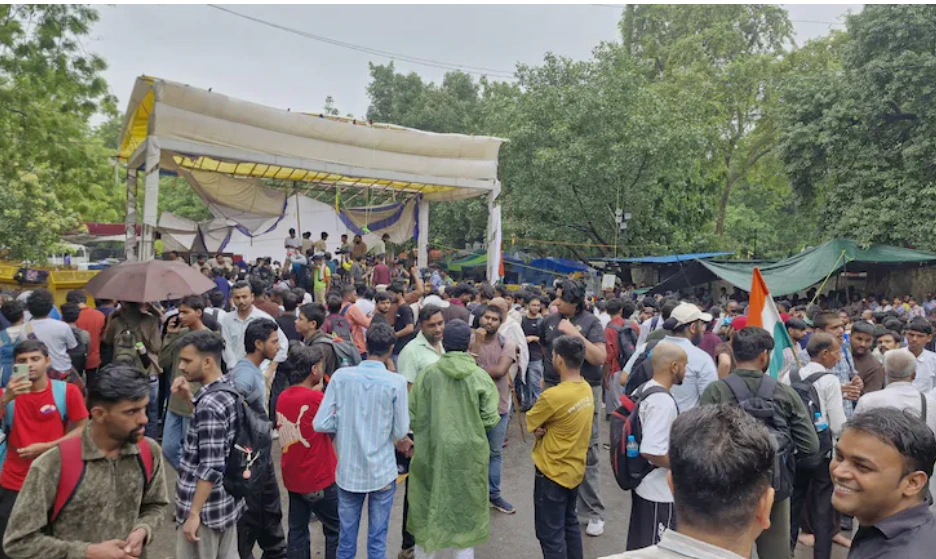
Supreme Court judge Justice Ujjal Bhuyan has criticised the assault of protesters by police personnel during the recent CJP demonstrations in Delhi, describing the conduct as “very, very distressing” and a matter of serious concern.

Speaking at the launch of retired IPS officer Yashovardhan Azad’s book Policing the Republic, Justice Bhuyan said the detachment expected from police officers appeared to be diminishing.

He expressed concern over young Indian Police Service officers personally participating in the assault of protesters and demonstrators.

Justice Bhuyan stresses need for responsible policing

Justice Bhuyan said effective policing does not require excessive use of force or infringement of human rights. He emphasised that the police play an important role in maintaining public confidence because citizens generally approach the police when they feel they have been wronged.

He said maintaining the credibility of the police force was therefore of “utmost importance”.

The judge’s remarks come amid continuing scrutiny of the police and paramilitary response to the CJP protests in Delhi.

Supreme Court panel to examine police action

The Supreme Court has constituted a high-level panel to investigate allegations concerning the use of force by Delhi Police during the July 20 student protests at Jantar Mantar and the subsequent Parliament march.

The panel, headed by former Supreme Court judge Justice R Subhash Reddy, will examine complaints relating to lathi charges, tear gas, pellet guns and electronic batons. It will also look into allegations of targeted harassment or molestation of female protesters and review available CCTV and video footage.

The police response during the protests has faced criticism, while Delhi Police has maintained that its personnel were also attacked during the clashes.

Judge raises concern over custodial deaths and torture

Justice Bhuyan also spoke about custodial torture and deaths, describing custodial death as one of the gravest crimes in a society governed by the rule of law.

He stressed that torture and cruel, inhuman or degrading treatment cannot be accepted, regardless of whether such conduct takes place during investigation, interrogation or other circumstances.

The judge further warned that when government functionaries themselves become lawbreakers, it can undermine respect for the law and encourage lawlessness.

He questioned whether citizens lose their fundamental rights simply because they have been arrested by police.

‘Fake encounters’ cannot be part of policing

Justice Bhuyan also addressed allegations of extra-judicial killings, commonly referred to as “fake encounters”. Referring to a 2011 Supreme Court judgment, he said such encounters undermine the rule of law.

He stressed that an “encounter philosophy” cannot become part of legitimate policing and said proven fake encounters involving serving police officers must be treated with the utmost seriousness.

The Supreme Court’s panel will now examine the allegations surrounding the police action during the July 20 protests as scrutiny of the events continues.

Continue Reading

Trending

© Copyright 2022 APNLIVE.com