English हिन्दी
Connect with us

India News

Local court acquits Mukhtar Ansari of murder charge for lack of evidence

Published

on

Local court acquits Mukhtar Ansari of murder charge for lack of evidence
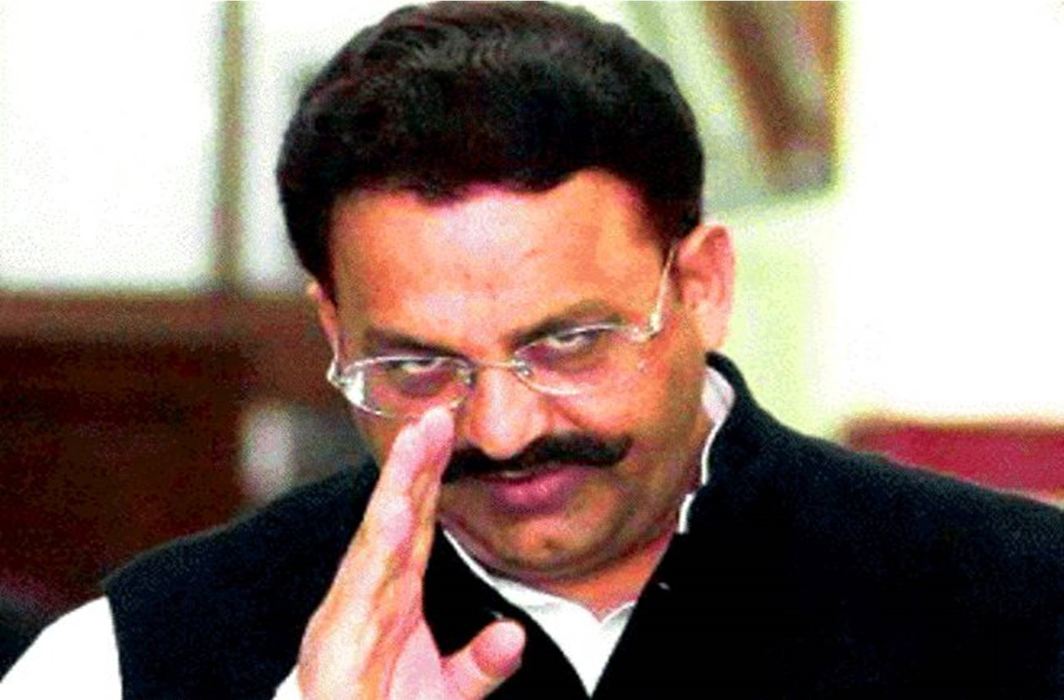
[vc_row][vc_column][vc_column_text]Police failed to prove how the mafia don-turned politician executed the double murder from his prison cell; Ansari remains in jail with other cases pending

Bahujan Samaj Party (BSP) MLA Mukhtar Ansari, the mafia don-turned politician who has been elected five times from the Mau Sadar seat of Uttar Pradesh and was lodged in the Banda district jail for a double murder in the City Kotwali police station area of Mau on August 29, 2009, was on Wednesday (September 27) acquitted by a local court. Acquitted along with him were seven others, though the court convicted three others to life.

Mukhtar Ansari’s counsel Daroga Singh has been quoted in the media as saying: “Additional district judge Adil Aftab Ahmad acquitted Mukhtar Ansari and seven others in the double murder case for lack of evidence. The court, however, sentenced three others Raju Kannojia, Amresh Kannojia and Arvind Yadav to life imprisonment.”

Lack of evidence is the most common reason for acquittals of political leaders who are also mafia dons. While the charge was that Ansari was an accomplice to the crime, virtually masterminding it, it was also true that at that time he was lodged in jail. The police failed to prove his complicity in the crime and the court had to let Ansari go.

On that day in 2009 armed men attacked contractor Manna Singh who was travelling with an associate in his SUV. In the shooting Manna Singh died on the spot, while his associate Rajesh Rai succumbed later to bullet injuries.

The charge, as filed by Manna Singh’s cousin Harinder Singh, said that Ansari had him killed, because Manna Singh refused to give him his commission.

Ansari, however, will remain in jail despite the acquittal, because he has other cases pending against him.

Ansari had also been the prime accused in the 2005 murder of BJP politician Krishnanand Rai. That has also not been proved, though at that time the SIT had pre-warned Rai of an impending attack.

Politically, Ansari has been an opportunist. Ansari won his first Assembly election as a candidate of Mayawati’s Bahujan Samaj Party (BSP), while the next two as an independent. In 2007 he joined BSP but lost the 2009 Lok Sabha election. The BSP expelled him in 2010 for criminal activities, but Ansari formed his own Quami Ekta Dal and won from the Mau seat in 2012. He tried to merge his party with the Bahijan Samaj Party before the 2017 polls at Shivpal Yadav’s behest, but with the then chief minister Akhilesh Yadav protesting that was not possible.

Meanwhile Mayawati, who had expelled Ansari earlier for criminal activities, suddenly saw another alliance come her way and immediately exonerated Asnsari and admitted his party into hers. While the BSP got a hammering at the polls, Ansari won his seat as a BSP candidate.[/vc_column_text][/vc_column][/vc_row]

India News

PM Modi urges shift to alternative energy and fuel austerity amid Middle East crisis

In response to severe energy and supply chain strains caused by the ongoing war in West Asia, Prime Minister Narendra Modi has ordered an intensive push toward alternative energy sources while urging the public to cut down on fuel consumption.

Published

on

As the escalating conflict in West Asia continues to disrupt international supply chains and impact global markets, Prime Minister Narendra Modi has urged senior ministers and citizens to aggressively explore alternative energy sources and adopt conservation practices. Chaired by the Prime Minister, a high-level meeting of the Cabinet Committee on Security (CCS) evaluated the short, medium, and long-term economic and strategic implications of the ongoing Middle East war involving the US, Israel, and Iran.

The government’s primary focus remains on safeguarding citizens from the economic shockwaves of the conflict, which has heavily strained global petroleum, power, and fertiliser sectors. Media reports indicate that the blockade of critical trade lifelines like the Strait of Hormuz has sent oil marketing companies into severe daily revenue losses to keep domestic prices regulated, prompting a nationwide call for energy self-reliance and behavioral transformation.

High-Level review targeting energy security and supply stabilization

During the top-tier strategy session, the Prime Minister reviewed the immediate and prolonged steps required to guarantee uninterrupted supplies of essential commodities. Senior cabinet members—including the ministers of finance, external affairs, petroleum, and defense—assessed India’s overall preparedness.

“Chaired a meeting of the CCS to review the mitigating measures in the wake of the ongoing conflict in West Asia,” the Prime Minister stated in a digital update. He added that discussions heavily emphasized diversifying import sources for key industrial segments, boosting domestic distribution logistics, and establishing a robust shield against international market volatility.

The continuous monitoring of geopolitical developments is aimed at protecting both public consumption interests and large-scale industrial requirements.

A call for public fuel conservation and alternative energy

Addressing the wider public, the Prime Minister described the current global context as a challenging period that demands unified national resilience. He appealed to the citizens of the country to voluntarily cut back on petrol and diesel consumption, highlighting fuel austerity as a national responsibility to conserve precious foreign exchange reserves.

Suggested measures echo the structural adaptations utilized during the pandemic, including encouraging carpooling, optimizing the use of public urban metro systems, and transitioning back to remote work, virtual meetings, and online conferences where applicable.

Simultaneously, the administration is pressing forward with structural energy sector upgrades. Efforts are being channeled into accelerating non-fossil fuel power generation, advancing battery energy storage systems, and scaling up strategic petroleum reserves to ensure that India remains insulated from future external maritime and geopolitical chokepoints.

Continue Reading

India News

Punjab espionage ring exposed as Pathankot man arrested for transmitting army movements to Pakistan

A major espionage module has been uncovered in Punjab’s Pathankot. Police arrested Baljit Singh for installing an internet-linked CCTV camera on National.

Published

on

In a significant development for national security, the police in Punjab’s Pathankot have dismantled a suspected cross-border spying network. A local resident has been taken into custody for allegedly sharing highly sensitive details regarding the movements of the Indian Army and various paramilitary units with handlers based in Pakistan.

The suspect, identified as Baljit Singh (also known as Bittu), belongs to Chakk Dhariwal village. According to senior police officials, Singh had strategically set up an internet-linked closed-circuit television (CCTV) camera at a shop situated near a bridge on the crucial Pathankot-Jammu stretch of National Highway-44. This setup allowed him to monitor and track the logistical movements of defense and paramilitary forces along the corridor.

Surveillance feed routed internationally

Senior Superintendent of Police, Daljinder Singh Dhillon, confirmed that the live digital surveillance feed from this highway camera was being routed electronically to operatives located in Pakistan as well as other international destinations.

During his interrogation, the accused admitted to installing the internet-enabled camera at a roadside shop near Sujanpur earlier this year in January. He further disclosed that he was receiving instructions from an unidentified handler operating out of Dubai, who had initially transferred a sum of Rs 40,000 to him for executing the task. Following his arrest, security personnel recovered the CCTV unit along with the accompanying Wi-Fi internet router used to transmit the data.

Multiple suspects booked as investigation widens

The breakthrough came after intelligence inputs pointed toward highly suspicious activities along the crucial highway stretch. Acting on the information, the Sujanpur police registered a formal case involving four individuals. Alongside Baljit Singh, the case names Vikramjit Singh (alias Vikka), Balwinder Singh (alias Vicky), and Taranpreet Singh (alias Tannu). Media reported that law enforcement considers the accused to be actively involved in anti-national and illicit networks.

A comprehensive dossier detailing the security breach has been forwarded to high-ranking federal and state authorities. Law enforcement teams are currently conducting extensive raids across the region to apprehend the remaining co-conspirators who are on the run. Meanwhile, an in-depth investigation is underway to fully trace the financial trails and chart out the wider cross-border connections underlying this spy module.

Continue Reading

India News

Cockroach Janata Party X handle withheld in India, founder launches new digital platform

The satirical digital campaign, Cockroach Janata Party, saw its official X handle withheld in India following a legal demand, prompting its founder to immediately launch a new alternative profile.

Published

on

The official X (formerly Twitter) account of the Cockroach Janata Party (CJP), a satirical digital movement that took social media by storm, was withheld in India on Thursday. According to the microblogging platform, the profile was restricted “in response to a legal demand.”

Responding to the development, the platform’s founder, Abhijeet Dipke, launched a new alternative handle on X within hours, titled ‘Cockroach is Back’, using the tagline ‘Cockroaches Don’t Die’.

Sparked by controversial remarks

The online campaign emerged on May 16, 2026, as a satirical response to an oral observation made by Chief Justice of India Surya Kant during a Supreme Court hearing a day prior. The Chief Justice had reportedly compared unemployed youth to “cockroaches” and “parasites of society,” criticizing those who enter activism or media spaces to attack institutions. Although the Chief Justice later issued a strongly worded clarification stating his comments were misquoted and targeted individuals using fake and bogus professional degrees, the remark had already triggered a massive viral movement online.

The satirical group quickly grew a substantial presence across various social media platforms. Before being withheld, the original X handle had acquired over 201,000 followers, attracting support from digital users, activists, and politicians alike.

Founder calls action a ‘self-goal’

Abhijeet Dipke, a 30-year-old political communication strategist who founded the movement, expressed little surprise over the restriction. Dipke stated that hacking attempts had been observed on their profiles prior to the restriction.

“This action was expected since there were attempts to hack the account yesterday. But this is a self-goal by the government,” Dipke told media. He further alleged that the rapid growth of the handle and the underlying movement might have caused apprehension within administrative circles. The group plans to pursue the matter through legal channels.

Despite the restriction on X within Indian jurisdiction, the movement’s Instagram account remains active, where it has reportedly accumulated significant digital traction. Meanwhile, the newly launched alternative X profile, ‘Cockroach is Back’, rapidly drew tens of thousands of followers within just a few hours of its creation.

Continue Reading

Trending

© Copyright 2022 APNLIVE.com