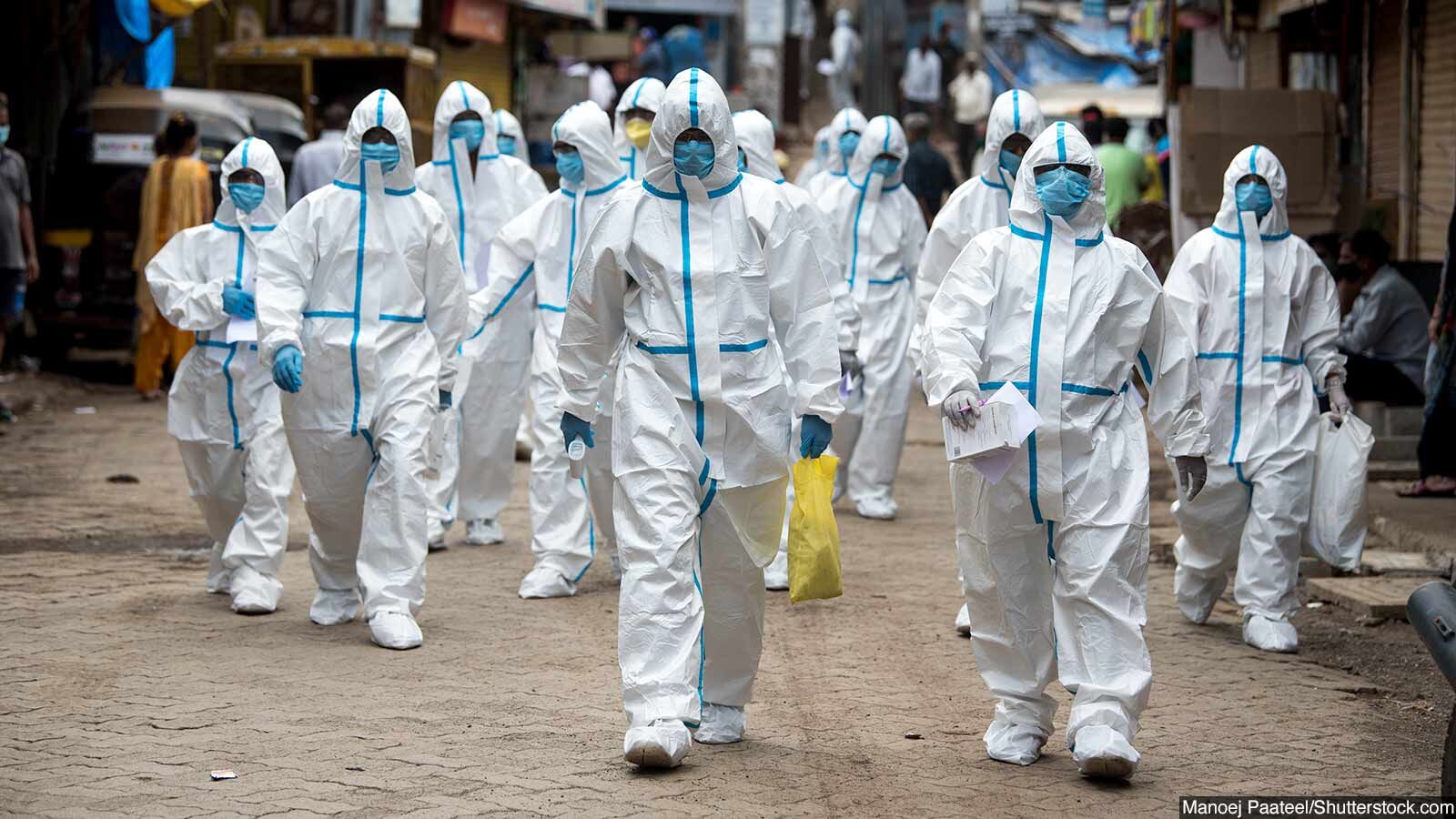
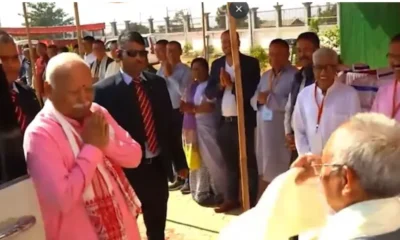
Boosting the medical oxygen infrastructure in the state, Manipur Chief Minister N Biren Singh on Monday inaugurated Pressure Swing Absorption (PSA) Oxygen Plants in three hill districts of Manipur at Chandel, Senapati and Ukhrul.
Addressing the public at Chandel district hospital, the Chief Minister said that the government would install Oxygen plants in all the districts of the state adding that each of the PSA plants inaugurated at Chandel, Senapati and Ukhrul districts would produce 1,000 litres of oxygen per minute (LPM) and around 200 D-type oxygen cylinders could be refilled daily at each PSA plant.
Later, the chief minister along with minister for Education S Rajen Singh, minister for Tribal Affairs and Hills Vungzagin Valte, officials among others went to Ukhrul and Senapati and dedicated the PSA Oxygen plants to the peoples.
During his visit to the districts, concerning the Covid-19 situation in the state, the Chief Minister urged people to overcome vaccine hesitancy and asked all eligible persons to get vaccinated as soon as possible. He maintained that early detection and timely treatment will save precious lives from the dreaded disease. He also urged the people to not believe in myths, rumours and misinformation on COVID-19 and its vaccine.
Agriculture Minister distributes urea fertilisers to the farmers
After the recent farmers protest rally over the non-availability of urea fertilizers, continuous efforts have been going on for massive distribution of fertilizers to farmers in the state.
The Agriculture department today distributed urea fertilisers to the farmers in different assembly constituencies of the state.
On Monday, Agriculture Minister Oinam Lukhoi Singh distributed the fertilizers to the farmer of Kumbi AC in Bishnupur District and expressed that the government fully acknowledged the concerns and grievances of farmers and their demands to receive the fertilisers during this Kharif season. He maintained that the department always strives to meet the requirements of farmers in the state.
Altogether, 1,695 bags of fertilisers were handed over to recognised farmers under the aegis of district agriculture officer in Bishnupur district and ensured to hand over more bags of fertilisers in the coming days.
PHE minister inspects water projects at Senapati
State PHE minister Losii Dikho along with engineers reviewed the work of Water supply projects sites in Senapati district on Monday. The minister visited different locations including near BSNL office, Zaikarii Colony, Apfii Saliki, District Hospital Senapati, Maralong colony among others.
During his visits, the minister assured to complete the projects soon by the end of this year despite the difficulties and delayed works due to the pandemic. He also instructed the PHED officials to speed up the ongoing works to avail water supply to every colony and households.
Manipur Covid-19 update
Manipur on Monday reported 467 new COVID-19 positive cases, taking the cumulative number to 1,04,791 while with seven more fatalities the death toll mounted to 1,657.
With 1,405 new recoveries, the total number of recovered cases was 96,128. The state now has 7,006 COVID-19 active cases.
Prime Minister Narendra Modi revived his ‘dimagi Naxal’ remark while addressing the centenary celebrations of Shri Ram College of Commerce (SRCC) in Delhi on Saturday, using the term to criticise his opponents.
Speaking to students at the Delhi college, PM Modi described the phrase as a “homeopathic pill” and said it had prompted those he described as “dimagi Naxals” to come forward and reveal their views.
The prime minister also used his address to speak to Gen-Z about India’s development journey and asked students to consider the challenges the country had faced in the past.
PM Modi recalls past crises
During his speech, PM Modi referred to the 2013 Kedarnath disaster and the 2008 global financial crisis while criticising the handling of national emergencies by previous governments.
He said the government at the time of the Kedarnath disaster was shaken and questioned its ability to respond to the crisis.
Referring to the 2008 banking crisis, PM Modi alleged that the government of the time failed to effectively deal with the situation and claimed that India’s banking system was pushed close to collapse.
Prime minister lists challenges faced by his government
PM Modi also highlighted several major global crises that occurred during his government’s tenure.
He mentioned the COVID-19 pandemic, the Russia-Ukraine war, disruptions to global trade and supply chains, and the crisis in West Asia.
The prime minister said there had been concerns that India would struggle during these crises but argued that the country had continued to move forward.
PM Modi’s earlier SRCC visit
PM Modi had earlier visited SRCC in 2013, when he was the chief minister of Gujarat. His speech at the college received significant attention, particularly on social media, ahead of the 2014 Lok Sabha election.
His latest visit came during the college’s centenary celebrations, where his address focused on young people, India’s development ambitions and the challenges faced by the country.
India Metro Rail Network May Overtake US in 2 Years
India’s metro rail network has reached 1,170 km across 26 cities. Union minister Manohar Lal said the country could overtake the US in network length within two years.
India is on track to become the country with the second-largest metro rail network in the world after China, with Union Minister Manohar Lal saying the country could overtake the United States within the next two years.
India’s metro rail network has now expanded to 1,170 km across 26 cities. The network is only 216 km shorter than the US metro rail network, which stands at 1,386 km, according to figures cited by the minister.
India’s metro network expands rapidly
Speaking after the inauguration of an extended metro service in Indore, Manohar Lal highlighted the pace at which metro connectivity has grown in India.
He said metro services were operational across just 245 km in five cities when Prime Minister Narendra Modi assumed office in 2014. The network has since expanded to 1,170 km across 26 cities.
The minister said India could overtake the US in terms of metro rail network length in the next two years and become the world’s second-largest country in this segment after China.
China currently has around 8,000 km of metro rail lines, according to the figures cited by the minister.
Indore metro extension inaugurated
The minister made the remarks after inaugurating an extended section of the Indore metro. The project was built at a cost of around Rs 2,850 crore.
The Indore metro was earlier operating commercially on a six-km stretch between Gandhi Nagar and Super Corridor-3 stations. Following the extension, the service will operate on a 17-km route between Gandhi Nagar and Malviya Nagar Chauraha.
Madhya Pradesh Chief Minister Mohan Yadav said the metro service would mark a new phase in Indore’s development. He also said the network would eventually be extended to Ujjain and other nearby areas.
India’s metro rail network: Key figures
India currently has 1,170 km of operational metro rail network.
Metro services are operational across 26 cities.
The US has around 1,386 km of metro rail network.
India is currently 216 km behind the US.
China has around 8,000 km of metro rail lines.
India’s operational network stood at 245 km across five cities in 2014.
Prime Minister Narendra Modi returned to Delhi University’s Shri Ram College of Commerce (SRCC) on Saturday, 13 years after his previous visit to the institution as Gujarat chief minister.
His latest visit came as SRCC marked its centenary celebrations. Modi’s 2013 address at the college had attracted significant attention as he spoke about India’s youth, governance and the country’s demographic potential.
In 2013, Modi was Gujarat chief minister and had not yet been named the BJP’s prime ministerial candidate. He returned to the same campus this year as Prime Minister, having completed 12 years as Prime Minister and serving his third consecutive term.
What PM Modi said at SRCC in 2013
The 2013 lecture was titled Emerging Business Models in the Global Scenario. The address also covered governance and India’s young population.
He described India’s youth as a source of national strength rather than simply a group of new-age voters. He also highlighted India’s demographic advantage and argued that the country needed to make better use of its young population.
One of the notable moments from the speech involved a glass of water. Modi contrasted the conventional descriptions of a glass as half full or half empty and said he viewed it as full, with half containing water and the other half air.
The speech also included his remarks on technology and young Indians. Referring to an anecdote from a visit to Taiwan, Modi used the phrase “mouse-charmers” to describe Indians using computers and suggested that young Indians had the ability to influence the world through technology.
‘Minimum government, maximum governance’
Modi’s 2013 address also touched on governance. He spoke about the role of government and the need for better governance.
He also spoke about India’s potential in the 21st century.
Modi returns as PM for SRCC centenary
The September 5 visit coincided with Teachers’ Day and SRCC’s 100th anniversary. The Prime Minister’s Office had announced that Modi would participate in the college’s centenary celebrations and address the gathering. SRCC was established in 1926 by industrialist and philanthropist Sir Shri Ram.
Earlier this year, Modi also met the SRCC governing body at his residence in April in connection with the college’s centenary celebrations and released a commemorative postage stamp marking the occasion.
The return to SRCC came 13 years after his 2013 appearance at the college, when he addressed students as Gujarat chief minister.
APN News is today the most watched and the most credible and respected news channel in India. APN has been at the forefront of every single news revolution. The channel is being recognized for its in-depth, analytical reportage and hard hitting discussions on burning issues; without any bias or vested interests.