English हिन्दी
Connect with us

India News

20 years of Parliament Attack: What happened in 2001 that shooked the entire nation?

Lashkar-e-Taiba and Jaish-e-Mohammad terrorists were behind this attack. At that time, a five-member suicide squad attacked the Parliament house.

Published

on

parliament attack

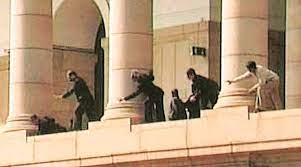
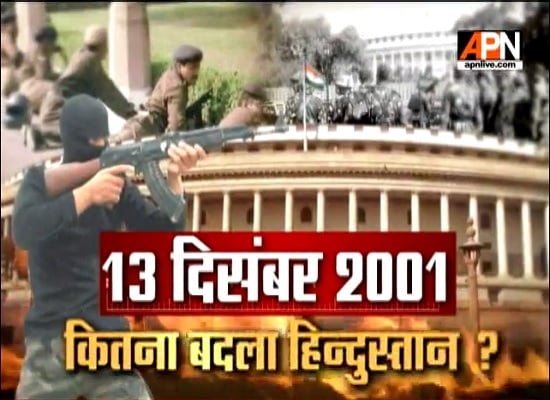
December 13, 2001, is known as the day that shooked the entire nation. On this day, the Parliament attack took place and it has been 20 years now. The attack was conducted by a terrorist group linked to Pakistan and at that time, BJP leader LK Advani was the Home Minister. Advani called the attack the most alarming, audacious act of terrorism.

Who were behind this attack?

Lashkar-e-Taiba and Jaish-e-Mohammad terrorists were behind this attack. At that time, a five-member suicide squad attacked the Parliament house.
How did the attackers execute the Parliament attack plan?

The five-member suicide squad entered the Parliament as they came in an Ambassador car and managed to get entry because of a forged government sticker. However, as the car entered the Parliament complex, one of the staff members became suspicious. At that time the vehicle was asked to turn back and during that, the vehicle hit the vehicle of then, vice president, Krishan Kant.

Soon after that, the gunmen who were armed with AK-47s and grenades got down and opened fire. The attack took place for about half an hour, and the attackers were neutralised outside the building.

Read Also: Hindu right-wing activists attack Christian preachers, set Bible on fire in Kolar, Karnataka

During the attack, several people lost their lives including five security personnel of Delhi Police, one woman constable of the CRPF and two security assistants of Parliament Watch and Ward section. A gardener and a photojournalist also lost their lives during the attack.

In just a few days, four people were arrested and were charged as the masterminds of the attack. In the Parliament attack, the case was levelled against the four namely- Shaukat Hussain, Afsan Guru, SAR Geelani and Mohammed Afzal Guru.

India News

Nitin Gadkari to review Delhi-Mumbai Expressway after fatal Dausa accident

Union Minister Nitin Gadkari is inspecting the Delhi-Mumbai Expressway to review safety measures and construction work following the fatal July 1 accident in Rajasthan’s Dausa district.

Published

on

Nitin Gadkari

The Centre has stepped up its focus on road safety along the Delhi-Mumbai Expressway as Union Road Transport and Highways Minister Nitin Gadkari undertakes a road inspection of the corridor just days after a fatal accident in Rajasthan’s Dausa district left eight people dead and 28 others injured.

According to officials of the National Highways Authority of India (NHAI), the minister is travelling by road from Delhi towards Kota and Ratlam via the Delhi-Mumbai Expressway. During the journey, he is expected to inspect various stretches of the highway and review ongoing infrastructure projects.

Inspection to cover safety, maintenance and construction

Officials said Gadkari is likely to pass through Dausa at around 2 pm and may visit the location where the July 1 accident occurred.

The inspection is expected to include a review of road maintenance, safety infrastructure, ongoing construction work and facilities at the Dara Tunnel in the Mukundara Hills near Kota. The visit will also cover sections of the expressway located in Madhya Pradesh and Gujarat.

Preparations have been intensified ahead of the minister’s visit, with NHAI and other departments reviewing safety arrangements and facilities along the route.

After crossing Dausa, Gadkari is scheduled to reach the Mukundra Tunnel project near Kota around 5:30 pm, where he will assess construction progress and hold a review meeting with officials.

Deadly July 1 accident renewed focus on highway safety

The minister’s visit comes after a devastating accident on July 1 involving a bus travelling from Haridwar to Indore.

The bus reportedly collided with the rear of a trailer truck near Dhanawda village at Zero Point under Kolwa Police Station in Rajasthan’s Dausa district before plunging into a roadside gorge and catching fire. Eight people lost their lives while 28 others sustained serious injuries.

Data from authorities shows that the Dausa stretch of the Delhi-Mumbai Expressway has witnessed a significant number of fatal accidents. In 2025, 33 road accidents claimed 35 lives, while 24 accidents recorded till the end of June 2026 resulted in 26 deaths.

Preliminary findings point to signage issues

Initial findings indicate that inadequate road signage may have contributed to the July 1 crash.

Officials believe the trailer truck involved in the accident was supposed to exit towards the Jaipur-Ajmer route but missed the turn at Zero Point because the exit was not clearly marked. After slowing down, it was struck from behind by the bus.

Sources familiar with the matter said drivers approaching from Delhi frequently face confusion while taking the Jaipur 4C Link Expressway due to the absence of clear directional arrows or signboards at Zero Point. Although signboards are placed around two kilometres before the exit, the arrows are reportedly too small to be easily noticed at highway speeds.

Authorities have also identified similar concerns at other locations on the expressway, including insufficient directional guidance for motorists travelling towards Jaipur via Dausa or Kanota.

Committee examining safety shortcomings

Following the accident, the Dausa district administration constituted an inquiry committee to examine safety issues along the affected stretch of the expressway.

On the directions of District Collector Soumya Jha, the District Road Safety Task Force conducted a review of road safety measures.

Committee member Vishnu Sharma said an eight-member inquiry panel headed by the Additional District Collector will inspect Packages 6, 7 and 8 between chainage 150 km and 240 km on July 8 and 9.

The preliminary inspection reportedly found several shortcomings, including non-functional SOS phones, unclear direction signs, and deficiencies in monitoring speeding vehicles and enforcing speed limits. The committee also observed that inadequate signboards at Zero Point could be increasing the risk of accidents.

Meanwhile, temporary encroachments along the expressway between Alwar and Dausa have been removed as part of safety measures. Officials have said the exact cause of the July 1 accident will be determined after the investigation is completed.

Continue Reading

India News

Hardeep Singh Puri dismisses E20 fuel controversy, says carmakers are comfortable with ethanol blend

Union Minister Hardeep Singh Puri has rejected concerns over E20 petrol, saying the controversy is based on misreporting and that automobile manufacturers have found no problems with the ethanol-blended fuel, which has been in use across India for over a year.

Published

on

Hardeep singh puri

Union Petroleum and Natural Gas Minister Hardeep Singh Puri has rejected concerns surrounding the government’s E20 petrol programme, describing the controversy as a result of “misreporting and misinterpretation”. The minister said automobile manufacturers have not raised concerns over the use of E20 fuel and questioned why the issue has resurfaced after the blended fuel has already been in use across the country for more than a year.

The government has been expanding ethanol blending in petrol as part of its broader strategy to reduce dependence on imported crude oil, lower carbon emissions and support India’s agricultural sector. E20 petrol contains 20 per cent ethanol and has been rolled out after compatibility assessments involving vehicle manufacturers and research institutions.

Puri rejects claims over E20 fuel

Responding to criticism circulating on social media, Puri said there is no evidence to support claims that E20 petrol damages vehicle engines or creates operational problems. He noted that millions of vehicles are already running on the fuel without widespread issues being reported.

According to the minister, nearly 20 crore two-wheelers and around 20 lakh four-wheelers are using E20 fuel. He added that vehicle manufacturers as well as service professionals have consistently indicated that they have not experienced any significant difficulties with the ethanol blend.

Questioning the timing of the debate, Puri said the fuel has already been available for a considerable period, making the sudden wave of criticism difficult to understand.

Government says E20 has been in use for over a year

The minister highlighted that India had already been using E15 fuel for more than three years before transitioning to E20. He said E20 petrol has been available nationwide since April 2025, meaning it has already completed more than a year of public use.

Puri also clarified that while discussions around higher ethanol blends such as E25 continue, the government has not announced any immediate rollout. He said testing is currently underway, and any future decision will be based on scientific evaluation and consultations with stakeholders, including automobile manufacturers.

Government says future ethanol blends will undergo testing

Addressing speculation about higher ethanol blends, Puri said the government is taking a cautious approach before introducing E25 petrol. He stressed that ongoing tests will be completed first, after which the findings will be reviewed before any policy decision is taken.

The minister said discussions with automobile manufacturers and other stakeholders would be an important part of the process before moving ahead with any higher ethanol blend.

“I neither make the cars nor the fuel. The car manufacturers are comfortable with the E20 fuel. Each one of them has made a statement,” Puri said, reiterating that vehicle makers have already expressed confidence in the current fuel blend.

He also noted that the rollout of E85 fuel would take additional time as it would require supporting infrastructure, including suitable fuel dispensing facilities at petrol pumps.

Government continues to promote ethanol blending

The Centre has identified ethanol blending as a key component of its energy transition strategy. Besides reducing India’s dependence on imported crude oil, the programme is intended to cut vehicular emissions and create additional demand for agricultural produce used in ethanol production.

The government has gradually increased ethanol blending targets over the past few years while working with automobile manufacturers and research agencies to ensure vehicle compatibility with higher ethanol blends.

Puri had earlier stated that the government welcomes constructive criticism of its policies but would not accept what he described as rumours regarding biofuel blending. His latest remarks come amid renewed social media discussions claiming that E20 fuel reduces vehicle mileage or causes engine-related issues.

Reiterating the government’s position, the minister said existing data and feedback from manufacturers do not indicate widespread problems with E20 petrol, adding that any future decisions on higher ethanol blends would continue to be based on testing, scientific assessment and stakeholder consultations.

Continue Reading

India News

Congress to challenge Meenakshi Natarajan’s Rajya Sabha nomination rejection in Madhya Pradesh High Court

Congress leader Meenakshi Natarajan has announced that the party will challenge the rejection of her Rajya Sabha nomination in the Madhya Pradesh High Court, alleging the decision was legally flawed and that the Election Commission failed to follow a consistent approach.

Published

on

The Congress is preparing to challenge the rejection of senior leader Meenakshi Natarajan’s Rajya Sabha nomination before the Madhya Pradesh High Court, shifting the dispute from the political arena to the legal forum.

Weeks after her nomination was rejected ahead of the Rajya Sabha elections, the former Member of Parliament asserted that the decision was not the result of any lapse by Congress leaders, legal experts or those involved in preparing the nomination papers. Instead, she claimed the rejection was based on an incorrect legal interpretation.

Congress to file election petition

Natarajan said the party would file an election petition within the prescribed time and contest the entire process before the High Court. She also alleged that a deliberate narrative was created to portray the rejection as a consequence of negligence within the Congress, thereby diverting attention from the Election Commission’s role.

According to her, the Returning Officer rejected her nomination citing non-disclosure of information related to a pending case. However, she argued that Form-26, which candidates are required to submit along with their nomination papers, does not contain any specific provision requiring disclosure of such information.

Natarajan said she has contested multiple elections in the past and maintained that experienced legal experts within the Congress have handled nomination papers for years, making such an oversight highly unlikely.

Questions raised over Election Commission’s approach

The Congress leader also questioned the Election Commission’s handling of the matter, alleging that it failed to apply uniform standards in similar cases.

She referred to the case of Rajya Sabha candidate Parimal Nathwani in Jharkhand, claiming he was given 24 hours to rectify issues in his nomination papers, whereas she was not provided a similar opportunity. According to Natarajan, the differing treatment raises concerns about consistency in the poll body’s decision-making process.

Congress sources said the party’s legal cell is preparing the election petition under the guidance of senior lawyers. The dispute had earlier reached the Election Commission and subsequently the Supreme Court, but the party will now pursue the legal remedy available after the election process through the High Court.

The Congress has also alleged that the Election Commission did not act impartially during the proceedings. Party leaders claimed senior Congress representatives and lawyers reached the poll body on time to present their arguments, but the proceedings were delayed. They further alleged that the Election Commission had the authority to overturn the Returning Officer’s decision but chose not to intervene.

BJP rejects Congress allegations

The Bharatiya Janata Party dismissed the Congress’ allegations, attributing the controversy to internal issues within the opposition party.

BJP state spokesperson Ajay Yadav said the rejection of Natarajan’s nomination was the result of internal infighting in the Congress. He also claimed that the senior leader had been sidelined within her party and suggested that the Congress should introspect instead of blaming the Election Commission.

Natarajan, however, rejected claims that the Congress was responsible for any lapse leading to the rejection of her nomination.

Continue Reading

Trending

© Copyright 2022 APNLIVE.com