English हिन्दी
Connect with us

India News

PM Modi inaugurates Maruti Suzuki’s EV and battery plant in Gujarat, e-Vitara to be exported to 100 nations

Prime Minister Narendra Modi inaugurated Maruti Suzuki’s electric car and battery plant in Gujarat. The e-Vitara will be produced in India and exported to 100 nations.

Published

on

PM Modi vitara plant

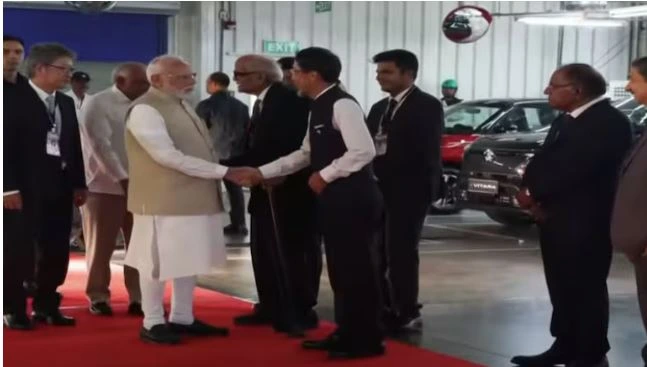
Prime Minister Narendra Modi on Monday inaugurated Maruti Suzuki’s state-of-the-art electric car and battery manufacturing facility in Hansalpur, Ahmedabad. The plant will manufacture hybrid battery electrodes and produce the company’s first global battery electric vehicle (BEV), the e-Vitara, which will be shipped to over 100 countries, including Japan and several European markets.

Boost to domestic EV ecosystem

The local production of hybrid battery electrodes will be carried out at the TDS Lithium-Ion Battery plant, a joint venture between Toshiba, Denso and Suzuki. With this initiative, more than 80 per cent of battery value will now be manufactured within India, strengthening the country’s push for self-reliance in green mobility.

Highlighting the development, PM Modi wrote on X, “Today is a special day in India’s quest for self-reliance and being a hub for green mobility. At Hansalpur, e-Vitara will be flagged off. This Battery Electric Vehicle (BEV) is made in India and will be exported to over a hundred nations. In a big boost to our battery ecosystem, production of hybrid battery electrodes will also commence at a plant in Gujarat.”

Maruti Suzuki’s global EV debut

Maruti Suzuki had first showcased the e-Vitara in January 2025 at the Bharat Mobility Global Expo. With a bold and modern design, the SUV comes equipped with sharp LED headlamps, DRLs, rugged skid plates, and a tech-loaded interior featuring a digital instrument cluster, large touchscreen infotainment system, JBL premium audio, wireless charging, 360-degree camera and sunroof.

The electric SUV will be available with two lithium-iron phosphate (LFP) battery packs — 49kWh and 61kWh — and options for both front-wheel drive (FWD) and all-wheel drive (AWD). Advanced driver assistance systems (ADAS) will also be offered.

India’s EV share and Maruti’s expansion

In FY25, Maruti Suzuki exported more than 3.32 lakh vehicles and sold 19.01 lakh units in the domestic market, with a total annual production capacity of 2.6 million units across its four plants. Commercial production of the e-Vitara officially commenced today at Hansalpur.

Currently, electric vehicles account for around 3 per cent of total car sales in India, but with the launch of the e-Vitara and domestic battery electrode production, industry experts expect this share to climb steadily in the coming years.

Continue Reading

India News

AAP wins confidence motion in Punjab assembly, Mann government proves majority

AAP government in Punjab wins confidence motion, reaffirming majority and stability in the assembly.

Published

on

The Aam Aadmi Party government in Punjab has passed a confidence motion in the state assembly, reaffirming its majority in the House.

The motion was moved by Chief Minister Bhagwant Mann during a special session of the Punjab Vidhan Sabha. The move came amid recent political speculation regarding the stability of the ruling party.

With a strong numerical position in the 117-member assembly, AAP demonstrated that it continues to command the support of a majority of legislators. The outcome of the vote reinforced the party’s dominance in the House.

Addressing the assembly, Mann said the confidence motion was brought to put an end to rumours about any instability within the government. He asserted that the party remains united and committed to governance in the state.

The trust vote was passed with the backing of AAP legislators, underlining internal cohesion despite ongoing political discussions at the broader level.

The result is expected to strengthen the Mann-led government’s position and provide stability as it moves forward with its policy agenda in Punjab.

Continue Reading

India News

NDMA alert SMS explained as India tests nationwide disaster warning system

India begins testing NDMA-based mobile alerts using cell broadcast technology to warn citizens during disasters.

Published

on

India has begun testing a new nationwide disaster alert system that sends emergency messages directly to mobile phones, often accompanied by loud beeps or vibrations. The initiative is being implemented by the National Disaster Management Authority (NDMA) in coordination with the Department of Telecommunications (DoT) to improve public safety during emergencies.

The alerts many users are receiving are part of a trial phase, and authorities have clarified that these are test messages that do not require any action.

What is the NDMA alert SMS system

The system is designed to warn citizens about disasters such as earthquakes, floods, tsunamis, lightning strikes, and even man-made emergencies like gas leaks.

It uses a mix of traditional SMS and Cell Broadcast (CB) technology, which allows alerts to be sent to all mobile phones within a specific geographic area simultaneously.

Unlike regular SMS, which are sent individually, cell broadcast messages are delivered instantly to multiple users at once, making them faster and more effective during critical situations.

Why you may hear loud alert sounds

Many users have reported sudden loud alarm-like sounds when receiving these alerts. This happens because the system is designed to override silent mode on phones to ensure the message gets immediate attention.

Such alerts are especially useful during time-sensitive emergencies when quick response can save lives.

Nationwide testing underway

The government is currently conducting pan-India trials of the system before its official rollout. Citizens across different states may receive these messages multiple times during the testing period.

Officials have urged people not to panic and to ignore the alerts during this phase, as they are only meant to check system performance and reach.

How the system will help in real emergencies

Once fully operational, the system will:

  • Deliver alerts in multiple Indian languages
  • Reach users instantly, even during network congestion
  • Target specific geographic areas for precise warnings
  • Work alongside existing disaster platforms like the Sachet portal

The goal is to ensure real-time communication during disasters, reducing response time and improving public safety.

Continue Reading

India News

Repolling ordered at 15 booths in West Bengal after complaints of irregularities

Repolling will be held at 15 polling stations in West Bengal’s Magrahat Paschim and Diamond Harbour constituencies after complaints of irregularities.

Published

on

Fresh voting will be conducted in 15 polling stations across two assembly constituencies in West Bengal on May 2, following complaints of irregularities during the recent polling phase.

The Election Commission has declared the earlier voting at these booths void and ordered repolling to ensure fairness in the electoral process.

Where repolling will take place

The repoll will be held in the Magrahat Paschim and Diamond Harbour constituencies in South 24 Parganas district. Out of the 15 booths, 11 are located in Magrahat Paschim and 4 in Diamond Harbour.

Polling is scheduled to take place from 7 am to 6 pm.

Why repolling was ordered

The decision comes after complaints related to alleged irregularities, including concerns linked to electronic voting machines (EVMs). Authorities reviewed the situation and decided to nullify the earlier voting in these booths to maintain the integrity of the election.

Background of the election

The repoll follows the second phase of the West Bengal Assembly elections held on April 29, which covered 142 constituencies. The Election Commission has taken multiple steps during the election process to address complaints and ensure free and fair polling.

Continue Reading

Trending

© Copyright 2022 APNLIVE.com