English हिन्दी
Connect with us

India News

Rs 600 cr is advance assistance, clarifies Centre; Union minister Alphons wants foreign aid policy changed

Published

on

Rs 600 cr is advance assistance, clarifies Centre; Union minister Alphons wants foreign aid policy changed
The Centre clarified on Thursday that Rs. 600 crore given to flood-hit Kerala was only “advance assistance” and more funds would be released after another assessment by an inter-ministerial team.

Meanwhile, Union Minister KJ Alphons said that he will request the Centre to change a 14-year old convention on accepting foreign financial assistance, NDTV reported.

The issue has sparked a row after the centre declared on Wednesday that it would not accept foreign aid to combat natural disasters, as per India’s policy since 2004 when Manmohan Singh government had declined foreign assistance in the aftermath of tsunami. The Centre’s response came after a reported offer of $100 million (around Rs. 700 crore) by the United Arab Emirates (UAE).

Death toll in Kerala floods has reached 373, more than 1.2 million people are in relief camps and losses are pegged at Rs 20,000 crore ($2.86 billion), 16% of the state’s 2018-19 expenditure, according to media reports.

“I would plead that for my state because I have seen the misery,” Alphons said. “We need the money.” The Union minister has been surveying the destruction caused by the flooding in the state.

Alphons cited Kerala’s contribution to India’s foreign exchange assets. “In fact in the last year itself, it had brought Rs 75,000 crore through remittances,” Alphons told PTI. “For these reasons, as a junior minister I am appealing to my senior colleagues to make a special consideration for the state. I appeal to them to make a one-time exception to the policy.”

On Wednesday, the Ministry of External Affairs formally rejected offers made by foreign countries to send aid for flood relief work in Kerala citing “existing policy”. The United Arab Emirates had offered Rs 700 crore as aid to Kerala. Earlier on Thursday, the European Union announced that it would donate 1.9 lakh euros (Rs 1.53 crore) to the Indian Red Cross relief work in Kerala.

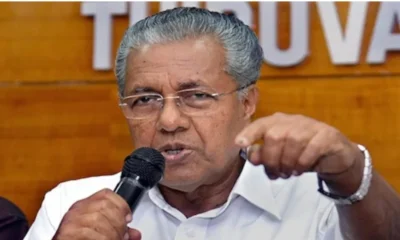
Chief Minister Pinarayi Vijayan said the National Disaster Management Authority, in its 2016 policy, allowed an exception to the convention on foreign assistance if any national government of another country offers aid as a good will gesture. .

Kerala has accused the centre of depriving it of foreign funds while allocating only Rs. 600 crore against its demand for Rs. 2,200 crore for rebuilding efforts after the state’s worst floods in a century.

“This is a dog in the manger policy,” Kerala Finance Minister Thomas Isaac had tweeted.

A statement from the Ministry of Home Affairs (MHA) last night said: “It is clarified that Rs. 600 crore released by Centre is the advance assistance only. Additional funds would be released from NDRF (National Disaster Response Force) on assessment of the damages as per laid down procedure.”

The MHA said the centre had provided urgent aid and relief material “in a timely manner and without any reservation”.

“In one of the largest rescue operations, 40 helicopters, 31 aircraft, 182 teams for rescue, 18 Medical Teams of Defence forces, 58 teams of NDRF, 7 companies of CAPFs were pressed into service along with over 500 boats and necessary rescue equipments. They successfully saved over 60,000 human lives by rescuing them from marooned areas and shifting them to relief camps. Defence aircrafts and helicopters have made 1,084 sorties of duration 1,168 flying hours and airlifted 1,286 tonne of load and carried 3,332 rescuers. In addition, a number of Navy and Coast Guard ships were pressed into service to carry relief material to Kerala. The search and rescue operations and mobilisation of resources alone would cost the Central Government hundreds of crore of rupees,” the MHA said.

The government said Rs. 600 crore was released in advance “pending an assessment” by a team of ministers. This, the statement added, was apart from Rs. 562.45 crore already in the State Disaster Relief Fund, to which the centre contributes 75 to 90 per cent.

The statement follows some severe criticism of the Rs 600 crore assistance even by independent sections. An India Spend analysis, pointing out that it was “less than the cost of one Rafale fighter jet (Rs 670 crore), 36 of which India hopes to buy from France”, added that this interim relief is less than:

–    The amount allocated towards the construction of an exhibition cum convention centre (ECC), Dwarka, New Delhi– Rs 700 crore.

–    the amount spent on the purchase of two new VVIP aircraft for special flights operated by Air India for the President, Vice President and Prime Minister–Rs 4,469.5 crore ($640 million);

–    the allocation made by the Centre for the revival of 50 airports/airstrips under the Regional Connectivity Scheme–Rs 890 crore.

India News

PM Modi assures no discrimination in women’s quota, delimitation debate intensifies in Parliament

PM Narendra Modi has assured that women’s reservation will be implemented without discrimination, amid a heated debate over delimitation in Parliament.

Published

on

PM modi

Prime Minister Narendra Modi has assured that there will be no discrimination in the implementation of women’s reservation, as Parliament witnessed a sharp debate over the proposed linkage between the quota and delimitation exercise.

During the ongoing special session, the government reiterated its commitment to ensuring fair representation while addressing concerns raised by opposition parties regarding the timing and structure of the legislation.

The proposed framework aims to reserve 33 percent of seats for women in the Lok Sabha and state assemblies. However, its implementation is tied to a fresh delimitation exercise, which is expected after the next census.

Opposition questions timing and intent

Opposition leaders have raised concerns that linking the women’s quota to delimitation could delay its implementation. They argue that the process of redrawing constituencies may push the actual rollout further into the future.

The issue has triggered a broader political confrontation, with multiple parties questioning whether the move could alter representation across states.

Some critics have also alleged that the delimitation exercise could disproportionately benefit certain regions based on population, a charge the government has rejected.

Government reiterates commitment to fair implementation

Responding to these concerns, the Centre has maintained that the reforms are necessary to ensure accurate and updated representation based on population data.

Leaders from the ruling side have repeatedly emphasized that the process will be carried out transparently and without bias. The assurance that there will be “no discrimination” is aimed at addressing fears among states and opposition parties.

The debate marks a key moment in Parliament, with both sides engaging in intense exchanges over one of the most significant electoral reforms in recent years.

Continue Reading

India News

Give all tickets to Muslim women, Amit Shah says, attacking Akhilesh Yadav on sub-quota demand

A sharp exchange between Amit Shah and Akhilesh Yadav in Parliament over sub-quota for Muslim women highlights key divisions on women’s reservation implementation.

Published

on

A heated exchange broke out in Parliament during discussions on the women’s reservation framework, with Union Home Minister Amit Shah and Samajwadi Party chief Akhilesh Yadav locking horns over the demand for a sub-quota for Muslim women.

The debate unfolded as the government pushed forward key legislative measures to implement 33% reservation for women in the Lok Sabha and state assemblies.

Akhilesh Yadav argued that the proposed reservation must ensure representation for women from marginalised communities, including Other Backward Classes (OBCs) and Muslim women. He said that without such provisions, large sections could remain excluded from political participation.

He also questioned the timing of the bill, alleging that the Centre was avoiding a caste census. According to him, a census would lead to renewed demands for caste-based reservations, which the government is reluctant to address.

Government rejects religion-based quota

Responding to the demand, Amit Shah made it clear that reservation based on religion is not permitted under the Constitution.

He stated that any proposal to provide quota to Muslims on religious grounds would be unconstitutional, firmly rejecting the idea of a separate sub-quota for Muslim women within the broader reservation framework.

The government has maintained that the existing framework already includes provisions for Scheduled Castes (SC) and Scheduled Tribes (ST) women within the overall reservation structure.

Wider political divide over implementation

The issue of sub-categorisation within the women’s quota has emerged as a major flashpoint, even as most opposition parties broadly support the idea of women’s reservation.

Samajwadi Party leaders reiterated that their support for the bill depends on inclusion of OBC and minority women, while the government continues to defend its constitutional position.

The debate is part of a broader discussion during the special Parliament session, where multiple bills linked to delimitation and implementation of the women’s quota are being taken up.

Continue Reading

India News

No state will lose a seat, Centre assures as delimitation debate takes centre stage in Parliament

Parliament’s special session begins with key focus on implementing women’s reservation and delimitation, setting the stage for major electoral changes.

Published

on

Parliament

A special session of Parliament commenced on Thursday, with the Centre set to take up crucial legislation related to women’s reservation and delimitation of constituencies. The session, scheduled over three days, is expected to witness intense debate as the government pushes forward its legislative agenda.

At the centre of discussions is the proposal to operationalise the women’s reservation law, which seeks to allocate 33 percent of seats in the Lok Sabha and state assemblies to women. The law, passed earlier, requires enabling provisions before it can be implemented.

The rollout of the reservation is closely tied to the delimitation exercise — a process that redraws parliamentary constituencies based on updated population data. The implementation is expected only after the next census and delimitation process are completed.

The government is aiming to put in place the framework so that the reservation can be enforced in future elections, likely around 2029.

Delimitation and numbers at play

Delimitation is a key aspect of the proposed changes, as it will determine how seats are redistributed and which constituencies are reserved. The exercise is expected to reflect population shifts and may also involve an increase in the total number of Lok Sabha seats.

This linkage has made the issue politically sensitive, with several opposition parties backing women’s reservation in principle but raising concerns over how and when delimitation will be carried out.

Political reactions and expected debate

The session is likely to see sharp exchanges between the government and opposition. While there is broad agreement on increasing women’s representation, disagreements remain over the timing, process, and potential political implications of the delimitation exercise.

Some leaders have argued that delimitation could significantly alter the balance of representation among states, making it a contentious issue beyond the women’s quota itself.

The government, however, has framed the move as a step toward strengthening women’s participation in governance and ensuring more inclusive policymaking.

Continue Reading

Trending

© Copyright 2022 APNLIVE.com