English हिन्दी
Connect with us

India News

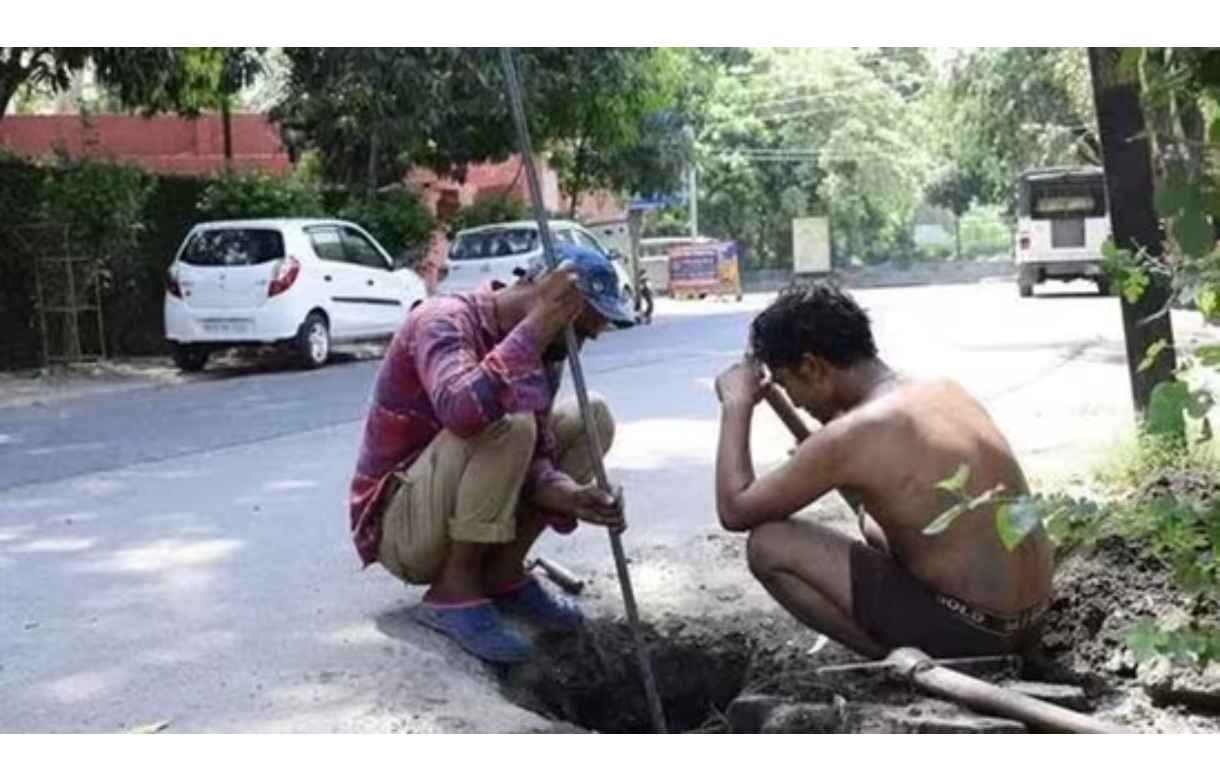
Supreme Court says government will have to pay Rs 30 lakh as compensation to those who die cleaning sewers

The bench added a sum of Rs 10 lakh will be given to those who suffer any kind of disability while cleaning sewers while hearing a public interest litigation. The bench said the state and the union government must ensure that manual scavenging is completely eradicated.

Published

on

Supreme Court says government will have to pay Rs 30 lakh as compensation to those who die cleaning sewers

The Supreme court of India on Friday said the government will have to pay Rs 30 lakh as compensation to those who die cleaning sewers. A bench of justices Aravind Kumar and S Ravindra Bhat said those who suffer permanent disabitities while cleaning sewers will get a payment of Rs 20 lakh as compensation.

The bench added a sum of Rs 10 lakh will be given to those who suffer any kind of disability while cleaning sewers while hearing a public interest litigation. The bench said the state and the union government must ensure that manual scavenging is completely eradicated.

The bench directed the government agencies and coordinates to ensure that such incidents do not take place. It added that High courts are not precluded from monitoring the cases which are related to sewer deaths. The top court also issued a numberc of directions which were not read during the meeting. A detailed order on the matter is awaited.

According to reports nearly 350 people have died in sewers in the last five years. The states of Delhi, Tamil Nadu and Uttar Pradesh account for 40 percent of these deaths. The government told the Rajya Sabha last year that 58,098 manual scavengers were identified all over the country in two surveys in 2013 and 2018 respectively.

Prohibition of employment as manual scavengers and their rehabilitation Act 2013 has banned manual scavenging. The caste based practice was banned in 1993 but activists say it still prevails in the Indian society. The government distinguishes between manual scavenging and a caste based practice of people who clean human excreta by hand and the practice of cleaning septic tanks and sewers as experts point out the latter is a mere extension of the banned practice.

India News

PM Modi to visit Punjab on July 17, launch railway projects as BJP prepares for solo poll battle

Prime Minister Narendra Modi will visit Punjab on July 17 to inaugurate the redeveloped Jalandhar Cantonment Railway Station and launch key railway projects as the BJP prepares to contest future elections independently in the state.

Published

on

Prime Minister Narendra Modi will visit Punjab on July 17 to inaugurate and lay the foundation for multiple railway projects, marking his first visit to the state since the Bharatiya Janata Party (BJP) decided to contest future elections independently in Punjab.

During the visit, the Prime Minister will inaugurate the redeveloped Jalandhar Cantonment Railway Station, which has been modernised under the Centre’s Amrit Bharat Station Scheme. The 110-year-old station is among 75 railway stations across the country scheduled to be inaugurated as part of the government’s railway modernisation programme.

The redevelopment aims to improve passenger amenities, enhance station accessibility and transform railway stations into modern transport hubs.

New train service between Jalandhar and Varanasi

Apart from inaugurating the upgraded station, PM Modi will also lay the foundation stone for the Shri Guru Ravidass Ji Maharaj Express, a new train service connecting Jalandhar and Varanasi.

Named after Guru Ravidass Ji Maharaj, the train is intended to strengthen connectivity between Punjab and Varanasi, where the revered saint spent a significant part of his life. Guru Ravidass is widely respected for promoting equality and social justice, and his teachings continue to hold special significance in Punjab, particularly among the Scheduled Caste community.

Visit comes amid changing political landscape

The Prime Minister’s visit comes at a time when political activity has intensified in Punjab ahead of the upcoming Assembly elections.

The BJP recently announced that it would contest future elections in Punjab without entering into alliances, making this visit politically significant as the party seeks to strengthen its independent presence in the state.

Party leaders have projected the visit as development-focused, highlighting infrastructure initiatives and improved connectivity. In social media posts, Punjab BJP leaders welcomed the Prime Minister and described the visit as an important occasion for the state.

Security and preparations underway

Authorities have stepped up preparations for the Prime Minister’s programme in Jalandhar. Security arrangements are being reviewed while logistical preparations at the railway station are underway to ensure the smooth conduct of the visit.

Continue Reading

India News

Rs 1,160 crore rice diversion case widens, 56 mills and 22 ethanol plants under investigation

Authorities have expanded the alleged Rs 1,160 crore government rice diversion investigation, bringing 56 rice mills and 22 ethanol plants under scrutiny over suspected misuse of subsidised rice meant for ethanol production.

Published

on

Government agencies have widened their investigation into an alleged Rs 1,160 crore rice diversion case, bringing 56 private rice mills and 22 ethanol plants across 17 districts under scrutiny. The probe is focused on determining whether subsidised government rice allocated for ethanol production was diverted through private mills instead of being used for its intended purpose.

Investigation expands after truck found at private rice mill

The investigation began after a truck transporting government rice from a Food Corporation of India (FCI) warehouse to an ethanol plant was allegedly found inside a private rice mill. What initially appeared to be an isolated incident has now expanded into a multi-district probe involving 17 seized trucks, over 50 witness statements and multiple accused.

Authorities are trying to establish how much of the nearly 5 lakh metric tonnes of government rice supplied to ethanol plants was actually converted into ethanol and whether a portion of it was diverted before returning to government warehouses.

Alleged circular trade under investigation

Investigators suspect that subsidised rice supplied to ethanol plants at around Rs 2,320 per quintal may have been sold to private rice mill operators at higher prices instead of being processed into ethanol.

According to the investigation, the rice was allegedly repacked by private mills and deposited back into government warehouses as custom-milled rice. Officials are also examining whether the original paddy supplied for milling was sold separately in the open market or transported to other states, potentially allowing multiple profits from the same stock.

Authorities believe the alleged arrangement, if established, could have enabled financial gains at several stages while avoiding actual ethanol production.

Officials examining monitoring failures

The investigation is also looking into whether lapses in monitoring or possible collusion allowed government rice to re-enter official warehouses without proper verification.

Officials are checking whether rice previously released under the ethanol scheme was accepted again as newly milled stock through the custom milling system.

Police register FIR, arrest four accused

Balaghat Superintendent of Police Aditya Mishra said the case began after authorities received information about three trucks carrying government rice from FCI warehouses to the AVJ Agrico ethanol plant. During a joint inspection by Revenue, Food and Police officials, one truck was allegedly found inside Sancheti Rice Mill, leading to the registration of an FIR for cheating.

A Special Investigation Team (SIT) comprising 20 to 25 members was subsequently formed.

According to the police, investigators have so far:

  • Arrested four people
  • Identified more than 13 accused
  • Recorded statements of over 50 witnesses
  • Issued notices to 56 rice mills
  • Seized 17 trucks
  • Obtained non-bailable warrants against two individuals

Police said the investigation remains ongoing and further action will be taken based on new evidence.

Production records and transport data under verification

Investigators are comparing FCI dispatch records with ethanol production data, transport logs, warehouse receipts and custom milling records.

Authorities are also examining production capacity, electricity consumption, machinery usage and raw material records at ethanol plants to verify whether the quantity of rice supplied matches actual ethanol output.

Similar verification is underway at rice mills to determine whether their claimed milling operations correspond with electricity consumption, labour deployment and machinery records.

Use of fortified rice raises additional questions

The case has drawn additional attention because the grain under scrutiny was fortified rice, which is enriched with iron, folic acid and Vitamin B12 to help address anaemia and malnutrition among children, pregnant women and adolescent girls.

Investigators are examining why fortified rice was supplied for ethanol production when distilleries generally use broken rice as feedstock. They are also looking into whether FCI followed stock rotation norms while allocating rice under the scheme.

Collector sought wider scrutiny

Confidential communications from the Balaghat Collector reportedly recommended verification of whether rice released for ethanol production actually reached the designated plants. The Collector also sought scrutiny of the allocation process, transportation chain, utilisation certificates and the roles of FCI officials, ethanol companies, transporters and rice mill owners.

The investigation currently covers nearly 5 lakh metric tonnes (50 lakh quintals) of government rice, valued at approximately Rs 1,160 crore at the subsidised allocation price.

Continue Reading

India News

Indian Army Agniveer CEE Result 2026 declared, ARO-wise merit list released

The Indian Army has announced the Agniveer CEE Result 2026. Candidates can now download the ARO-wise merit list and check their eligibility for the next stages of recruitment.

Published

on

Indian Army Agniveer Result

The Indian Army has announced the Agniveer Common Entrance Examination (CEE) Result 2026, allowing candidates to check their qualifying status through the official recruitment portal. The Army Recruitment Office (ARO)-wise merit lists have been uploaded on joinindianarmy.nic.in, where candidates can download the PDF corresponding to their recruitment region.

The merit lists contain the names and roll numbers of candidates who have successfully cleared the written examination and become eligible for the next phase of the Agniveer recruitment process.

How to check Indian Army Agniveer CEE Result 2026

Candidates can access their results by following these steps:

  • Visit the official Indian Army recruitment website.
  • Click on the Agniveer CEE Result 2026 link available on the homepage.
  • Select the relevant Army Recruitment Office (ARO) or recruitment region.
  • Download the merit list PDF.
  • Search for your roll number or name to confirm your qualification status.

What happens after the Agniveer CEE result?

Candidates shortlisted in the Common Entrance Examination will now have to undergo the remaining stages of the recruitment process. These include:

  • Physical Fitness Test (PFT)
  • Physical Measurement Test (PMT)
  • Document Verification (DV)
  • Medical Examination

Only candidates who successfully clear every stage will be considered for final selection under the Agniveer recruitment programme.

Candidates advised to verify details carefully

After downloading the merit list, candidates should carefully check all the information mentioned in the document. If they notice any discrepancy related to their result or personal details, they should immediately contact their respective Army Recruitment Office (ARO) for assistance.

Candidates are also advised to keep checking the official Indian Army recruitment portal for updates regarding the schedule, venue and instructions for the upcoming physical tests, document verification and medical examination.

Continue Reading

Trending

© Copyright 2022 APNLIVE.com