English हिन्दी
Connect with us

India News

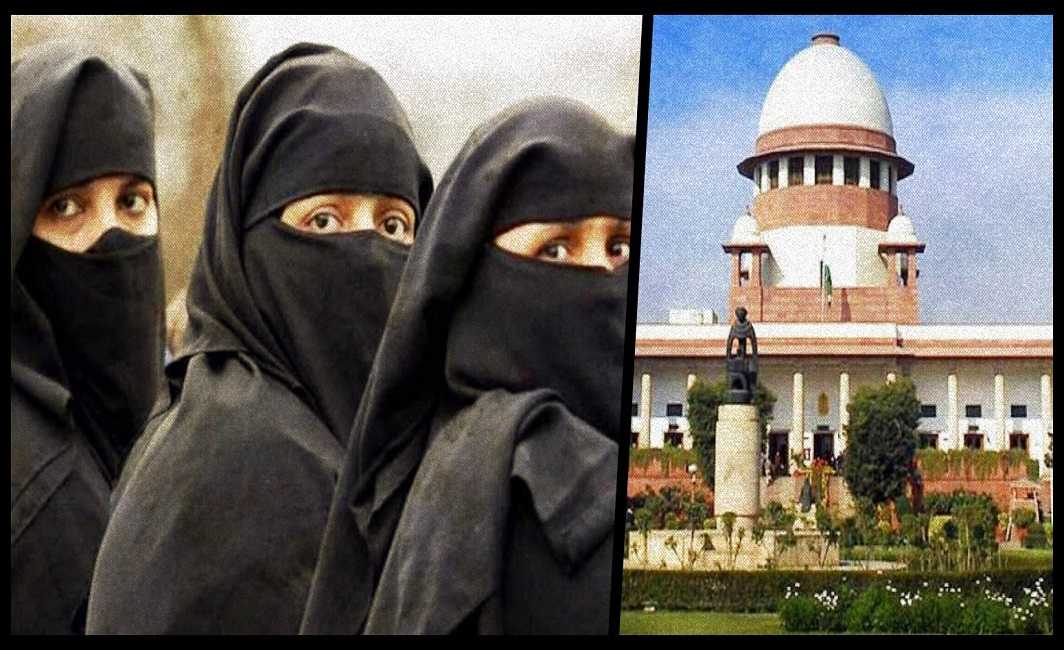
Talaq Judgement: Muslim Women A Play Thing in Communal Politics?

Published

on

Talaq Judgement: Muslim Women A Play Thing in Communal Politics?
[vc_row][vc_column][vc_column_text]By Saeed Naqvi

Put it down to my acute perversity, because as soon as celebrations broke out and I glanced at the Supreme Court’s Triple Talaq judgement, Josh Malihabadi’s rubayee (quatrain) swam into my ken:

“Ae rind kya yehi hai baaghe rizwaan?

Na hooron ka kaheen pata na ghilma ka nishaan

Ek kunj mein maayuus-o-mulool-o-tanha

Bechare tahel rahey hain Allah mian”

(O’ Tavern companion, where have we come? Is this the promised garden?

I see no beautiful houris, nor handsome men.

In a gloomy corner, crestfallen,

Sad and lonely, Allah Mian paces ponderously)

Josh is mocking at Man’s distortion of God’s purpose.

Of course, this is escapism on my part, but I can hardly help it because in all my 75 plus years I have never known anyone, even by remote association, who discarded his wife by pronouncing “talaq, talaq, talaq.” Since Muslims are supposed to be in the grip of this all pervasive practice, I may be forgiven for feeling a little left out.

The defiance and passion with which the General Secretary of Jamiat Ulema e Hind Maulana Mahmood Madani, has reacted leaves me breathless:

“If you wish to punish the person (for pronouncing triple talaq) you may do so but such a talaq will be recognized” by Jamiat and society at large. The Maulana, to his credit, advises Muslims not to resort to triple talaq but he insists that the courts or the state not be allowed to interfere with Muslim practices, presumably based on Muslim law.

Do I stand with the Maulana to keep my Muslim identity intact? Or do I ignore him as I have ignored all clerical edicts throughout my life?

That a five judge bench of the Supreme Court has struck down the obviously abhorrent practice, should find me in the ranks of those thunderously applauding the judgment. But that too is not my chosen path.

I spot triumphalism in this national exultation led by Narendra Modi, Amit Shah, Yogi Adityanath and leaders of other parties in supporting roles. The Muslim male has been administered a double-fisted punch on his chin and his women freed from his basement harems.

Chief Justice Kehar has accorded protection to 90 percent of Muslims from the barbaric practice.

Do I belong to this 90 percent or was I always protected, being among the 10 percent who, by His Lordship’s calculus, were outside the dark canopy of shoddy Islamic laws?

Since most surveys seem to suggest talaq-talaq afflicts not more than one percent, does it behove their Lordships to paint the entire community with one brush?

Should not the Ministry of Social Welfare, the Minority Commission, instead of sitting on their haunches, do a survey to establish the extent to which the practice is prevalent?

Beef is a sensitive word these days. But beef (not buffalo but cow) is slaughtered and eaten by Muslims, non Muslims and Dalits in the North East, West Bengal, Kerala, Tamil Nadu etcetera. Would their Lordships judge Hindus as beefeaters along with Muslims across the country or would a clarification be in order that the practice is prevalent only in specific regions of the country?

Does the universal celebration over the judgment inspire optimism? Now that the Indian establishment across the board is so demonstrably filled with the milk of human kindness towards the divorced Muslim woman, it probably augurs well not just for the Muslim “Suhagan” (happily married) but for the entire Muslim community, all 180 million of them.

In his very first speech in Parliament in May 2014, Narendra Modi became the only Prime Minister to openly say what never came naturally to Congressmen that among the many burdens that weighed the nation down was “1,200 years of foreign subjugation”. Congressmen said this privately but never publicly.

The official party line, the one that the Congressmen went public with was about “200 years” of British rule. The Muslim period was glossed over. There was no public debate.

In fact at the earlier stages, soon after 1947, a common and particularly galling allegation was: “Muslims partitioned the country and then stayed on.”

There is no record of Congress leaders ever offering a clarification for this canard. So implicated were they in the country’s fracture, that they refrained from encouraging debate on this issue lest it turn upon them.

The Congress was not the only guilty party. Even socialists like Ram Manohar Lohia talked of the “spirit of Haldighati” as a panacea for boosting Hindu morale. He went along with the version of history which credits Maharana Pratap with victory over Akbar, a highly disputed proposition.

Since I stayed with JP in his Kadam Kuan residence in Patna, I saw firsthand how the Bihar movement was put together by Nanaji Deshmukh of the RSS and his close friend, Ramnath Goenka, publisher, owner of Indian Express. Socialists, conservative Congress leaders who had broken away from Indira Gandhi (or whom she had disbanded) all came together in the Janata Party government. Subsequent politics during Indira Gandhi and Rajiv Gandhi years had become manifestly sensitive to this reality: varying shades of Hindu majoritarianism were an essential requirement for the electoral game. It was on this trajectory that Narendra Modi gained exceptional height in 2014. Has he peaked?

The other day my sister and her daughter travelled by AIR INDIA. She had asked for a vegetarian diet, her daughter for non vegetarian. The printout of her ticket said: “Vegetarian Hindu meal”. The other printout was equally explicit: non vegetarian “Muslim meal”. Their Lordships may wish to find out if institutionalized apartheid is creeping upon us?

This is the background against which the nation and its media are amplifying the turn that the Supreme Court has given to the plight of Muslim women, divorced by recourse in an ungodly method. Intentionally or unintentionally on the part of their Lordships, the situation created by their judgment is fraught with politics, even though only one percent of Muslim women who have escaped talaq, talaq have reasons to rejoice. If propaganda is the name of the game, these ladies should be facilitated on their way to Mecca for Haj, by way of thanksgiving. This is a photo op not to be missed.[/vc_column_text][/vc_column][/vc_row]

India News

PM Modi assures no discrimination in women’s quota, delimitation debate intensifies in Parliament

PM Narendra Modi has assured that women’s reservation will be implemented without discrimination, amid a heated debate over delimitation in Parliament.

Published

on

PM modi

Prime Minister Narendra Modi has assured that there will be no discrimination in the implementation of women’s reservation, as Parliament witnessed a sharp debate over the proposed linkage between the quota and delimitation exercise.

During the ongoing special session, the government reiterated its commitment to ensuring fair representation while addressing concerns raised by opposition parties regarding the timing and structure of the legislation.

The proposed framework aims to reserve 33 percent of seats for women in the Lok Sabha and state assemblies. However, its implementation is tied to a fresh delimitation exercise, which is expected after the next census.

Opposition questions timing and intent

Opposition leaders have raised concerns that linking the women’s quota to delimitation could delay its implementation. They argue that the process of redrawing constituencies may push the actual rollout further into the future.

The issue has triggered a broader political confrontation, with multiple parties questioning whether the move could alter representation across states.

Some critics have also alleged that the delimitation exercise could disproportionately benefit certain regions based on population, a charge the government has rejected.

Government reiterates commitment to fair implementation

Responding to these concerns, the Centre has maintained that the reforms are necessary to ensure accurate and updated representation based on population data.

Leaders from the ruling side have repeatedly emphasized that the process will be carried out transparently and without bias. The assurance that there will be “no discrimination” is aimed at addressing fears among states and opposition parties.

The debate marks a key moment in Parliament, with both sides engaging in intense exchanges over one of the most significant electoral reforms in recent years.

Continue Reading

India News

Give all tickets to Muslim women, Amit Shah says, attacking Akhilesh Yadav on sub-quota demand

A sharp exchange between Amit Shah and Akhilesh Yadav in Parliament over sub-quota for Muslim women highlights key divisions on women’s reservation implementation.

Published

on

A heated exchange broke out in Parliament during discussions on the women’s reservation framework, with Union Home Minister Amit Shah and Samajwadi Party chief Akhilesh Yadav locking horns over the demand for a sub-quota for Muslim women.

The debate unfolded as the government pushed forward key legislative measures to implement 33% reservation for women in the Lok Sabha and state assemblies.

Akhilesh Yadav argued that the proposed reservation must ensure representation for women from marginalised communities, including Other Backward Classes (OBCs) and Muslim women. He said that without such provisions, large sections could remain excluded from political participation.

He also questioned the timing of the bill, alleging that the Centre was avoiding a caste census. According to him, a census would lead to renewed demands for caste-based reservations, which the government is reluctant to address.

Government rejects religion-based quota

Responding to the demand, Amit Shah made it clear that reservation based on religion is not permitted under the Constitution.

He stated that any proposal to provide quota to Muslims on religious grounds would be unconstitutional, firmly rejecting the idea of a separate sub-quota for Muslim women within the broader reservation framework.

The government has maintained that the existing framework already includes provisions for Scheduled Castes (SC) and Scheduled Tribes (ST) women within the overall reservation structure.

Wider political divide over implementation

The issue of sub-categorisation within the women’s quota has emerged as a major flashpoint, even as most opposition parties broadly support the idea of women’s reservation.

Samajwadi Party leaders reiterated that their support for the bill depends on inclusion of OBC and minority women, while the government continues to defend its constitutional position.

The debate is part of a broader discussion during the special Parliament session, where multiple bills linked to delimitation and implementation of the women’s quota are being taken up.

Continue Reading

India News

No state will lose a seat, Centre assures as delimitation debate takes centre stage in Parliament

Parliament’s special session begins with key focus on implementing women’s reservation and delimitation, setting the stage for major electoral changes.

Published

on

Parliament

A special session of Parliament commenced on Thursday, with the Centre set to take up crucial legislation related to women’s reservation and delimitation of constituencies. The session, scheduled over three days, is expected to witness intense debate as the government pushes forward its legislative agenda.

At the centre of discussions is the proposal to operationalise the women’s reservation law, which seeks to allocate 33 percent of seats in the Lok Sabha and state assemblies to women. The law, passed earlier, requires enabling provisions before it can be implemented.

The rollout of the reservation is closely tied to the delimitation exercise — a process that redraws parliamentary constituencies based on updated population data. The implementation is expected only after the next census and delimitation process are completed.

The government is aiming to put in place the framework so that the reservation can be enforced in future elections, likely around 2029.

Delimitation and numbers at play

Delimitation is a key aspect of the proposed changes, as it will determine how seats are redistributed and which constituencies are reserved. The exercise is expected to reflect population shifts and may also involve an increase in the total number of Lok Sabha seats.

This linkage has made the issue politically sensitive, with several opposition parties backing women’s reservation in principle but raising concerns over how and when delimitation will be carried out.

Political reactions and expected debate

The session is likely to see sharp exchanges between the government and opposition. While there is broad agreement on increasing women’s representation, disagreements remain over the timing, process, and potential political implications of the delimitation exercise.

Some leaders have argued that delimitation could significantly alter the balance of representation among states, making it a contentious issue beyond the women’s quota itself.

The government, however, has framed the move as a step toward strengthening women’s participation in governance and ensuring more inclusive policymaking.

Continue Reading

Trending

© Copyright 2022 APNLIVE.com