English हिन्दी
Connect with us

India News

BJP’s Patiala farmer outreach triggers row over BKU Shadipur claim

The BJP’s Patiala farmer outreach has triggered a dispute after BKU (Shadipur) rejected the party’s claim that its leaders joined the BJP and said its identity was allegedly used at the event.

Published

on

Representational

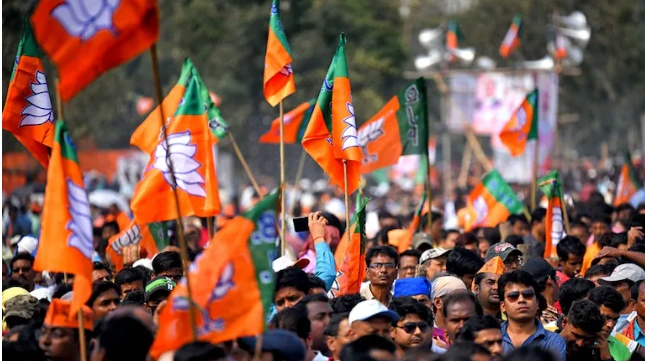
The BJP’s farmer outreach in Punjab’s Patiala has triggered a dispute with the Bharatiya Kisan Union (Shadipur), after the organisation rejected the party’s claim that its leaders had joined the BJP at an event.

The BJP had announced on Monday that around 100 to 150 leaders associated with farmer organisations had joined the party during its Nasha Mukti Yatra in Patiala Rural. The development was presented as part of the BJP’s efforts to connect with Punjab’s farming community ahead of the 2027 Assembly elections.

However, BKU (Shadipur) leader Buta Singh Shadipur said no one from the organisation had joined the BJP.

BKU Shadipur disputes BJP’s claim

Buta Singh Shadipur alleged that some people were brought from outside and presented as members of the farmer union. He also alleged that the organisation’s badge, name and logo were used during the programme.

The union is examining the event and has indicated that it could take legal action after reviewing the available material.

“Our legal advisers are with us. We are examining the videos and other material. Once the investigation is complete, we will consider sending legal notices to the people concerned,” Singh said.

He also said the use of the organisation’s identity could create an impression that BKU (Shadipur) had supported the BJP.

Singh stressed that individual participation in the BJP programme should not be interpreted as a decision taken by the farmer organisation.

BJP event participant defends decision

The BJP’s account of the event was supported by farmer Nirmal Singh, who defended his decision to join the party.

“Earlier, we opposed the BJP and said the BJP would not be allowed to enter Punjab. But after seeing all three major parties, people have now decided to support the BJP,” Nirmal Singh said.

He also criticised the AAP government in Punjab and said he believed the BJP could improve the situation in the state.

“The AAP has spoiled the atmosphere in Punjab. That is why we are joining the BJP. If any party can improve the situation in Punjab, we believe it is the BJP,” he said.

Union examines possible legal action

BKU (Shadipur) legal adviser Advocate Prabhjeet Singh said the alleged use of the organisation’s registered name and logo without permission was being examined.

He said the union was considering possible action under trademark law as well as defamation proceedings.

The dispute centres on whether the participation of individuals at the BJP event can be represented as an organisational decision by BKU (Shadipur). The union has maintained that individual participation should not be portrayed as an endorsement or decision by the organisation.

BJP steps up rural outreach in Punjab

The controversy comes as the BJP increases its outreach to rural and farming constituencies in Punjab ahead of the 2027 Assembly elections.

The party has sought to expand its political engagement beyond urban constituencies traditionally associated with its support base. Its outreach has included issues such as drugs, farmers’ welfare and rural development.

The Patiala episode has now added a dispute over the representation of a farmer organisation to the BJP’s efforts to engage with Punjab’s farming community.

India News

Sonia Gandhi snaps at Digvijaya Singh over Nitish Kumar remark

Sonia Gandhi responded sharply after Digvijaya Singh raised Nitish Kumar’s exit from the Opposition alliance during the Congress Working Committee meeting.

Published

on

Sonia Gandhi

A discussion on the Opposition alliance and Bihar Chief Minister Nitish Kumar’s political move led to a sharp exchange between senior Congress leaders Sonia Gandhi and Digvijaya Singh at the Congress Working Committee meeting.

During the meeting, Mr Digvijaya Singh raised the issue of Nitish Kumar and argued that the Congress and its allies should have been able to retain him within the Opposition alliance, according to people familiar with the discussion.

Sonia Gandhi responded firmly, saying that Nitish Kumar had “betrayed” the Opposition bloc and that it was better that he had left when he did.

The exchange came during a wider CWC discussion on the Congress’s political strategy and the recent electoral landscape.

Digvijaya Singh raises Nitish Kumar issue

Digvijaya Singh also argued in favour of restoring ballot papers in elections during the meeting, according to the account of the discussions. His remarks on Nitish Kumar were part of the internal deliberations on the Opposition’s political strategy.

The discussion reflected differing views within the Congress on how the party and its allies should have approached Nitish Kumar’s association with the Opposition bloc.

Sonia Gandhi’s response

Sonia Gandhi disagreed with the suggestion that the Opposition should have retained Nitish Kumar.

She said that Kumar had betrayed the Opposition bloc and indicated that his departure from the alliance was better for the Opposition than continuing with him, according to the report of the CWC proceedings.

The exchange took place during the Congress’s broader discussions on electoral issues and its political approach.

Continue Reading

India News

INDIA Bloc to meet today over SIR, Gyanesh Kumar and Election Commission

The INDIA bloc is scheduled to meet in New Delhi today amid the continuing political dispute over the Election Commission, SIR and Chief Election Commissioner Gyanesh Kumar.

Published

on

CEC Gyanesh Kumar

Opposition parties under the INDIA bloc are set to hold a meeting in New Delhi on Wednesday amid the continuing dispute over the Election Commission, the Special Intensive Revision (SIR) of electoral rolls and Chief Election Commissioner Gyanesh Kumar.

The meeting is scheduled at the Constitution Club of India and comes after opposition parties stepped up their criticism of the poll panel following reports about objections raised by Election Commissioners Sukhbir Singh Sandhu and Vivek Joshi on several issues concerning the commission’s functioning.

The Election Commission, however, has rejected the suggestion that there was formal dissent within the three-member panel. Sources have said the commissioners had made observations that were considered by the poll body, while the commission has maintained that its decisions, including those concerning SIR, were taken unanimously.

INDIA bloc meeting on Gyanesh Kumar

The opposition meeting is expected to focus on its strategy concerning Gyanesh Kumar and the Election Commission.

An earlier report said INDIA bloc parties had agreed to pursue a fresh removal motion against the Chief Election Commissioner, with Congress taking the initiative. A notice for the proposed motion was being prepared, according to Congress sources cited in that report.

The issue gained momentum after reports that Election Commissioners Sukhbir Singh Sandhu and Vivek Joshi had raised objections on several occasions concerning matters including electoral-roll management and changes to Form 6.

The Election Commission has disputed the interpretation of these internal observations as formal dissent. It has said that written notes, observations and suggestions are part of the functioning of a multi-member constitutional body and that official decisions followed due procedure.

Election Commission’s position on SIR

The Election Commission has maintained that the June 24, 2025 order launching the nationwide SIR exercise was approved unanimously by the full commission. It has also said that subsequent schedules related to the exercise received unanimous approval.

At its September 26 meeting, the three-member commission — Gyanesh Kumar, Sukhbir Singh Sandhu and Vivek Joshi — issued clarifications on several issues linked to the recent controversy.

The commission said that internal deliberations should not be treated as disagreement over final decisions and announced measures including advance circulation of meeting agendas and issuance of minutes.

Opposition’s concerns

Opposition parties have continued to question the Election Commission’s functioning and its handling of the SIR exercise.

The controversy centres partly on reports that the two Election Commissioners had recorded objections on several issues over a period of months. The opposition has cited these reports while demanding greater transparency and action against the Chief Election Commissioner.

The Election Commission, on the other hand, has maintained that its major decisions were taken collectively and unanimously. This difference in interpretation has become a central part of the ongoing political dispute over SIR and the functioning of the poll panel.

Continue Reading

India News

S Jaishankar warns of major food crisis, urges policymakers to look beyond borders

External Affairs Minister S Jaishankar has warned that disruptions to grain shipments and fertiliser supplies could contribute to a major food crisis in the coming months. He also highlighted interconnected pressures on food, fuel, fertiliser and finance.

Published

on

External Affairs Minister S Jaishankar has warned that the world could face a major food crisis in the coming months amid disruptions to grain shipments and fertiliser supplies.

Speaking at an event organised by the Asia Society in New York, Jaishankar linked the food security concerns to wider global pressures involving energy, fertilisers and finance. He described these interconnected challenges as part of what he has called the “4F crisis” — food, fuel, fertiliser and finance.

Jaishankar’s remarks came at the end of the UN High-Level Week in New York, where he also discussed global conflicts, supply-chain vulnerabilities, development challenges and the changing nature of international relations.

Jaishankar’s food crisis warning

Jaishankar said disruptions affecting grain exports could put additional pressure on food supplies. He also pointed to fertiliser shortages and the difficulties faced by major suppliers.

He specifically highlighted the importance of grain shipments through the Black Sea region and warned that difficulties in moving supplies could have wider consequences for food security. He said the situation could contribute to a major food crisis in the coming months.

The minister also referred to the possibility of additional pressure from weather conditions, including a strong El Niño, according to reports on his remarks.

What is the 4F crisis?

The “4F crisis” refers to pressures involving food, fuel, fertiliser and finance.

Jaishankar said a large part of the world is dealing with these interconnected challenges. He also pointed to growing vulnerabilities in global supply chains and said progress towards the Sustainable Development Goals was falling behind.

The four areas are closely connected. Disruptions to energy supplies can affect production and transportation, while fertiliser shortages can add pressure to agricultural output. At the same time, geopolitical conflicts can affect the movement of capital and increase financial pressure on developing economies.

Global conflicts adding pressure

Jaishankar linked the wider situation to ongoing conflicts and geopolitical tensions. He said the consequences of major conflicts are no longer confined to the countries directly involved.

He also highlighted concerns over the situation in West Asia and conflicts in Africa, including Sudan. According to Jaishankar, these developments are contributing to an increasingly difficult global environment.

The minister further said conflicts can push capital towards perceived safer markets, creating additional financial pressure on developing countries.

Jaishankar’s message to policymakers

Jaishankar urged governments to consider how their policy decisions affect countries beyond their own borders.

He argued that policymakers should not look only at domestic interests when decisions can have wider international consequences. He said countries should not become so focused on their own interests that they ignore the effects of their decisions elsewhere.

His remarks placed particular emphasis on the difficulties faced by developing countries, which can have less room to absorb simultaneous shocks involving food, energy, fertilisers and finance.

‘Interdependence is the reality’

Jaishankar also spoke about the tension between economic interdependence and geopolitical competition.

“The interdependence is the reality, the competition is the sentiment,” he said while describing what he called a central paradox of the current global environment. He argued that countries remain deeply connected but can increasingly use those connections as sources of leverage.

He also described diplomacy as an “extreme sport”, pointing to the growing risks associated with economic relationships, supply chains and geopolitical competition.

What did Jaishankar say about the global outlook?

Jaishankar described the international environment as increasingly difficult, citing conflicts, economic pressures, supply-chain vulnerabilities and uncertainty surrounding technology.

At the same time, he said he was not pessimistic about the world and noted that countries still have an interest in establishing stable and reliable arrangements.

Continue Reading

Trending

© Copyright 2022 APNLIVE.com