English हिन्दी
Connect with us

Latest Politics News

Former IPS officer Sanjiv Bhatt sentenced to life term in a 1990 custodial death case

Published

on

Sanjiv Bhatt

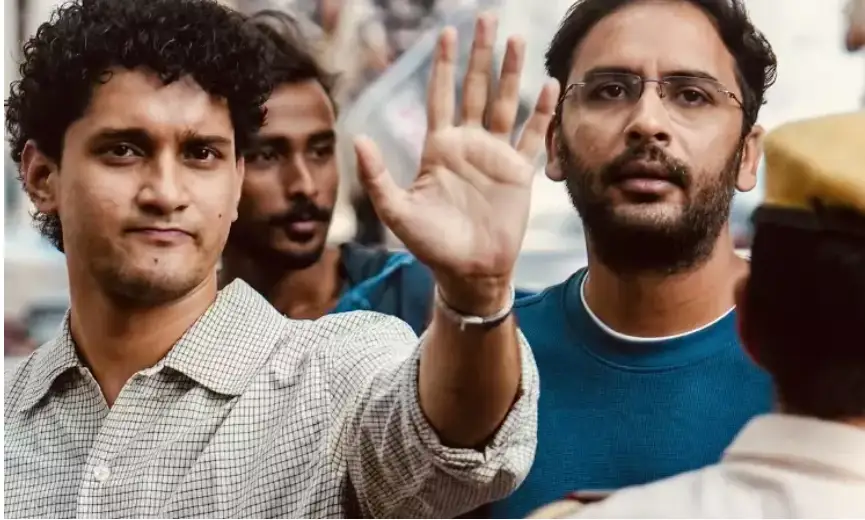
[vc_row][vc_column][vc_column_text]Former Gujarat cadre IPS officer Sanjiv Bhatt, who accused Narendra Modi, then chief minister, of complicity in 2002 Gujarat riots, was today (Thursday, June 20) found guilty of murder in a 1990 custodial death case and sentenced them to life imprisonment sentenced to life imprisonment by Jamnagar District and Sessions Court.

Also held guilty and given a similar sentence was Pravinsinh Zala, another police officer, media reports said.

Jamnagar’s sessions judge DN Vyas was yet to pronounce the quantum of sentence for six other policemen who were also convicted in this case, according to news agency ANI.

“The court found Pravinsinh Zala and Sanjiv Bhatt guilty under IPC section 302 and thus sentenced them to life imprisonment under IPC section 302. Rest of the accused were found guilty under section 323, 506 for custodial torture,” said Tushar Gokani and Madhu Mehta, special public prosecutors in the case.

The verdict was given out by judge DM Vyas, and quantum of punishment is awaited for the rest of the five accused.

The custody death case went for three decades after which the Supreme Court ordered that the judgment should be given before June 20 this year by the Jamnagar Sessions Court.

The sentence by the Jamnagar court comes a week after the Supreme Court denied Bhatt’s petition to examine additional witnesses.

The case dates back to 1990 when Bhatt was posted as the additional superintendent of police in Jamnagar. He had detained around 150 people during a communal riot in Jamjodhpur town, at the time of a rath yatra, being carried out by LK Advani. One of the detained persons, Prabhudas Vaishnani, had died in a hospital after he was released, allegedly due to torture. A complaint of custodial death was registered against eight policemen, including Bhatt, by Amrutlal Vaishnani, the brother of the deceased.

The policemen had opposed criminal proceedings against them on the ground that they were doing their official duty and the man who died was not subjected to custodial torture as alleged.

Justice Sonia Gokani of Gujarat High Court, in April, had ordered for a speedy trial in the special criminal application filed by the brother of the deceased, instructing that hearings be conducted in the matter on a day-to-day basis.

Bhatt, a 1988-batch IPS officer, is currently in judicial custody in a 22-year old drug planting case of Banaskantha, in a Palanpur jail.

Bhatt, who was a1988 batch officer of Gujarat cadre, was suspended by the Gujarat government after he took on Narendra Modi, accusing him of asking the police to go slow on Hindus during the 2002 riots in which 1,200 people were killed.

The police officer, however, could not back up his claim and was suspended soon after. In 2015, the government sacked the police officer for “unauthorized absence” from service

The BJP had rebutted him, insisting that the Sanjiv Bhatt was working on the agenda of rival political parties. His wife contested the assembly election in 2012 against Narendra Modi on a Congress ticket.[/vc_column_text][/vc_column][/vc_row]

India News

Nagaland Assembly urges Centre to withdraw Protected Area Permit regime

Nagaland Assembly unanimously passed a resolution urging the Centre to withdraw the Protected Area Permit regime, citing concerns over tourism, investment and international engagement.

Published

on

The Nagaland Legislative Assembly has unanimously passed a resolution urging the Centre to withdraw the Protected Area Permit (PAP) regime in the state, arguing that the restrictions are affecting tourism, investment, international engagement and economic opportunities.

The resolution was moved by Deputy Chief Minister and Home Minister Yanthungo Patton and was adopted through a voice vote.

PAP regime was reimposed in 2024

The Protected Area Permit regulates the entry of foreign nationals into notified areas. The regime had been relaxed in Nagaland in 2011 but was reimposed on December 17, 2024.

During the Assembly discussion, Patton said Nagaland had emerged as a peaceful destination for tourism, culture, investment, entrepreneurship and international engagement. He said these sectors were increasingly contributing to employment and livelihood opportunities, particularly for young people.

The resolution also highlighted events and initiatives such as the Hornbill Festival and the “Land of Festivals” initiative, saying they had helped showcase Nagaland and India’s cultural diversity internationally while generating economic opportunities for local communities and entrepreneurs.

Assembly links PAP restrictions to economic concerns

The state government argued that the return of the PAP regime has complicated efforts to expand international tourism, business and investment.

The Assembly resolution said the regime was creating difficulties for international tourism, business and investment, along with cultural exchanges and overseas partnerships.

However, the state maintained that relaxing the permit regime would not mean compromising national security.

The resolution assured the Centre that foreign nationals could continue to be registered, regulated and monitored through technology-based and institutional mechanisms in coordination with central agencies.

Neiphiu Rio backs review of PAP regime

Chief Minister Neiphiu Rio also participated in the debate along with Tourism and Higher Education Minister Temjen Imna Along, Industries and Commerce Advisor Hekani Jakhalu and MLA Naiba Konyak.

The legislators maintained that Nagaland’s present circumstances warranted a different approach, stressing that the state was peaceful and seeking greater opportunities in tourism, investment and other sectors.

Rio linked the demand to Nagaland’s economic aspirations and the need to create more opportunities for young people while maintaining the state’s commitment to national security.

“Security and development can go together,” Rio said.

The resolution further argued that regulations that have outlived their developmental relevance should not become barriers to employment, economic activity and Nagaland’s participation in the wider national and global economy.

Continue Reading

India News

Mayawati says Akash Anand needs more maturity, rules out major BSP role

BSP chief Mayawati says nephew Akash Anand needs greater political maturity before taking on a major responsibility in the party.

Published

on

Akash Anand

Bahujan Samaj Party (BSP) chief Mayawati on Thursday said her nephew Akash Anand needs to gain greater political maturity before he can be entrusted with any major responsibility in the party.

Addressing a national-level meeting of BSP office-bearers, Mayawati said she had allowed Akash Anand to continue working within the organisation but felt that he was not yet ready to handle a significant party responsibility.

“I have allowed Akash Anand to work in the party, which is before all of you, but Akash Anand still needs to become more mature. Till then, it would not be appropriate to give him a major responsibility in the party,” Mayawati said.

Mayawati also made it clear that Akash Anand, who is the BSP’s national coordinator, would continue working in the party. However, he will not be entrusted with any major responsibility for the time being.

Mayawati refers to Kanshi Ram’s principles

Explaining her position, Mayawati referred to the principles of BSP founder Kanshi Ram.

She said Kanshi Ram had permitted members of his family and other relatives to assist with party work, but was against giving them election tickets or positions after the party came to power.

Mayawati said she was also committed to following that principle. According to her, maintaining this approach was important to protect the BSP from tactics allegedly employed by political opponents during elections.

BSP to contest elections alone

During the meeting, Mayawati also announced a major political decision concerning the BSP’s electoral strategy.

She said the party had decided to contest all elections across the country on its own, irrespective of whether they were small or major elections.

Targeting the Congress, Mayawati described it as a “strongly anti-Dalit and anti-Ambedkar” party and said the BSP would therefore fight elections independently rather than depend on other parties.

The decision was announced as Mayawati reviewed the BSP’s organisational work and discussed shortcomings with party office-bearers.

She instructed leaders at different levels to implement the party’s annual organisational activities with complete honesty and dedication.

Mayawati attacks RSS over minority rights

Mayawati also criticised the Rashtriya Swayamsevak Sangh (RSS), referring to comments made by its chief Mohan Bhagwat during his recent visit to the United States.

Bhagwat had said that a Hindu who believes there should be no Muslims in Bharat would not remain a Hindu. He had also spoken about Hindu philosophy accepting that different faiths can lead to the same truth and emphasised the idea of unity in diversity.

Mayawati, however, said there was a significant difference between the RSS’s statements and its actions.

She argued that the organisation lacked credibility when it came to issues concerning the interests and welfare of the Bahujan Samaj, reservation as a constitutional right, and the safety, dignity and religious freedom of women, Muslims and other religious minorities.

She further said that despite its long existence, the RSS had not received the recognition and respect it sought.

Mayawati invokes Ambedkar’s Constitution

The BSP chief also challenged the RSS to demonstrate its commitment to the Constitution drafted under the leadership of Babasaheb Dr Bhimrao Ambedkar.

Mayawati said that if the RSS genuinely had faith in a humanitarian, welfare-oriented and egalitarian Constitution, it should follow its principles honestly and ensure that its members did the same.

BSP reiterates focus on Bahujan Samaj

At the national meeting, Mayawati reviewed the BSP’s organisational activities, assessed its shortcomings and gave directions to office-bearers regarding the party’s future work.

She reiterated that protecting the interests of the Bahujan Samaj and bringing exploited and deprived sections to political power remained the BSP’s central mission.

Mayawati maintained that achieving political power was necessary for the party to fulfil these objectives.

Her latest remarks on Akash Anand indicate that while her nephew will remain associated with the BSP and continue working for the organisation, he will not receive a major party responsibility until she believes he has attained the required political maturity.

Continue Reading

India News

Raghav Chadha marked as shifted in Punjab draft voter rolls, alleges AAP vendetta

Raghav Chadha has alleged political vendetta after his name was marked “shifted” in Punjab’s draft electoral rolls during the SIR exercise.

Published

on

Raghav Chadha

BJP Rajya Sabha MP Raghav Chadha has raised questions after his name was marked as “shifted” in Punjab’s draft electoral rolls prepared during the Special Intensive Revision (SIR) of voter lists.

Chadha, who remains a Rajya Sabha member from Punjab and has his voter registration in Mohali, alleged that the classification was not a routine clerical error and accused the Aam Aadmi Party-led Punjab government of political vendetta.

The electoral rolls currently under discussion are draft lists, with the final rolls scheduled to be published in October 2026.

Raghav Chadha questions voter list classification

Chadha said he was surprised to find his name classified as “shifted” despite being a sitting MP from Punjab.

He questioned how such a classification was made and pointed to the involvement of officials at different stages of the electoral roll revision process. According to Chadha, Booth Level Officers, Assistant Electoral Registration Officers, Electoral Registration Officers and District Election Officers are part of the process.

He alleged that these officials could potentially face political pressure because their transfers and postings are controlled by the state government.

Chadha also referred to Paragraph 4(d) of the Election Commission of India’s SIR guidelines. He said the provision requires public representatives, including MPs and MLAs, whose names are flagged in the electoral database to be included in the draft rolls so that they can participate in the claims and objections process.

He alleged that this provision was not followed in his case.

Punjab CEO seeks report on Chadha’s voter status

Punjab Chief Electoral Officer Anindita Mitra told that she was not aware of any deletion of Chadha’s name from the electoral rolls.

She said a detailed report would be sought from the district election authorities to determine whether his name had actually been deleted and, if so, the reason for the action.

Mitra also pointed out that the claims and objections process is currently underway. September 13 is the deadline for filing appeals over changes or discrepancies in the electoral rolls.

AAP rejects political vendetta allegation

The controversy has also drawn a response from the Aam Aadmi Party.

AAP leader Neel Garg rejected Chadha’s allegation, saying the party had no interest in deleting the vote of any individual. He instead alleged that the issue was being raised by the BJP and referred to the SIR exercises in Bihar and West Bengal.

Chadha joined the BJP in April 2026 along with six other AAP Rajya Sabha MPs.

The dispute comes as Punjab’s electoral rolls undergo revision ahead of the 2027 Assembly elections. Since the claims and objections process is still open, the status of Chadha’s name is subject to the ongoing electoral process.

Continue Reading

Trending

© Copyright 2022 APNLIVE.com