English हिन्दी
Connect with us

Latest Politics News

‘Modi like bride who makes noise with bangles but doesn’t work’: Navjot Singh Sidhu

Published

on

Navjot Singh Sidhu

[vc_row][vc_column][vc_column_text]Congress leader Navjot Singh Sidhu hit out at Narendra Modi with a sexist jibe today (Saturday, May 11) by comparing the Prime Minister to a bride who only makes noise with bangles but doesn’t make enough chapattis.

The Punjab minister also called Modi “liar-in-chief, divider-in-chief and business manager of Ambani and Adani”, with reference to TIME magazine’s latest cover.

“Modi Ji uss dulhan ki tarah hain jo roti kum baelti hai aur chudiyaan zada khankati hai taaki mohalle walon ko yeh pata chale ki woh kaam kar rahi hai. Bas yahi hua hai Modi sarkaar mein (Modi ji is like a bride who makes less chapattis but more noise with her bangles so that neighbours know she is working. This is what happened during Modi government),” Sidhu said while addressing media in Indore.

Also Read: Indian Air Force gets its first Apache Guardian helicopter in United States

The Congress leader said elections are being fought for the welfare of people and not against the BJP as the party is “looting the country”.

“I raise issues against the Prime Minister so that the future generation does not point fingers at us claiming that we did not do anything when the BJP was looting the country. I have given statements against the Prime Minister in six press conferences. I have also raised many issues, but he did not even address a single issue. Moreover, if one looks closely, he does not talk about women security, educations, Hunger Index, farmers in his rallies,” the former cricketer said.

With reference to TIME magazine’s latest cover, Sidhu accused Modi of being a liar, “ I call him (Narendra Modi) Liar-in-Chief, Divider-in-Chief and Business Manager of Ambani and Adani,” he said.

The cricketer-turned-politician is not new to controversies, on Friday he referred to BJP leadership as “kaale angrez” (dark-skinned British).

Also Read: A BJP woman activist arrested for sharing Mamata Banerjee’s morphed picture

“Congress is the party that gave freedom to the country; it is the party of Maulana Azad and Mahatma Gandhi. They got freedom from the British, now will give the people of Indore the freedom from ‘Kaale Angrez’. We free the country from these ‘chors and chowkidars’,” Sidhu had said.

Sidhu was barred from campaigning by the Election Commission for 72 hours last month for allegedly asking Muslims in Bihar against splitting their votes. He was served another notice by the poll body on Friday for his remarks against the Prime Minister.

(With ANI Inputs)[/vc_column_text][/vc_column][/vc_row]

India News

Rahul Gandhi’s T-shirt style gets a colourful twist for Gen Z outreach

Rahul Gandhi has adopted colourful shirts during his nationwide “Chhatron Ki Goonj” programme as the Congress steps up its outreach to Gen Z.

Published

on

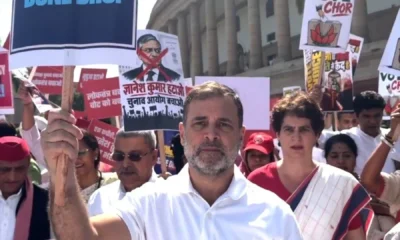
Congress leader Rahul Gandhi has added a new twist to his public image as he steps up outreach to Gen Z through the nationwide “Chhatron Ki Goonj” programme.

The Leader of the Opposition in the Lok Sabha, who became known for wearing T-shirts during the 2022 Bharat Jodo Yatra, has recently been seen in brightly coloured shirts at several student-focused events.

The change marks a departure from the white T-shirts that became closely associated with his appearance during the Bharat Jodo Yatra, when he walked from Kanyakumari to Kashmir.

From white T-shirts to colourful shirts

Rahul Gandhi wore white T-shirts during the Bharat Jodo Yatra, including during its winter leg. He subsequently continued to appear in T-shirts at party programmes and political events.

The style also became a subject of political criticism, with the BJP repeatedly targeting Gandhi over his choice of attire and describing him as “non-serious”.

Gandhi, however, continued with the T-shirt look and it was also adopted by some Congress leaders who had traditionally appeared in kurta-pyjamas.

His latest appearances have brought a more colourful wardrobe into focus.

Rahul Gandhi’s colourful appearances

Gandhi wore a blue shirt at the first “Chhatron Ki Goonj” event in Kota, where he addressed the issue of paper leaks.

In Dehradun, he was seen wearing a shirt instead of his usual T-shirt. At an event in Allahabad, he wore a pink shirt while interacting with students, drawing discussion on social media.

He later appeared in a yellow shirt at an event in Pune.

The Pune programme focused specifically on female students and working women, with Gandhi addressing issues related to women’s safety, freedom and rights.

Congress steps up Gen Z outreach

The “Chhatron Ki Goonj” programme is part of Rahul Gandhi’s outreach to young people, with paper leaks and issues affecting students among the subjects being highlighted.

The Congress is also seeking to engage young women through programmes and interactions focused on issues concerning them.

Youth and women remain important voter groups in elections, and the Congress is increasingly focusing its outreach on Gen Z as it seeks to strengthen its connection with younger voters.

Gandhi’s colourful shirts have consequently become an additional talking point during his latest student and youth engagements.

Continue Reading

India News

MK Stalin announces major DMK organisational Changes in Tamil Nadu

MK Stalin has announced a major DMK organisational overhaul, introducing age and term limits and expanding party districts from 77 to 110.

Published

on

DMK chief MK Stalin has announced a major overhaul of the party’s organisational structure, months after the party lost the Tamil Nadu assembly election.

Acknowledging the defeat, Stalin said the party must openly recognise its mistakes. He also pointed to the functioning of party office-bearers as one of the factors behind the electoral loss.

“Although there are several reasons for our defeat, the functioning of our party office-bearers is also one of them,” Stalin said, stressing that the party must acknowledge its shortcomings and ensure better performance at every level.

Stalin also described the DMK as a “specialist” in making comebacks and said the party would return stronger.

Age and term limits for party posts

Among the major changes announced by Stalin are age and tenure limits for party positions.

Stalin said the changes would involve a significant restructuring of the DMK’s administrative system, with priority being given to new faces. He said the measures were intended to make the party sustainable for the next 100 years and help restore the trust of young people and women.

Under the new rules, branch secretaries must be aged 45 or below and can hold the position for a maximum of two terms.

District secretaries, meanwhile, must be below 70 years of age and can serve for a maximum of three terms.

DMK to increase party districts from 77 to 110

The DMK executive committee has approved increasing the number of party districts from 77 to 110.

The expansion will be implemented as part of the party’s 16th organisational elections. Revenue districts will generally be reorganised so that each party district covers two assembly constituencies.

Where only one constituency remains after the reorganisation, it will be attached to another suitable party district within the same revenue district as a third constituency.

Stalin has been authorised to determine and announce the constituencies that will form the 110 party districts.

New branch structure planned in urban areas

The DMK will also introduce a new branch-level structure in urban areas, along with the post of branch secretary.

The new system will initially be implemented in Chennai, Coimbatore, Madurai, Tiruchirappalli and Salem. It may subsequently be extended to other corporations.

Once the new party districts are announced, district executive committees will have to meet and establish the union, city, area, town, ward and branch-level units within 15 days.

The organisational changes come as the DMK seeks to restructure its party machinery and prepare for its political comeback following its assembly election defeat.

Continue Reading

India News

Jharkhand students, JMM workers clash over Hemant Soren effigy burning

Clashes broke out in Ranchi, Hazaribag and Giridih as protesting students attempted to burn effigies of Hemant Soren and Rahul Gandhi.

Published

on

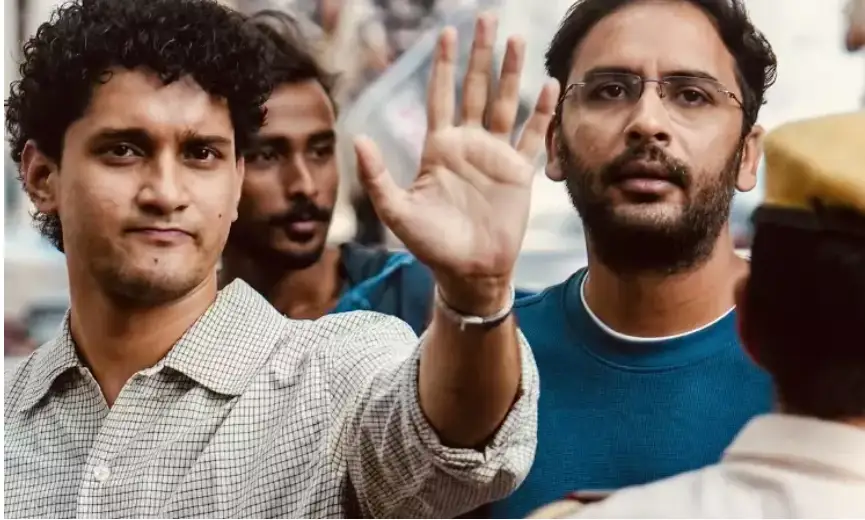
Clashes broke out between protesting students and police in Ranchi and several other parts of Jharkhand on Friday evening as students attempted to burn effigies of Chief Minister Hemant Soren and Congress leader Rahul Gandhi, officials said.

Similar incidents were reported in Hazaribag and Giridih, where workers of the ruling Jharkhand Mukti Morcha (JMM) clashed with students who were trying to burn effigies of Soren.

The protesting students are affiliated with the JPSC-JSSC Reforms Manch. They have accused the Jharkhand government of deceiving and betraying job aspirants following the High Court’s intervention in cases concerning recruitment examinations and appointments.

In Ranchi, a large number of students gathered at Albert Chowk to burn the effigies. Police said a scuffle broke out when they tried to control the situation.

Ranchi DSP KV Raman said the protesters changed the designated route of their march and went towards the JPSC office, where traffic was brought to a halt.

According to Raman, police repeatedly asked the protesters to follow the designated route for the march and effigy burning, but the students did not comply.

Student leaders, however, alleged that police and JMM workers attempted to prevent them from holding a peaceful march.

“They cannot stop us from holding peaceful and democratic protests,” JPSC-JSSC Reforms Manch leader Ravindra Paswan said.

Another student leader, Piyush Kumar Singh, alleged that a core committee member of the Manch, Kunal, was detained by police. He claimed that Kunal fainted and was subsequently taken to Sadar Hospital.

The protesters also alleged that female participants were assaulted by JMM workers during the scuffle.

Why are Jharkhand students protesting?

The students had earlier called off their agitation after the Hemant Soren government decided to cancel JPSC examinations where irregularities had been alleged.

However, the Jharkhand High Court subsequently intervened in several matters related to the recruitment process.

On Friday, the court stayed notifications cancelling the appointments of Child Development Project Officers (CDPOs) and those recruited through the JSSC-CGL examination.

A day earlier, the court had stayed notifications cancelling the 11th and 13th JPSC examinations. It had also stayed the order cancelling the appointments of food safety officers.

The developments have renewed the students’ concerns over the government’s handling of recruitment-related cases.

JLKM announces recruitment reforms yatra

Meanwhile, JLKM leader Devendra Nath Mahto announced that his party would launch a ‘Recruitment System Reforms Yatra’ from August 24.

Mahto alleged that the Jharkhand government was not strongly defending cases concerning the cancellation of several recruitment examinations before the High Court.

He warned that if the government failed to effectively present its case before the Jharkhand High Court on September 15, when the matters are scheduled for hearing, they would plan to gherao the Chief Minister’s residence.

Continue Reading

Trending

© Copyright 2022 APNLIVE.com