English हिन्दी
Connect with us

Latest Politics News

PM Modi talks of govt achievements, makes major announcements for defence & water

Published

on

PM Narendra Modi

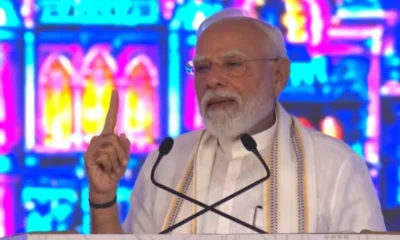
In his first Independence Day speech after being voted back, Prime Minister Narendra Modi recounted his government’s achievements ‘within 10 weeks of returning to power’, made a couple of major announcements and outlined his views on some issues of social concern.

A major announcement was appointing a Chief of Defence Staff (CDS) to head all three wings of India’s defence forces – Army, Navy and Air Force – a decision pending since long. The need for this was strongly realised twenty years ago during the review of the Kargil war and would have far-reaching ramifications for defence preparedness and co-ordination between the three services.

Modi said the creation of a Chief of Defence Staff (CDS) would “further sharpen coordination between the forces”. The CDS will coordinate between the three services, the Army, Air Force and Navy, he said. “Our forces are India’s pride. To further sharpen coordination between the forces, I want to announce a major decision from the Red Fort. India will have a Chief of Defence Staff. This is going to make the forces even more effective,” PM Modi said from the ramparts of the Red Fort in New Delhi.

Another significant announcement related to water, which has emerged as a major concern, conceiving the creation of Jal Jeevan Mission for water conservation and revival of water bodies, and an allocation of Rs.3.5 lakh crores.

“Just as I called upon the country to join the Swachchta Mission to make India Open Defecation Free, I ask that you join the Jal Jeevan Mission which cannot succeed unless people participate on a mass level,” said PM Modi.

Modi dwelt upon the removal of special status of Jammu and Kashmir and the reorganisation of the State into two Union territories and the passage of the Triple Talaq Bill in great detail, stating that his government believed neither in “creating problems nor prolonging them” but in meeting them head on and resolving them.

On J&K and Article 370, he said that scrapping the special status to Jammu and Kashmir is the first step towards realising the dream of Sardar Vallabhbhai Patel. He slammed the previous governments for needlessly letting the issue go on for all these decades. “India is asking those who supported Article 370, if this was so important and life-changing, why was this Article not made permanent? After all, those people had large mandates and could have removed the temporary status of Article 370,” he said.

The removal of special status to Jammu and Kashmir would ensure justice and development to backward sections of society in the State and lakhs of migrants who had moved to the State post partition of India, he said. “Now we can say with pride, One Nation, One Constitution,” he said, reiterating the long-standing stand of the party.

On the Triple Talaq Bill, he said that if social evils such as ‘Sati’ could be proscribed, “Muslim sisters were also deserving of justice by the removal of Triple Talaq.” Citing the new triple talaq law as a medium to ensure a better life for Muslim women, he said, “Scrapping of instant triple talaq will help Muslim women live a better life. The decision should not be seen through a political prism. If we can take steps against ‘Sati’ custom, female foeticide and dowry, then why not against instant triple talaq.”

Modi also reasserted his stand on simultaneous Lok Sabha and Vidhan Sabha elections, saying the concept of ‘one nation, one election’ is imperative to make the country great. “Today, India is talking about ‘One Nation, One Election’. Discussions should now be held on one nation one election, it is imperative to make the country great,” he said.

Asserting that his government will not leave any stone unturned to “fulfil the aspirations of the New India”, he said, “GST brought to life the dream of One Nation, One Tax. India has also achieved One Nation, One Grid in the energy sector. Arrangements have been made for One Nation, One Mobility Card. Today, India is talking about One Nation, One Election.”

A large part of the Prime Minister’s speech was devoted to concerns related to the environment and behavioural changes needed at the societal level.

Also Read: Heavy penalty for commercial vehicles in Delhi without radio-frequency identification (RFID)

Pitching for population control, he termed those practising a small family norm as performing a form of patriotism. “Population explosion in the country will create various problems for the coming generations. Those who follow the policy of small family also contribute to the development. It is also a form of patriotism,” he said.

He also emphasised the goal of becoming free of single-use plastic starting October 2nd, Mahatma Gandhi’s birth anniversary. He urged shopkeepers to discourage the use of plastic bags in their stores and asked citizens to gift cloth bags to each other for use this Diwali.

He made a special appeal to farmers to avoid the use of chemical based fertilizers and aim to keep at least 20-25% of their land holding free of these. “When we say ‘Bharat Mata ki Jai’ we should care for the health of the motherland too,” he said. He also urged bureaucrats in his own government to find ways and means to reduce the presence of government in the everyday life of the people.

Also Read: PM Modi gives a heartfelt speech at Sushma Swaraj’s condolence meet

He made a special appeal to youngsters to travel to at least 15 destinations within India in the next year, not just to know the country better but to give a boost to the tourism sector.

The PM’s speech had no reference to neighbouring Pakistan but did make common cause with other neighbours such as Bangladesh and Sri Lanka who had been, like India, at the receiving end of terror fomented from beyond their borders. He also wished Afghanistan on its upcoming centenary of independence.

While the economy continuing to be down, Modi sought to assure people that the fundamentals of the economy were strong and that his government had earmarked Rs.100 lakh crores in the next five years for investment in infrastructure which he said would lift the economy.

“India does not want incremental progress. A high jump is needed, our thought process has to be expanded. We have to keep in mind global best practices and build good systems,” he said.

India News

Congress Dismisses Karnataka Leadership Transition Rumors After Six-Hour Delhi Meet

The Congress party has rejected ongoing rumors regarding a leadership change or a rotating Chief Minister formula in Karnataka, stating that a recent six-hour meeting in Delhi focused strictly on the upcoming Rajya Sabha and MLC elections.

Published

on

The Congress party has strongly downplayed the intense political buzz surrounding a potential leadership transition or a change in the Chief Minister’s post in Karnataka. Following a marathon six-hour meeting with the state’s top leadership in New Delhi, the party explicitly rejected the ongoing speculation, labeling it as having “no reality.”

A brief statement issued to the media after the high-level meeting advised against spreading rumors, clarifying that the discussions were entirely centered on upcoming electoral strategies rather than structural changes within the state government. The party stated that the deliberations solely revolved around the state’s three vacant Rajya Sabha seats and the upcoming Member of Legislative Council (MLC) elections.

Rajya Sabha and MLC Polls Take Center Stage

The high-stakes meeting was attended by Congress President Mallikarjun Kharge, senior leader Rahul Gandhi, and party General Secretary KC Venugopal, alongside Karnataka Chief Minister Siddaramaiah and Deputy Chief Minister DK Shivakumar.

Briefing the media post-meeting, KC Venugopal stated that conversations were strictly confined to the Rajya Sabha and MLC elections, emphasizing that there is no truth to any other political speculation. Chief Minister Siddaramaiah also confirmed that the agenda of a potential cabinet expansion or a leadership shift did not come up during the six-hour-long discussion.

Background of the Power Struggle

The question of leadership in Karnataka has remained a recurring theme for over a year. Supporters of Deputy Chief Minister DK Shivakumar have consistently maintained that the central leadership promised a rotating Chief Ministership arrangement when the government was formed after the 2023 assembly elections.

Speculation had intensified recently as the ruling government faced local anti-incumbency pressures alongside renewed political activity from the opposition bench. Some internal reports had even indicated a push from within certain sections of the high command, including Priyanka Gandhi Vadra, for a leadership revamp.

Balancing Caste Equations and Party Structure

The central leadership has navigated the situation cautiously to maintain political stability. Chief Minister Siddaramaiah, 80, commands a powerful “Ahinda” support base—a coalition comprising minority communities, backward classes, and Dalits. This social alliance was crucial in helping the party navigate the traditional Vokkaliga and Lingayat caste dynamics during the 2023 elections.

Although the rotation issue had previously gained significant momentum when the government completed two years in office, the party high command had chosen to maintain the status quo to avoid any adverse electoral impact in neighboring assembly elections, such as in Tamil Nadu. With those elections concluded, supporters of the 64-year-old Deputy Chief Minister had expressed optimism for a transition. Shivakumar currently holds the dual responsibility of being the Deputy Chief Minister as well as the state Congress chief, signaling his critical organizational value to the party. However, for the time being, the party high command has firmly signaled that the current leadership structure will remain unchanged.

Continue Reading

India News

Congress high command steps in to resolve Karnataka leadership impasse with crucial Delhi meeting

The Congress leadership, including Mallikarjun Kharge and Rahul Gandhi, is holding a vital meeting in Delhi with Karnataka Chief Minister Siddaramaiah to find a definitive solution to the state’s prolonged leadership impasse.

Published

on

The top leadership of the Congress party is scheduled to hold a high-level meeting at its headquarters in the national capital today morning to address the long-standing leadership dispute in Karnataka. Senior leaders, including party president Mallikarjun Kharge and MP Rahul Gandhi, will lead the discussions aimed at resolving the continuous friction between Chief Minister Siddaramaiah and Deputy Chief Minister DK Shivakumar.

The ongoing power struggle over the state’s top position has persisted since the party’s electoral victory in 2023. For the current session, only Chief Minister Siddaramaiah has been called to join the discussions in Delhi. When questioned about the agenda by reporters, the Chief Minister stated that he was unaware of the specific subjects to be discussed, noting that political speculation is inevitable.

Background of the internal division

The internal friction intensified significantly in November 2025 when the state government completed its two-and-a-half-year mark in office. Supporters of the Deputy Chief Minister pointed to a purported unacknowledged internal arrangement suggesting a rotational chief ministership split equally across the five-year term. Despite multiple prior interventions by central party leadership to manage the internal friction, a permanent resolution has remained elusive.

While Deputy Chief Minister DK Shivakumar has not been invited to this morning’s initial session, indications suggest that separate individual discussions and a potential joint meeting involving both leaders are planned as part of the broader resolution process. Observers note that several state ministers and legislators have also traveled to the national capital as the party leadership aims to settle the administrative roadmap and finalise leadership plans before the next assembly elections.

Continue Reading

India News

No uniform civil code provisions will be imposed on tribals, clarifies Amit Shah

Union Home Minister Amit Shah has assured tribal communities that the proposed Uniform Civil Code will not interfere with their customs, urging them not to be misled by misinformation.

Published

on

Union Home Minister Amit Shah on Sunday declared that the proposed Uniform Civil Code (UCC) will not impact tribal populations in any manner. He called upon the community to stay vigilant against “conspiracies” and misinformation circulating on the subject.

Addressing the Janjati Sanskritik Samagam—a tribal conclave organized by the Janjati Suraksha Manch at the Red Fort grounds to mark the 150th birth anniversary year of Birsa Munda—Shah stated that specific provisions have been implemented in states ruled by the ruling party to exclude tribal communities from the scope of the code.

Clarification on customs and traditions

The Home Minister highlighted that a deliberate narrative has emerged suggesting the proposed legislation would strip tribal societies of their distinct culture, traditions, and customary lifestyles.

He explicitly clarified that the central government has no intention of forcing UCC regulations upon tribal or Vanvasi communities. Shah pointed out that where regional administrations have initiated the code, care has been taken by the leadership to ensure that indigenous populations remain fully outside its jurisdiction. He requested attendees to disseminate this assurance deeply into forest zones and rural villages to erase lingering apprehensions.

Focus on security and community development

Beyond the legislative framework, Shah detailed the progress made toward curbing internal security threats, stating that the nation is steadily advancing toward eradicating Naxalism entirely. He noted that violent disruptions had severely restricted progress in these belts for decades, leading to the loss of thousands of tribal lives. According to the minister, regional stability will now pave the way for accelerated development across remote hills and forests.

The address also covered constitutional rights regarding personal faith. Shah mentioned that the original framework of the Constitution grants every citizen the dignity to practice their traditional beliefs without facing coercion, temptation, or material inducement for religious conversion.

Reflecting on financial allocations, the minister criticized earlier political administrations for keeping tribal welfare funding low. He underscored that the current administration under Prime Minister Narendra Modi significantly elevated the dedicated tribal budget from a previous Rs 28,000 crore to Rs 1.54 lakh crore. Terming the vast gathering a historical movement for cultural preservation, Shah described the societal awakening as a major step toward safeguarding tribal heritage for future generations.

Continue Reading

Trending

© Copyright 2022 APNLIVE.com