English हिन्दी
Connect with us

India News

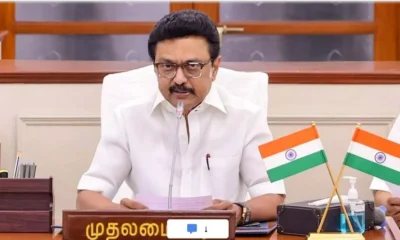
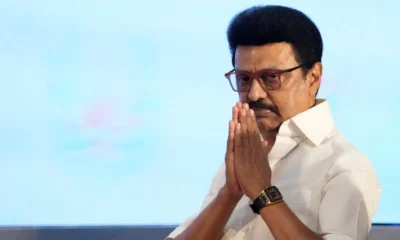
Udhayanidhi Stalin calls arrest comedy, attacks Vijay after release from police questioning

After being released following police questioning over his Trisha remarks, Udhayanidhi Stalin called his arrest a “comedy”, attacked Vijay-led TVK, denied insulting women and vowed to fight the case legally.

Published

on

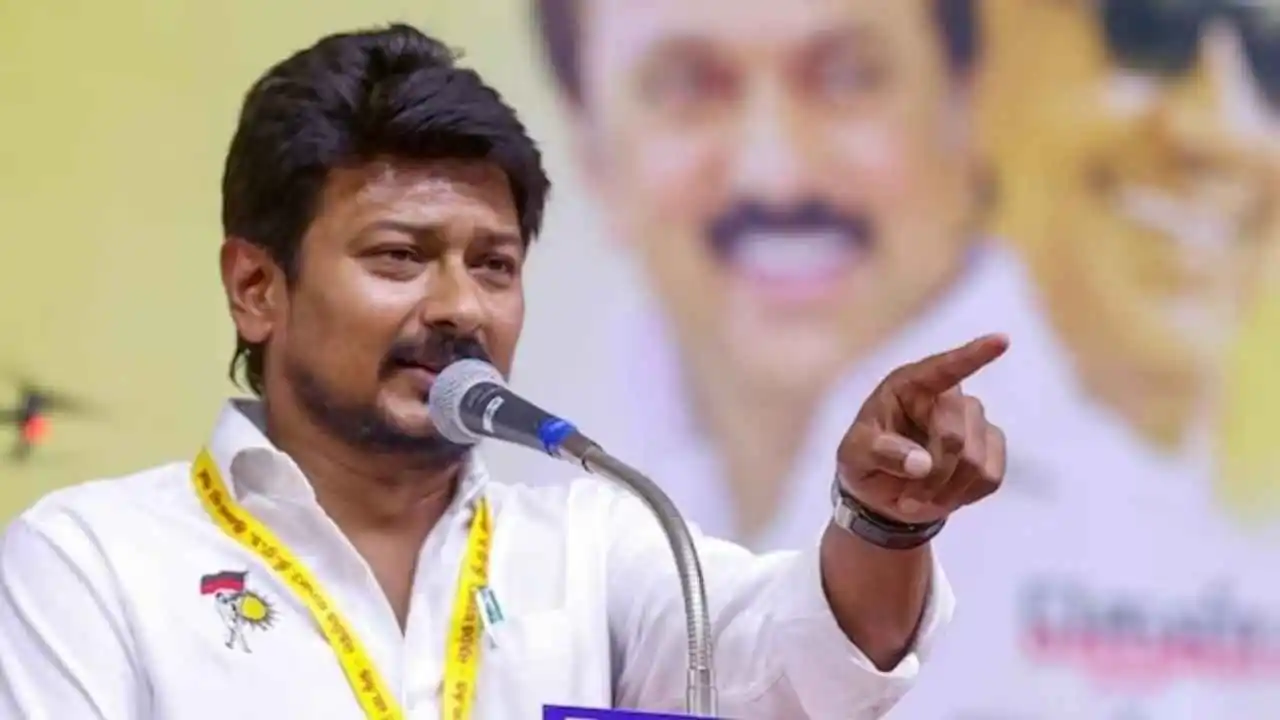
Senior DMK leader and Tamil Nadu Leader of the Opposition Udhayanidhi Stalin launched a sharp attack on the ruling Tamilaga Vettri Kazhagam (TVK) government shortly after being released following police questioning over his remarks on actor Trisha Krishnan.

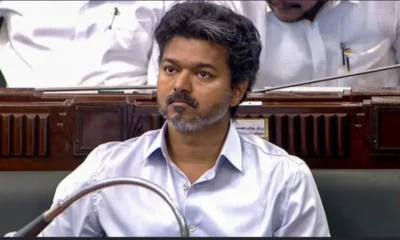
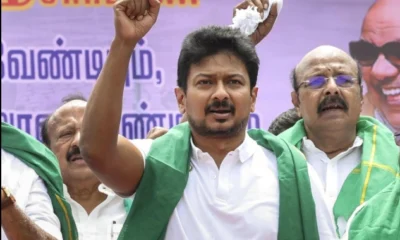
Welcomed by supporters outside the police station in Thanjavur on Tuesday evening, Stalin described his detention as a “comedy” staged by a “circus government” and referred to Chief Minister Vijay as a “dummy Chief Minister”.

He alleged that the action against him was intended to shift public attention away from what he described as the government’s failure to address the Cauvery water issue affecting farmers.

Udhayanidhi Stalin links arrest to Cauvery water issue

Addressing supporters after his release, Udhayanidhi Stalin claimed he had been treated “like a terrorist” despite raising concerns related to farmers, the Mekedatu dam project and the Cauvery river dispute.

He said that during the previous DMK government, water from the Mettur dam was released annually on June 12 for farmers, but alleged that the current TVK government had failed to secure water despite five months in office.

According to Stalin, his criticism was focused on governance and the state’s handling of water-related issues rather than personal attacks.

DMK leader denies insulting women over Trisha remarks

Responding to the controversy surrounding his speech, Udhayanidhi Stalin maintained that his remarks had been taken out of context.

He alleged that portions of his speech had been selectively edited to create a misleading impression. Rejecting allegations that he had used inappropriate language or double meanings, he said his comments were solely about the need for water for farmers.

Stalin also stressed that he had no intention of disrespecting women and said he regarded every mother and sister in Tamil Nadu as members of his own family. He expressed disappointment that some political allies criticised him without watching his complete speech.

Says he is ready to face legal action

In a post on X, the DMK leader asserted that he would not be intimidated by police cases or political pressure.

Referring to his political background, he said he was prepared to fight the matter through legal means and would continue raising the Cauvery issue on behalf of farmers. He also thanked DMK workers and alliance leaders who protested against his detention and demanded the release of those held during demonstrations.

TVK dismisses Udhayanidhi Stalin’s allegations

TVK leader Adhava Arjuna rejected Stalin’s accusations, saying the government was not driven by political revenge.

He argued that the ruling party did not view Udhayanidhi Stalin as a political rival and challenged him to resign as an MLA and contest a fresh election without relying on his family’s political legacy. Arjuna claimed that TVK would field an ordinary woman candidate and asserted that Stalin would struggle to retain public support if such an election were held.

How the controversy began

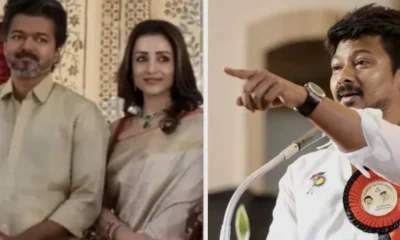
The controversy stems from Udhayanidhi Stalin’s speech in Thanjavur on the Cauvery water dispute with Karnataka, during which members of the audience repeatedly chanted actor Trisha Krishnan’s name.

The TVK alleged that Stalin’s response carried an inappropriate double meaning and accused him of lowering the standards of political discourse while disrespecting women.

Stalin has consistently denied the allegation, maintaining that his remarks were misrepresented through edited clips. He reiterated that he never intended to offend anyone, particularly women, and said his upbringing and family values would never allow such conduct.

India News

BJP fields Suvendu Adhikari aide’s mother Hasirani Rath in Nandigram

The BJP has named Hasirani Rath, mother of late Suvendu Adhikari aide Chandranath Rath, as its candidate for the Nandigram Assembly by-election.

Published

on

Suvendu Adhikari

The BJP has named Hasirani Rath as its candidate for the Nandigram Assembly by-election in West Bengal, ending speculation over who would contest the politically significant seat.

Hasirani Rath is the mother of late Chandranath Rath, who had served as a personal assistant to West Bengal Chief Minister Suvendu Adhikari. She is scheduled to file her nomination papers in the presence of Adhikari.

The BJP has also nominated Shakharav Sarkar for the Rejinagar Assembly constituency. The by-elections in Nandigram and Rejinagar are scheduled for October 6, while September 16 is the last date for filing nominations.

BJP picks Chandranath Rath’s mother

Chandranath Rath, a native of Chandipur in East Midnapore, had worked as Suvendu Adhikari’s personal assistant. He was killed on May 6, two days after the West Bengal Assembly election results were declared.

According to the report, Chandranath Rath was shot at close range by motorcycle-borne attackers in Madhyamgram in North 24 Parganas while he was riding pillion. The rider accompanying him was also injured.

After the incident, Suvendu Adhikari met Chandranath Rath’s family and assured them of justice. Hasirani Rath has since continued to express her faith in Adhikari.

Local residents had earlier demanded that Hasirani Rath be fielded from Nandigram. The BJP has now formally nominated her for the constituency, which is listed as Assembly Constituency No. 210.

Hasirani Rath’s political background

Hasirani Rath comes from a middle-class background and has been associated with politics since 1998. She has previously contested panchayat elections and served as a panchayat member for two terms.

Her nomination puts a grassroots political figure at the centre of the BJP’s campaign in Nandigram. The move also follows the party’s recent selection of candidates with personal connections to politically significant events in West Bengal.

Nandigram bypoll on October 6

The Nandigram and Rejinagar Assembly by-elections will be held on October 6, with the nomination process set to close on September 16.

Hasirani Rath said she would accept the responsibility assigned to her by the BJP. She also referred to Suvendu Adhikari as her guardian while speaking about her candidature.

The Nandigram contest is particularly significant for the BJP as the seat was previously held by Suvendu Adhikari, who retained another constituency after winning both seats in the 2026 West Bengal Assembly election.

Continue Reading

India News

Modi-Xi meeting draws global attention, China says India should be partner

Chinese Foreign Minister Wang Yi said the Modi-Xi meeting at the BRICS summit reached a consensus on partnership, border peace and wider cooperation.

Published

on

Chinese Foreign Minister Wang Yi has said Prime Minister Narendra Modi and Chinese President Xi Jinping reached a key consensus during their meeting on the sidelines of the 18th BRICS Summit in New Delhi, with both sides viewing India and China as partners rather than rivals.

The meeting between Modi and Xi took place on September 12 during Xi’s two-day visit to New Delhi for the BRICS summit. According to Wang, the two leaders held a candid and in-depth discussion on strategic, long-term and broader issues concerning India-China relations.

India-China partnership highlighted

Wang said the “most important consensus” reached by the two leaders was that China and India should be partners.

According to the Chinese foreign minister, Xi said the two countries could draw on each other’s strengths, support one another and pursue common development.

Wang also said the Modi-Xi meeting attracted widespread international attention.

He described the recent improvement in China-India relations as a shift from a “restart” towards a “renewed elevation”, while saying that cooperation between the two countries has continued to expand.

Focus on border peace

The two countries agreed to jointly maintain peace and tranquility in their border areas, Wang said.

He added that both sides pledged to strengthen political mutual trust, appropriately manage differences and contradictions, and maintain peace along the border.

During his meeting with Modi, Xi called for mutual respect and understanding to help overcome disruptions in bilateral ties. He also advocated progress on India-China relations and border issues, with the two tracks reinforcing each other.

Wang said Modi responded positively and reaffirmed that India approaches its relationship with China from a strategic and long-term perspective.

Modi says India ready to be China’s partner

According to Wang’s account of the meeting, PM Modi said India was ready to be a partner rather than an adversary to China.

Modi also viewed the development of the two countries as an opportunity rather than a challenge, Wang said.

He added that India remains committed to high-level exchanges with China, stronger strategic communication and broader people-to-people ties based on mutual respect and trust.

Cooperation in BRICS and other forums

The two leaders also agreed to support each other’s BRICS chairmanship, according to Wang.

They discussed stronger coordination through multilateral platforms, including the United Nations, the Shanghai Cooperation Organisation and the G20.

The two sides also agreed to expand cooperation in areas including cultural and people-to-people exchanges and direct air connectivity, Wang said.

Wang said China and India should deepen mutually beneficial cooperation and contribute to cooperation across the Global South.

China calls for implementation of consensus

Chinese Foreign Ministry spokesman Guo Jiakun said China would work with India to implement the understandings reached by Modi and Xi.

Guo said Beijing would seek to expand the areas of cooperation, deepen people-to-people exchanges and strengthen coordination in multilateral forums.

He also said China would continue efforts to improve bilateral ties and support each other’s development, with the aim of contributing to peace and prosperity in the region and beyond.

PM Modi and Xi Jinping reached a key consensus that India and China should be partners, not rivals, Chinese Foreign Minister Wang Yi said after their BRICS meeting.

The two sides also discussed border peace, BRICS cooperation and stronger bilateral ties.

Continue Reading

India News

3 Italians leave Delhi without immigration clearance, Air India gets notice

Three Italian nationals flew from Delhi to Munich without immigration clearance after travelling from Amritsar. The Civil Aviation Ministry has issued Air India a show-cause notice.

Published

on

Three Italian nationals travelled from Delhi to Munich without completing mandatory immigration clearance, prompting the Ministry of Civil Aviation to issue a show-cause notice to Air India.

The incident took place in the early hours of September 4. The three passengers had arrived in Delhi from Amritsar on Air India flight AI-1115 at around 12:50 am before boarding Lufthansa flight LH-763 to Munich at approximately 1:45 am.

The ministry has sought an explanation from Air India and given the airline seven days from receipt of the notice to respond.

How the passengers bypassed immigration

The three passengers were travelling under Air India’s hub-and-spoke arrangement, in which travellers from smaller airports connect to international destinations through a major hub.

They travelled from Amritsar to Delhi and were issued domestic, or “D”, boarding passes for their Air India flight. They were also issued boarding passes for their onward Lufthansa flight to Munich at Amritsar.

According to the ministry’s notice, Air India’s standard operating procedure provides for two categories of boarding passes — “D” for domestic passengers and “I” for international passengers. The ministry has questioned the issuance of the additional boarding passes in this case.

After arriving in Delhi, the passengers were taken from Gate 39 towards the International-to-International Transfer Area. They then reached the departure area and boarded the Lufthansa flight without passing through the immigration checkpoint.

Ministry flags five SOP provisions

The Ministry of Civil Aviation has flagged five provisions of Air India’s Domestic-International Operations SOP in connection with the incident.

These include rules concerning the categories of boarding passes, segregation of domestic and international passengers after disembarkation, and access to the International-to-International Transfer Desk.

The ministry has also raised questions over Air India’s requirement to maintain a nodal officer and monitoring team at hub and spoke airports around the clock. These mechanisms are intended to ensure that passengers do not enter the international departure process through an incorrect route without completing the required formalities.

The ministry said the monitoring mechanism failed in this case.

Ministry seeks answers from Air India

The show-cause notice asks Air India to explain how passengers holding domestic boarding passes were able to enter the international transfer area.

It has also sought clarification on why the passengers were issued boarding passes for their onward Lufthansa flight at Amritsar and has asked about the role of Air India personnel and SATS staff involved in handling the passengers.

The ministry has further sought information about the designated nodal officer and monitoring team’s presence and actions at the time. It has questioned why the required reconciliation of domestic and international passengers was not completed promptly.

Questions have also been raised over whether the General Declaration, passenger manifest and API-PNR data concerning the passengers were shared with immigration authorities in time and whether their status was accurately reflected in those records.

Lapse detected during manual reconciliation

According to the notice, the lapse was detected later during manual reconciliation.

The incident has therefore raised questions about both the handling of the passengers and the systems intended to prevent domestic-arrival passengers from entering the international departure process without completing immigration clearance.

Air India gets seven days to respond

The Ministry of Civil Aviation has asked Air India to explain why action should not be initiated against the airline for failing to follow the prescribed SOP and take adequate precautions.

The airline has seven days from receiving the notice to submit its response.

The ministry has warned that failure to respond within the stipulated period could be treated as having no explanation to offer, after which administrative and regulatory action may be considered based on the available records.

What is the hub-and-spoke model?

Under a hub-and-spoke model, passengers from smaller airports travel through a major airport before connecting to international destinations.

In this case, the passengers travelled from Amritsar to Delhi before connecting to a Munich-bound international flight.

At the hub airport, passengers arriving on domestic flights but holding onward international bookings must be identified and routed through the prescribed process, including immigration clearance before leaving India.

In the Delhi incident, the three Italian passengers instead entered the international transfer process and boarded their Munich flight without completing the required immigration formalities.

Continue Reading

Trending

© Copyright 2022 APNLIVE.com