English हिन्दी
Connect with us

India News

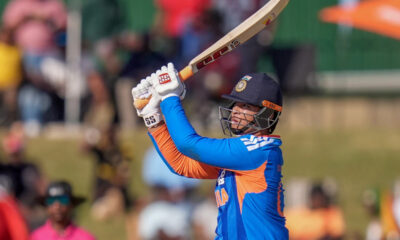
Vaibhav Sooryavanshi becomes India’s youngest international debutant, surpasses Sachin Tendulkar

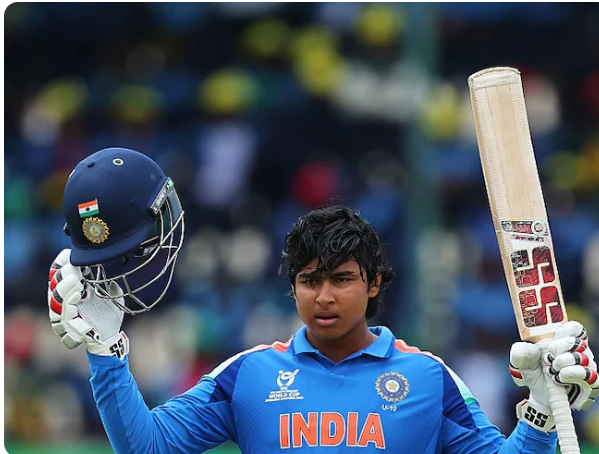
Teenage batting sensation Vaibhav Sooryavanshi has become India’s youngest-ever international cricketer after making his debut in the second T20I against England at the age of 15 years and 99 days. The milestone sees him surpass Sachin Tendulkar and Shafali Verma in the Indian record books.

Published

on

Vaibhav suryavanshi123

Indian cricket witnessed the beginning of a new era as teenage batting sensation Vaibhav Sooryavanshi made his senior international debut, becoming the youngest player ever to represent India in men’s or women’s cricket.

The left-handed batter received his maiden India cap ahead of the second T20I against England in Manchester. At 15 years and 99 days, Sooryavanshi broke a long-standing national record previously held by cricket legend Sachin Tendulkar, who made his international debut at the age of 16 years and 205 days in 1989.

The milestone also saw Sooryavanshi overtake Shafali Verma, who had been India’s youngest international debutant overall after making her debut at 15 years and 239 days.

Historic moment for Indian cricket

The young opener’s debut had been eagerly anticipated ever since he was included in India’s squads for the Ireland and England T20I series.

Although he did not feature in the matches against Ireland, India initially continued with the experienced opening pair of Sanju Samson and Abhishek Sharma for the opening T20I against England. Following Samson’s struggles with the bat, discussions around Sooryavanshi’s inclusion intensified.

The Indian team management eventually decided to hand the youngster his opportunity, with captain Shreyas Iyer and head coach Gautam Gambhir backing the teenager for his first international appearance. The debut cap was presented to him by Tilak Verma before the Manchester encounter.

Youngest men’s debutants for India

Following his debut, Sooryavanshi now tops the list of India’s youngest men’s international debutants.

  • Vaibhav Sooryavanshi – 15 years, 99 days (vs England, July 4, 2026)
  • Sachin Tendulkar – 16 years, 205 days (vs Pakistan, November 15, 1989)
  • Piyush Chawla – 17 years, 75 days
  • Laxman Sivaramakrishnan – 17 years, 118 days
  • Parthiv Patel – 17 years, 152 days
  • Maninder Singh – 17 years, 193 days

While Sooryavanshi now holds the record for India’s youngest international debutant, Pakistan’s Hasan Raza remains the youngest men’s Test debutant globally at 14 years and 227 days. Romania’s Marian Gherasim continues to hold the record as the youngest international cricketer overall, having debuted in T20Is at 14 years and 16 days.

Shreyas Iyer backs the young opener

Speaking before the match, captain Shreyas Iyer expressed confidence in the youngster’s temperament and ability to perform at the highest level.

Iyer said Sooryavanshi had consistently impressed during training, adding that the teenager deserved his opportunity after displaying fearless batting and showing no signs of pressure despite his age.

IPL heroics paved the way

Sooryavanshi’s selection followed a remarkable IPL 2026 campaign for the Rajasthan Royals, where he emerged as the tournament’s highest run-scorer.

He accumulated 776 runs at a strike rate of 237.30, registering one century and five half-centuries while smashing 72 sixes. His performances earned him multiple individual honours, including the Orange Cap, Most Valuable Player, Emerging Player, Super Striker, and Super Sixes awards.

Strong performances across formats

The teenager has also impressed in domestic and age-group cricket.

During the recent tri-series involving Sri Lanka A and Afghanistan A, he scored 211 runs in five innings, including a match-winning 94 in the final. He also recorded the fastest fifty in List A cricket by reaching the milestone in just 11 balls against Sri Lanka A.

His record in youth cricket has been equally impressive. Sooryavanshi finished as the leading run-scorer at the Under-19 World Cup with 439 runs in seven matches, helping India lift the title. He also set a tournament record by hitting 30 sixes.

Across youth ODIs, he has accumulated 1,412 runs at an average of 56.48, while his T20 numbers include 1,477 runs from 34 innings at a strike rate above 220.

In the IPL, the youngster has already crossed the 1,000-run mark in just 23 innings, underlining the promise that has made him one of India’s brightest emerging talents.

With his record-breaking debut now complete, Indian cricket fans will be hoping that Vaibhav Sooryavanshi’s international journey lives up to the enormous expectations surrounding one of the country’s most exciting young prospects.

India News

Assam BJP leader Bikash Dhar found dead, 5 arrested for murder

BJP leader Bikash Dhar, 52, was found dead in an abandoned house in Assam’s Sribhumi district after being reported missing on August 12. Police have arrested five people in connection with the alleged murder.

Published

on

A 52-year-old BJP leader who had been missing for two days was found dead in Assam’s Sribhumi district on Friday, with police alleging that he was murdered.

Bikash Dhar, a resident of Chagalmowa village under Bazaricherra police station, was found dead inside an abandoned house in the Yogicherra area near the Tripura border on Friday morning.

Dhar’s family had filed a missing complaint on August 12 after he left home following a phone call.

According to his son Madan Dhar, Bikash left around 1 pm after saying that he had to attend an emergency meeting. When he did not return and his phone was switched off, the family began searching for him and later approached the police.

Five arrested in murder case

Sribhumi Superintendent of Police Leena Doley said an investigation was launched after the missing complaint was received. The probe was conducted under the supervision of the Additional Superintendent of Police (Crime).

Police said five people have been arrested in connection with the alleged murder. They were identified as Abdul Salam, Sifat Ali, Abdul Ahad, Saiful Ali and Badrul Haque.

According to the police, interrogation of Abdul Salam revealed that the accused had an enmity with Dhar. Police alleged that the group killed him and dumped his body near a water body.

Another person, identified as Sunam Miya, was named during the investigation and reportedly fled to Tripura on the night of the incident.

Police find injury and cut marks on body

Police said injury and cut marks were found on Dhar’s body, and a murder case has been registered.

During the recovery of the alleged weapon, police said accused Badrul Haque attempted to escape from custody. A police constable was injured during the incident.

Police said they fired at Haque’s leg to prevent him from escaping, resulting in a bullet wound.

The investigation into the circumstances surrounding Dhar’s death and the alleged involvement of the accused is underway.

Continue Reading

India News

Jharkhand CID raids multiple locations in JPSC exam irregularities case 

Jharkhand CID conducted raids across several districts to arrest seven accused in a case involving alleged irregularities in JPSC competitive examinations.

Published

on

The Jharkhand Crime Investigation Department (CID) has conducted raids at several locations across the state as part of its investigation into alleged irregularities in competitive examinations conducted by the Jharkhand Public Service Commission (JPSC).

According to a CID press release, the searches were carried out to arrest seven accused named in Case No. 16/2026 and execute warrants issued against them.

The accused have been identified as Aditya Pandey, Pawan Kumar Singh, Ravishankar Kumar, Santosh Kumar Singh, Sanand Prakash, Lalu Kumar Yadav and Saurabh Kumar Pandey.

The CID conducted searches in several districts as part of efforts to apprehend the accused. The agency said its investigation into the case is continuing.

CID examining evidence in exam irregularities case

The case relates to alleged irregularities in various competitive examinations conducted by the JPSC.

As part of the investigation, the CID has begun matching OMR carbon copies obtained during the probe and examining other evidence collected in the case.

The agency said further action would be taken according to law on the basis of the evidence gathered. It added that legally permissible action against those found involved in the case is underway.

ABVP protests over JPSC, JSSC exams

The CID raids come amid protests over alleged irregularities and paper leaks in examinations conducted by the JPSC and Jharkhand Staff Selection Commission (JSSC).

On August 13, the Akhil Bharatiya Vidyarthi Parishad (ABVP) held protests in several cities, demanding a Central Bureau of Investigation (CBI) probe and strict action against those responsible.

In New Delhi, students and ABVP workers protested outside Jharkhand Bhawan, calling on the Jharkhand government to take steps to restore confidence in the examination system.

According to the ABVP, similar protests were held in Lucknow, Kolkata, Guwahati, Agartala, Jaipur, Hyderabad, Ahmedabad, Surat, Gorakhpur, Jodhpur, Kota, Raipur, Bhubaneswar, Varanasi and Prayagraj, as well as at university campuses.

The student organisation has sought an impartial CBI investigation into alleged irregularities in JPSC and JSSC examinations. It has also demanded cancellation of the JSSC CGL examination, citing concerns over its integrity, along with fresh examinations where irregularities have been reported.

Meanwhile, JPSC-JSSC aspirants continue to protest at Jaipal Singh Munda Stadium in Ranchi. The ABVP has also alleged that students protesting peacefully on August 10 and 11 faced lathi-charge, water cannons and arrests.

Jharkhand CID has conducted raids at multiple locations in connection with alleged irregularities in JPSC competitive examinations and efforts to arrest seven accused named in Case No. 16/2026.

The action comes amid continuing student protests demanding a CBI probe into alleged JPSC-JSSC exam irregularities.

Continue Reading

India News

Karnataka Cabinet clears public property bill amid RSS registration row

Karnataka Cabinet approves a Bill to regulate the use of government premises and public property amid a political row over RSS registration.

Published

on

Priyank Kharge

The Karnataka Cabinet has approved a proposed law to regulate the use of government premises and public property in the state, amid an ongoing political debate over the registration and use of public spaces by the Rashtriya Swayamsevak Sangh (RSS).

The Karnataka Regulation of Use of Government Premises and Public Property Bill, 2026 was cleared by the Cabinet, Home Minister Priyank Kharge said after the meeting.

According to the government, the proposed legislation aims to establish a legal framework governing the use of government lands, buildings, playgrounds, parks, roads and other public assets by private individuals, organisations, associations and societies.

Kharge said the objective was to prevent unauthorised use and misuse of public property while ensuring that such assets are protected for public benefit.

What the Karnataka public property bill proposes

The proposed legislation is expected to lay down procedures for obtaining permission to use government property for events, meetings and other activities.

It also proposes provisions for penalties in cases involving misuse of government premises or damage to public property, according to officials.

The government is expected to introduce the Bill in the Karnataka legislature, where it will be taken up for discussion and passage.

Priyank Kharge denies Bill targets RSS

The proposed legislation comes against the backdrop of a row involving the RSS and its use of public property in Karnataka.

Kharge, however, rejected speculation that the Bill had been framed specifically against the RSS or any other organisation. He said the government did not have a particular institution, association, organisation, society, club, union, syndicate or NGO in mind.

The issue has been part of a wider political debate since 2025, with Kharge opposing the use of government premises and public property by the RSS and calling for the organisation to register formally.

In June, Kharge also wrote to RSS chief Mohan Bhagwat seeking clarity on the organisation’s legal status, financial transparency and constitutional accountability.

The development is likely to keep the debate over the use of public property and the legal status of organisations in Karnataka in focus as the proposed legislation moves to the state legislature.

Continue Reading

Trending

© Copyright 2022 APNLIVE.com