English हिन्दी
Connect with us

Latest world news

China lone critic of India-Vietnam Akash pact

Published

on

China lone critic of India-Vietnam Akash pact
[vc_row][vc_column][vc_column_text]By Sujit Bhar

India’s decision to sell the sophisticated Akash missile systems to Vietnam has drawn strong reactions from sections of the Chinese media. They range from a virtual warning from their state-run media to derision from columnists. The international media, on the other hand, has treated this with optimism as has the Indian media.

In the face of it, Prime Minister Narendra Modi’s Look East policy could project Vietnam as a strong hub amid the network that India hopes to build. The UD $ 500 million line of credit, upped from the US $ 100 million October 2014 understanding when the then-Prime Minister Nguyen Tan Dung visited India is a critical pitch that could put an unwanted Indian finger in already convoluted South China Sea pie.

Akash is a medium range surface-to-air missile (SAM) that India’s Defence Research and Development Organisation has manufactured. With a range of 25km, it can easily target aircraft, helicopters and drones. India’s Varunastra anti-submarine torpedoes are also for sale if Vietnam so wishes. Theoretically, these can easily be used by Vietnam on neighbours China during conflict.

The Indian line was clear from Modi’s October statement last year. He had said: “Our defence cooperation with Vietnam is among our most important ones. India remains committed to the modernization of Vietnam’s defence and security forces.”

This “treaty” has three angles. First, this will represent a disruptive Indian presence in an area where China is upping the ante, a tit-for-tat, so to say, for China’s presence in Pakistan. Secondly, it could be an Indian foreign policy success story that can translate to major trade deals in the area. And third, a budding Indian defence industry wants to expand like the Chinese defence industry is. India’s aim in weapons export is US $ 2 billion. China has boosted its weapons export to US $ 6 billion in a short time.

Indian Defence Research Wing (IDRW) in an article says: “Bilateral defence education and training programmes are also growing, as witnessed in rising Indian assistance to the Information Technology and Foreign Languages Training Center at the Signal Officers Training School in Nha Trang… India has agreed to train Vietnamese pilots on Russian-built SU-30s and Sukhoi fighter jets and currently trains Vietnamese submarine operators on Russia-produced Kilo-class submarines.”

This shows that the understanding has now deepened and has seen years of strategic build-up on wither side, a positive step.

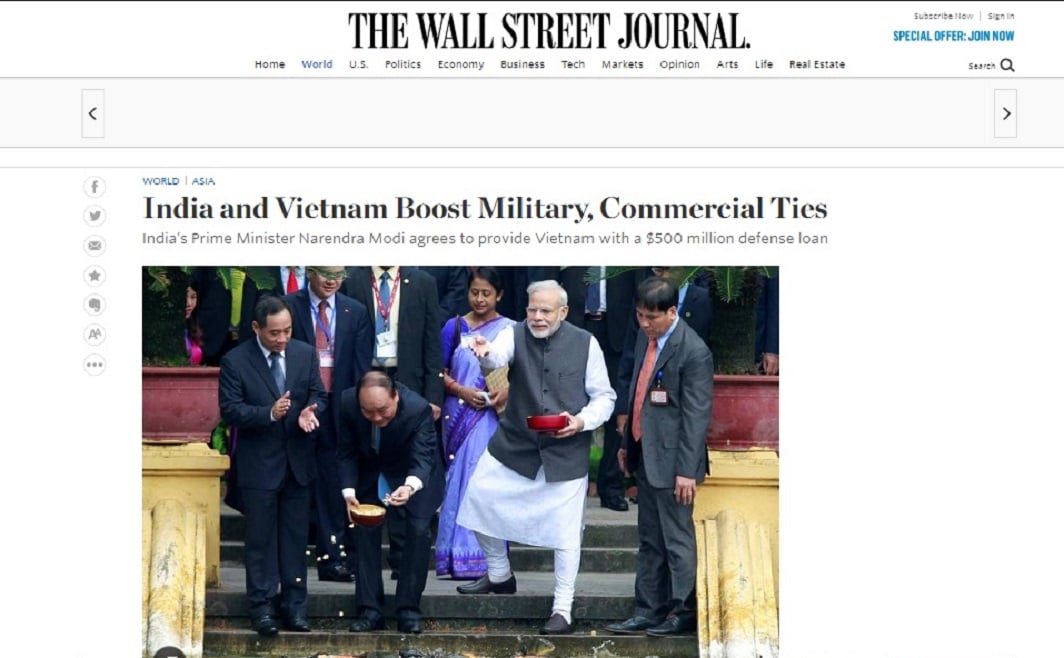
The Wall Street Journal has reported: “Defence analysts say the weapons are ideally suited to taking out naval targets. In seeking to upgrade military capabilities as China improves its own capabilities, Vietnam has emerged as the world’s eighth-largest arms importer from 2011 to 2015, according to the Stockholm International Peace Research Institute.

“Indian warships have also made a point of visiting Vietnamese ports, part of Hanoi’s own policy of encouraging more international navies into the contested waters of the South China Sea, where both Vietnam and China have overlapping claims to some of the world’s busiest shipping lanes.”

The Journal also observes: “Carlyle Thayer, emeritus professor and a Vietnam expert at the Australian Defence Force Academy, notes that the Indian leader’s visit to Vietnam follows high-level Chinese visits to Pakistan last year, where China is helping to finance the development and expansion of the deep-water port at Gwadar on the Arabian Sea.”

The Diplomat, a Tokyo-based journal on South Asia has said: “India has also considered offering Vietnam the considerably more advanced BrahMos supersonic cruise missile, pending consent for the sale from Russia, a co-developer of the BrahMos. India and Russia are reported to have resolved intellectual property issues that had held up talks with Vietnam over the BrahMos.” That sale has been scuppered thereafter, as Russia has yet to agree, but the issue remains on the table, as a threat to China.

An op-ed article in China’s Global Times was critical of the deal. In the article, headlined ‘India-Vietnam sea cooperation will be limited’, the author writes: “India and Vietnam seem to share quite a few common interests and similarities in terms of their policies toward Beijing. They both have complicated and unresolved border disputes with China. They both have bitter history of being defeated in border wars with China…”

He goes on to write: “Under (sic) such a backdrop, Modi’s visit to Vietnam has without doubt made Indians associate the tour with many strategic meanings, believing that New Delhi and Hanoi might jointly pile pressure on Beijing.

“As far as I am concerned, such a possibility cannot be totally excluded, but it will not play a vital role either. India has always been cautious when it comes to directly putting the screw on China. In this regard, the US has never stopped drawing New Delhi over to its side for its rebalance to the Asia-Pacific strategy, but India only showed reluctance toward it and has not responded to Washington actively. This has made the White House quite grouchy.”

On the side, China has warned Vietnam on the outcome if it signs this deal with India. One has to remember that China not only contributes heavily to Vietnamese development, Vietnam is a huge tourist destination for the Chinese, bringing in rich foreign currency.

This will be a critical and quizzical issue for Vietnam and India.[/vc_column_text][/vc_column][/vc_row]

Latest world news

US ends oil sanctions waiver for Iran and Russia, impact likely on India’s energy imports

The US decision to end the Iran and Russia oil waiver may impact India’s oil imports, fuel prices and global energy markets.

Published

on

US oil tanker

The United States has decided not to extend a temporary sanctions waiver that allowed limited trade in Iranian and Russian oil, marking a shift towards stricter enforcement of economic restrictions.

The waiver, introduced in March 2026, had permitted the sale of oil already loaded on ships to stabilise global supply during heightened geopolitical tensions. However, it is now set to expire around mid-April without renewal.

US officials have indicated that the move is part of a broader strategy to increase pressure on both Iran and Russia amid ongoing conflicts and geopolitical tensions.

What the waiver did and why it mattered

The short-term waiver allowed millions of barrels of oil—estimated at around 140 million barrels—to enter global markets, helping ease supply shortages and prevent sharp price spikes.

It also enabled countries like India to purchase discounted crude oil from Russia and resume limited imports from Iran after years of restrictions.

Impact on India

India, one of the world’s largest oil importers, is expected to feel the impact of the decision in several ways:

  • Reduced access to discounted oil
    India had been buying cheaper Russian crude and recently resumed Iranian imports under the waiver. Its end may limit these options.
  • Potential rise in fuel costs
    With fewer discounted supplies available, India may need to rely more on costlier sources, which could increase domestic fuel prices.
  • Supply diversification pressure
    India may need to explore alternative suppliers in the Middle East, Africa, or the US to maintain energy security.
  • Geopolitical balancing challenge
    The move adds pressure on India to align with US sanctions while managing its own economic interests.

Global energy market concerns

The end of the waiver comes at a time when global oil markets are already under stress due to conflict in West Asia and disruptions in key routes like the Strait of Hormuz.

Analysts warn that tightening sanctions could:

  • Reduce global oil supply
  • Increase price volatility
  • Intensify competition among major buyers like India and China

Bigger picture

The US decision reflects a broader shift from temporary relief measures to stricter enforcement of sanctions, even if it risks tightening global energy markets.

For India, the development highlights a recurring challenge—balancing affordable energy access with geopolitical realities.

Continue Reading

Latest world news

Sanctioned tanker fails to breach US blockade, turns back near Strait of Hormuz

A US-sanctioned tanker failed to cross the Hormuz blockade and turned back, underscoring rising tensions and disruption in global shipping routes.

Published

on

A US-sanctioned oil tanker failed to break through a newly imposed American naval blockade and was forced to turn back near the Strait of Hormuz, highlighting growing tensions in the region.

The vessel, identified as the Rich Starry, reversed its course after attempting to exit the Gulf, according to shipping data. The development comes just days after the United States enforced restrictions on ships linked to Iranian ports.

The blockade was announced by Donald Trump following the collapse of recent diplomatic talks with Iran. The move aims to restrict maritime traffic associated with Iranian trade.

Officials said that during the first 24 hours of enforcement, no vessel successfully crossed the blockade. Several ships, including the sanctioned tanker, complied with instructions from US forces and turned back toward regional waters.

The tanker is reported to be linked to a Chinese company previously sanctioned for dealing with Iran. It was carrying a cargo of methanol loaded from the United Arab Emirates at the time of the incident.

The situation underscores the rising risks in one of the world’s most critical oil transit routes. The Strait of Hormuz typically handles a significant share of global energy shipments, but traffic has sharply declined due to ongoing geopolitical tensions.

The blockade, which applies specifically to vessels travelling to or from Iranian ports, has added further uncertainty for shipping companies, insurers and global energy markets.

Continue Reading

Latest world news

Jaishanakar discusses Middle East crisis with Kuwait and Singapore counterparts, focus on Indian community

Jaishankar holds talks with Kuwait and Singapore counterparts on West Asia tensions, highlights Indian community safety.

Published

on

India’s External Affairs Minister S. Jaishankar held discussions with his counterparts from Kuwait and Singapore amid the ongoing crisis in West Asia, focusing on regional developments and the safety of Indian nationals.

In separate telephonic conversations, Jaishankar exchanged views with Kuwait’s Foreign Minister Sheikh Jarrah Jaber Al-Ahmad Al-Sabah and Singapore’s Foreign Minister Vivian Balakrishnan. The discussions come at a time of heightened tensions in the Middle East region.

According to details shared by the minister, his conversation with the Kuwaiti counterpart primarily revolved around the evolving regional situation and the well-being of the Indian community residing in Kuwait.

He described the interaction as a constructive exchange, highlighting India’s continued attention to the safety and interests of its citizens abroad during the crisis.

In a separate interaction with Singapore’s foreign minister, Jaishankar said the two sides discussed the ongoing conflict in West Asia and its broader implications.

The talks reflect India’s ongoing diplomatic engagement with key global partners as tensions in the Middle East continue to escalate, impacting regional stability and international concerns.

The latest outreach is part of a series of high-level communications by India aimed at closely monitoring developments in the region while safeguarding its strategic and humanitarian interests.

Continue Reading

Trending

© Copyright 2022 APNLIVE.com