English हिन्दी
Connect with us

Latest world news

Globalization Of Terror: Syrian Intelligence Sheds Light On Rohingya Exodus

Published

on

Rohingya Muslim

By Saeed Naqvi

Evidence of Rohingya Muslims in Rakhine state since the 7th century is not accompanied by a narrative of harmony with the Buddhist majority in Burma (Myanmar) throughout this period. But since the 1970-80, increased repression, economic deprivation, denial of citizenship rights could possibly be because of the reverberations following the Iranian revolution in 1979.

Saudi Arabia, particularly shaken by the emerging, bipolarity in the Muslim world, took the lead in drumming up an anti Shia hysteria. Riyadh had an interest in diverting the world’s attention towards Iran because a much bigger danger had reared its head within Saudi society. An anti monarchy, radical, Islamic group had occupied Islam’s most important mosque in Mecca for weeks almost at the same time as the Iranian revolution. Saudi needed to create Wahabi enclaves wherever they could.

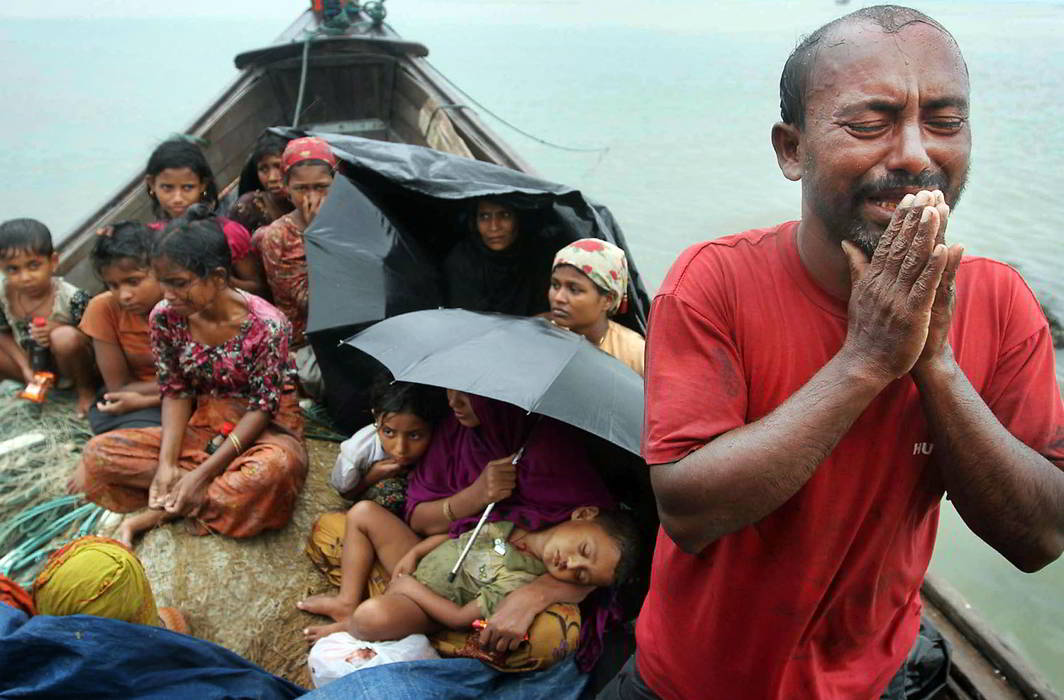
This brief background is essential to understand antecedents to the current exodus of 4,00,000 Rohingyas.

There is a twist to the Rohingya tale, particularly the unprecedented military crackdown in August resulting in the refugee crisis. A source for this narrative has been the unlikely figure of Grand Mufti Ahmed Bader Eddin Mohammad Adib Hassoun, Syria’s highest religious authority on a visit to India last week.

The Mufti deserves to be introduced.

If conversation is the art of hearing and of being heard, one half of that dictum is totally ignored by this cleric, donning the grandest headgear. Seated at the head of a long dining table, his speech is an unstoppable torrent. In this instance, it serves a purpose: it enables the guests to relish, with dedication, a multi course feast, something which has gone out of fashion from the current relatively frugal, diplomatic fare.

Scattered throughout the Mufti’s elaborate exposition are nuggets of information. If these are “plants”, why would New Delhi accord hospitality to a cleric at a fairly high level? He met Home Minister, Rajnath Singh. The office of the National Security Adviser gave him quality time, as did Kashmir Chief Minister, Mehbooba Mufti and several others. Clearly, the Mufti is well briefed on the post conflict mopping up operation in various parts of Syria. There is priceless intelligence scattered all around.

Americans no longer deny that they have from time to time fallen back on militants or terrorist groups as tactical assets. In an interview to Christiane Amanpour, Russian Foreign Minister, Sergey Lavrov made exactly that allegation and Amanpur would not risk a counter allegation, even a question. Heaven knows what beans Lavrov might spill on live TV.

Since the Mufti’s visit, a disturbing piece of information circulating in some circles concerns the Rohingyas. It makes their plight even more tragic. According to this narrative the present crisis was precipitated from outside.

The story begins in 2012 when Prince Bandar bin Sultan, former Saudi Ambassador to the US (nicknamed Bandar Bush because of his friendship with George W. Bush), who had then been given the “Syrian portfolio” by the late King Abdullah, invited a Rohingya named Hafiz Taha, to his office in Riyadh.

Taha was given the task to develop “Islamist sleeper cells” in Rakhine. The idea was twofold: to promote Islamism of the Wahabi variety among a people who were otherwise inclined towards a folksy form of Sufism. The second purpose was to sow seeds of long term conflict in a country abutting China’s Kunming (Yunnan). There is some anxiety in the West that parts of Mandalay are increasingly Chinese dominated.

In her study on the Rohingyas for the Council on Foreign Relations, Eleanor Albert’s version tallies with the Mufti’s narrative on how the trouble started in Rakhine in August. Arakan Rohingya Salvation Army “claimed responsibility for attacks on police and army posts.” Is it any surprise that the government declared ARSA a terrorist organization? It was then that the military mounted a “brutal campaign that destroyed hundreds of Rohingya villages and forced more than five hundred thousand Rohingya to leave Myanmar, approximately half of the Rohingya population out of the country.”

Military brutality never seen in history was then unleashed: security forces allegedly opened fire on fleeing civilians and planted land mines near the border crossings used by the Rohingyas to flee to Bangladesh.
A long simmering conflict, intensifying over the past decade, was custom made for outsiders to ignite and cause an explosion. This precisely is what appears to have been precipitated in Rakhine state two months ago. “But why would sleeping cells be activated now?”
US Intelligence agencies learnt a lesson from turning their back on Afghan militants after they had helped expel the Soviet Union from Afghanistan in 1989. This reservoir of lethal Islam, found work for itself in Kashmir, Egypt, Algeria and so on. Since the genie could not be put back in the bottle, Saudis, under western supervision, began to refine Islamic terror as an exportable asset.

Much of the cloak and dagger US operations became public either at Senate hearings on the Hill or through diplomatic leaks. After all, nothing could be hidden from the Russians in Syria because they had boots on the ground.

In the Syrian whodunit, Americans have actually been admitting their mistakes with endearing docility. Remember Secretary of Defence Ashton Carter, his face distinctly in the lower mould, being grilled by a congressional committee, then by the media, for the clumsiness of US Special Operations in Syria? The “moderates” they were training left their weapons with the Al-Nusra Front and sought safe passage. Carter announced, on live cameras, that a $500 million training programme had been discontinued.

Remember Gen. Lloyd Austin admitting to the Armed Services Committee of the Senate that “only four or five” fighters trained by the Americans were “in the fight.”

In an interview to Thomas Friedman of the New York Time in 2015, President Barack Obama admitted that he had not bombed ISI when it first reared its head because “that would have relieved pressure on Iraq’s Shia Prime Minister, Nouri al Maliki” whose departure, and not ISI’s elimination, was a US priority.

The cake for flaunting terrorism as an asset goes to Bandar bin Sultan who promised a “terrorism free Sochi Olympics” in February 2014 to Vladimir Putin in the Kremlin if only the Russians helped him show Bashar al Assad the door out of Damascus.

The plight of those in the Rohingya exodus is even more heart breaking because they have no hint of the Kafkian script which has maliciously affiliated then with the externally financed Rohingya Salvation Army, a group they know nothing about.


Latest world news

Trump approves nearly $9 billion weapons sales to Israel, UAE and other allies amid Iran tensions

The US has fast-tracked nearly $9 billion in weapons sales to Israel, UAE and other allies as tensions linked to the Iran conflict continue despite a fragile ceasefire.

Published

on

Donald Trump statement

The United States has approved nearly $9 billion worth of weapons sales to key Middle Eastern allies, including Israel and the United Arab Emirates, amid ongoing tensions linked to the Iran conflict.

The decision, cleared by the administration of Donald Trump, includes expedited military transfers to Israel, the UAE, Qatar, and Kuwait. The approvals were granted under an emergency provision, allowing authorities to bypass the usual congressional review process.

Emergency clearance amid ongoing conflict

Officials said the move was necessary due to the evolving security situation in the region, particularly as the conflict involving Iran continues despite a fragile ceasefire. The war, which began earlier in 2026, has heightened instability across West Asia.

US Secretary of State Marco Rubio invoked emergency powers to fast-track the deals, citing urgent defence requirements for allied nations.

What the arms package includes

The approved package includes a mix of advanced defence systems and precision weapons:

  • Patriot missile defence replenishments worth over $4 billion for Qatar
  • Precision-guided weapon systems for multiple countries
  • Integrated battle command systems for Kuwait
  • Additional advanced weapons support for Israel and the UAE

The total value of these deals is estimated at over $8.6 billion, often rounded to nearly $9 billion.

Timing linked to iran war

The approval comes nearly nine weeks into the conflict involving the US, Israel, and Iran, with tensions still high despite a ceasefire that has been in place for several weeks.

Analysts note that the move signals continued US military backing for its regional allies, particularly in strengthening air defence and precision strike capabilities during uncertain conditions.

Criticism and concerns

The decision to bypass congressional oversight has drawn criticism from some quarters, particularly over transparency and the broader implications of increasing arms supplies in a conflict-prone region.

Continue Reading

Latest world news

Trump and Putin hold over 90-minute call, discuss Iran war and Ukraine conflict

Trump and Putin held a 90-minute call focusing on Iran tensions and the Ukraine conflict, with warnings over escalation and talks of ceasefire.

Published

on

Vladimir Putin and Donald Trump

US President Donald Trump and Russian President Vladimir Putin held a phone conversation lasting more than 90 minutes, focusing on escalating tensions in the Middle East and the ongoing war in Ukraine.

According to official statements, the discussion was described as “frank and businesslike,” with both leaders addressing key global security concerns. A major part of the conversation centred on the situation involving Iran and developments in the Persian Gulf.

Putin supported Trump’s decision to extend the ceasefire related to Iran, suggesting that continued restraint could create space for negotiations and help stabilise the region. However, he also issued a strong warning, stating that renewed military action by the United States or Israel could lead to “extremely damaging consequences” not only for Iran but for the wider international community.

Ukraine conflict also discussed

The leaders also discussed the ongoing war in Ukraine, which has continued for several years since Russia’s invasion in 2022. During the call, there were indications of potential efforts toward a temporary ceasefire, although no final agreement has been confirmed.

Reports suggest that the idea of a short-term pause in hostilities was explored, possibly linked to upcoming symbolic dates, but significant differences between the parties remain unresolved.

Focus on diplomacy amid global tensions

The call highlights ongoing diplomatic engagement between Washington and Moscow at a time of heightened geopolitical tensions involving both the Middle East and Eastern Europe.

While both sides acknowledged the importance of dialogue, the situation on the ground in both conflict zones remains complex, with no immediate resolution in sight.

Continue Reading

Latest world news

Trump rejects Iran peace plan as tensions rise, Tehran signals military readiness

Trump rejects Iran’s peace plan, keeping focus on nuclear concerns as Tehran signals readiness and tensions continue to rise.

Published

on

Donald Trump statement

U.S. President Donald Trump has rejected a proposal from Iran aimed at easing ongoing tensions, signaling a continued deadlock between the two countries.

The proposal reportedly included steps linked to easing restrictions around the Strait of Hormuz, a key global oil route. However, the United States declined the offer, maintaining that any agreement must address concerns related to Iran’s nuclear programme.

Washington has made it clear that resolving nuclear issues remains a priority and that partial measures without broader commitments will not be accepted.

Nuclear issue remains central

The U.S. position continues to focus on preventing Iran from advancing its nuclear capabilities. Officials believe that without a comprehensive agreement, temporary arrangements could delay a long-term resolution.

The rejection of the proposal indicates that negotiations remain stalled, with both sides holding firm on key demands.

Iran issues warning

Following the rejection, Iranian officials have issued strong statements, indicating readiness to respond if pressure from the U.S. continues.

Reports suggest that Iran has asserted its military preparedness, warning that any escalation could lead to serious consequences. The remarks reflect growing tensions as diplomatic efforts struggle to produce results.

Rising geopolitical tension

The situation remains volatile, with both countries engaged in a prolonged standoff. Measures such as restrictions on trade routes and strategic pressure points continue to impact the broader region.

The Strait of Hormuz remains a critical factor in the conflict, given its importance for global energy supplies.

Outlook uncertain

With no immediate breakthrough in sight, tensions between the United States and Iran are expected to persist. The lack of agreement on key issues, particularly the nuclear programme, continues to hinder progress toward de-escalation.

Continue Reading

Trending

© Copyright 2022 APNLIVE.com