English हिन्दी
Connect with us

Latest world news

Israel release Palestinian Protest icon girl

Published

on

Israel release Palestinian Protest icon girl

Ahed Tamimi receives heroic welcome home

Israel has released 17-year-old Palestinian protest icon Ahed Tamimi from prison early on Sunday, after she, along with her mother, has served eight-month sentence for slapping and kicking Israeli soldiers in front of her family home in Nabi Saleh locality in December last year.

According to Saudi owned Al-Arabiya news, Ahed, the young icon who received support from sympathisers worldwide, and her mother Nariman Tamimi, were then transferred by Israeli army to the Palestinians territories, where a festive homecoming awaited them in their hometown village.

Her mother filmed Ahed Tamimi slapping Israeli soldiers and posted it on Facebook, where it went viral and instantly turned her into symbol of resistance. With her unruly mop of curly red hair, the Palestinian teen quickly became an icon.

In Nabi Saleh, supporters welcomed Tamimi home with banners and Palestinian flags planted on the roof of her home. Hundreds of chairs were set up for well-wishers in the courtyard.

Read More: Supporting Israel: US more isolated on Palestine at UNSC

Her father, Bassem Tamimi, said he expects her to take a lead in the struggle against Israeli occupation. Ahed was 16 when she was arrested and turned 17 in custody. Her case has trained a spotlight on the detention of Palestinian minors by Israel. Some 300 minors are currently being held in Israeli prisons, according to Palestinian figures.

Israel release Palestinian Protest icon girl

Israel captured the West Bank, Gaza and east Jerusalem in the 1967 Mideast war. Palestinians are increasingly disillusioned about efforts to establish a state in those territories, after more than two decades of failed negotiations with Israel.

The chances of establishing state of Palestine has gone dim after US President Donald Trump has recently recognised Jerusalem as Israel’s capital and moved its embassy to the holy city. Earlier, Palestinians were being assured that East Jerusalem will be their capital under two state solutions.

Read More: Jordan and Palestine support Israeli Christians’ Church closure

US have been, for decades, mediating the unsuccessful peace process where Palestinians were represented by PLO, who are considered to be hand in gloves with Tel Aviv and Washington. However, no territory was given back to Palestinians during all these years. Israelis were forced to withdraw from south Lebanon in 2000 by Hezbollah fighters, the only territory Israelis left after occupation.

Read More: Palestine to ask India to replace US as sole mediator in negotiations with Israel, says official
Latest world news

US strikes Iran for seventh straight night as Tehran warns no border safe if attacks continue

The US carried out a seventh straight night of strikes on Iran as Tehran warned it could expand military operations if attacks continue, raising fears of wider regional escalation.

Published

on

Donald Trump

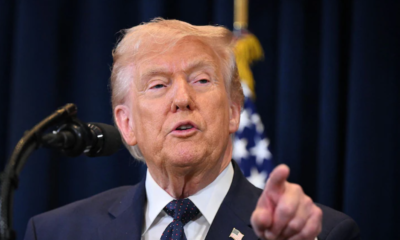
The United States launched military strikes on Iran for the seventh consecutive night on Friday, while Tehran warned it could significantly expand its offensive if the attacks continue for several more days.

According to the US Central Command, American forces carried out another round of strikes aimed at “continuing to degrade Iranian military capabilities.” The latest attacks come amid an escalating conflict that has seen both countries exchange drone and missile strikes across the region.

Iran warns of wider offensive

Iranian officials accused the United States of targeting civilian infrastructure, including an airport, a railway station and two bridges. Tehran also claimed it had carried out strikes against US military assets across the region.

Major General Mohsen Rezaei, a senior military adviser to Iran’s supreme leader, warned that Iran would resume “full-scale offensive operations” if US attacks continue for another two or three days.

He said Iran would no longer restrict itself to proportional retaliation and warned that “no political border will be safe” if the conflict escalates further.

US President Donald Trump had earlier warned that Iranian infrastructure could become a target, although there was no official confirmation from Washington that such infrastructure had been struck during Friday’s operations.

UN expresses concern over escalation

United Nations Secretary-General Antonio Guterres expressed deep concern over the intensifying conflict and said attacks targeting civilian infrastructure were unacceptable.

The current round of hostilities began on February 28 following US-Israeli strikes on Iran. Tehran responded by effectively closing the Strait of Hormuz, one of the world’s most important oil shipping routes, and launching attacks against Israel and US interests across the Gulf region.

Iranian Revolutionary Guards aerospace force commander Majid Mousavi said operations against US targets would continue until Washington halted military action around Iran’s southern coastal areas and the Strait of Hormuz.

Regional tensions widen

The conflict has increasingly spread across the Middle East.

Iran said it targeted US military positions in Kuwait, where authorities reported damage to a power and water facility. Kuwait’s military also said several personnel were injured in drone attacks on military bases.

Iran’s Revolutionary Guards claimed responsibility for strikes on US radar systems and military aircraft in Qatar. Qatari authorities said they successfully intercepted a missile attack.

Iran also claimed to have attacked two US radar sites in Oman and the Al-Tanf military base in Syria. However, a Syrian military source denied any attack on the base, while US officials said American troops had already withdrawn from Al-Tanf earlier this year.

Jordan’s military said it intercepted three Iranian missiles, while Bahrain reported precautionary measures after Iranian state media claimed US aircraft and helicopters stationed at an airbase there had been targeted.

Civilian impact and diplomatic efforts

The conflict has also affected civilian infrastructure and essential services.

Iran’s energy ministry urged citizens to reduce electricity consumption after it said US strikes placed pressure on the country’s energy facilities and power grid.

In Iraq’s Kurdistan region, the exiled Komala Party of Iranian Kurdistan said drone and rocket attacks killed nine of its members, blaming Iran for the strikes.

Iran’s health ministry said at least 38 people have been killed and more than 400 injured since the latest phase of fighting began.

Meanwhile, diplomatic efforts to end the conflict continued. China and Pakistan called on both Washington and Tehran to halt military operations and return to negotiations.

The wider regional crisis has also disrupted maritime security. The United Kingdom Maritime Trade Operations agency said a commercial tanker was struck by a projectile overnight off the coast of Oman as attacks on shipping in the Strait of Hormuz continued.

Continue Reading

India News

60 US Senators back bill proposing 100% tariffs on countries buying Russian oil, including India

Published

on

By

 A bipartisan group of 60 US Senators has backed a bill proposing 100 per cent tariffs on imports from countries that continue to purchase Russian oil, a move that could have significant implications for India, one of Moscow’s largest crude oil buyers since the outbreak of the Russia-Ukraine war.

The legislation, introduced by late Republican Senator Lindsey Graham and Democratic Senator Richard Blumenthal, is intended to increase economic pressure on Russia by discouraging other countries from continuing to buy its energy exports. If enacted, the bill would authorise the US President to impose steep tariffs on goods imported from nations that continue purchasing Russian crude oil and other petroleum products.

India has sharply increased its imports of discounted Russian crude since the Russia-Ukraine conflict began in February 2022. The Indian government has consistently maintained that its energy procurement decisions are based on national interest, energy security and the need to ensure affordable fuel supplies for its consumers. Officials have repeatedly stated that India will continue sourcing oil from the most economically viable markets.

The proposed legislation has not yet become law. It needs to pass both chambers of Congressthe US Senate and the House of Representativesbefore it can be presented to the US President for approval. Until then, the proposed tariffs will have no legal effect.

The development comes as the United States and its allies continue efforts to tighten economic pressure on Russia over the Ukraine conflict. If passed, the legislation could have far-reaching implications for trade relations with countries that continue importing Russian oil, including India, and may also influence global energy markets and diplomatic ties.

Neither the US administration nor the Indian government has announced any policy change following the introduction of the bill. The proposal is expected to remain under close scrutiny as it moves through the US legislative process.

Continue Reading

Latest world news

US airstrikes hit Iranian children’s cancer hospital as IRGC claims downing of American MQ-9 drone

A major military escalation in the Middle East has seen US overnight airstrikes hit several Iranian cities, damaging a children’s cancer facility in Ahvaz, while the IRGC claims it has intercepted a US military drone over Andimeshk.

Published

on

Iran us strikes

A fresh round of intense military escalation has unfolded in the Middle East as the United States launched a new wave of overnight airstrikes across Iran. The military action coincided with a renewed American blockade of Iranian ports, prompting Tehran to strike back at regional allies and reaffirm its vow to keep the vital Strait of Hormuz closed until the US halts its military campaign.

Multi-city bombardment impacts medical facility and military sites

Explosions rattled numerous locations across Iran, including major centers and coastal zones such as Qeshm Island, Bandar Abbas, Sirik, Chabahar, Konarak, Rask City, Khondab, and the western city of Khorramabad.

A severe consequence of the operation occurred in the city of Ahvaz, where local media reported that the Shahid Baghaei Hospital sustained damage from the American bombardment. The strike impacted the hospital’s specialized children’s cancer treatment department, forcing an emergency evacuation of the facility which provides critical chemotherapy treatments.

Beyond civilian infrastructure, Iranian officials stated that the airstrikes hit an army barracks, resulting in the deaths of at least seven troops. According to Tehran, the total casualties from the ongoing US campaign have reached at least 35 dead and more than 300 injured. In response to the aerial incursions, state media confirmed that air defence systems were activated over the capital city of Tehran. Fresh strikes were also reported in Bushehr, the location of Iran’s lone civilian nuclear power plant, following earlier blasts near southern maritime hubs.

Maritime confrontation and regional retaliation

US Central Command (CENTCOM) stated that its operations targeted Iranian military assets that directly threaten commercial vessels navigating the strategic waterway. Furthermore, the US military confirmed it disabled a Curacao-flagged oil tanker, the M/T Belma, by firing Hellfire missiles into its smokestack after the vessel attempted to breach the naval blockade. CENTCOM confirmed via social media that the ship is no longer moving toward Iran.

In retaliation, the Islamic Revolutionary Guard Corps (IRGC) launched attacks targeting the US Fifth Fleet stationed in Bahrain, triggering air sirens as incoming threats were intercepted. Additionally, Jordan’s armed forces reported intercepting and downing three missiles launched from Iran.

The IRGC also claimed a major defensive success via media reports, stating its aerospace force utilized a newly deployed air defence system to intercept and destroy an “enemy” MQ-9 drone over the southwestern city of Andimeshk. Meanwhile, in northern Iraq, Kurdish forces reported that the US-led coalition successfully shot down eight explosive-laden drones over Erbil, near the US consulate, with no casualties reported.

Washington increases regional arms sales and signals next steps

Against the backdrop of active hostilities, the US State Department announced the provisional approval of a $1.96 billion weapons sale to Saudi Arabia, alongside a separate $484 million aircraft sustainment package for Kuwait. The proposed Saudi agreement includes up to 20,000 Advanced Precision Kill Weapon System guidance sections for both air-to-air and air-to-ground configurations, alongside launchers, warheads, and logistical support. The package for Kuwait focuses on the sustainment of C-17 aircraft. Both deals must pass congressional review before final finalization.

Following the third wave of American strikes within a 24-hour window, Donald Trump commented during a defence summit at the US Army War College that Iran appears willing to settle, though he remained ambiguous about the path forward. However, in a later media interview, he sharpened his rhetoric, threatening potential strikes on power plants and bridges if Tehran refuses to return to negotiations, warning that the situation would worsen significantly next week.

Diplomacy remains active amid the Hormuz crisis

Despite the surge in kinetic actions, mediated talks between Washington and Tehran have not officially collapsed. Iran’s top negotiator, Mohammad Bagher Ghalibaf, emphasized that any memorandum of understanding requires valid implementation of its clauses to remain meaningful, warning that Iran will not adhere to the agreement if it receives no tangible benefits.

Concurrently, Iranian Deputy Foreign Minister Kazem Gharibabadi stated that the reimposed US naval blockade has effectively compromised the interim Islamabad memorandum established last month.

In what was described as a goodwill gesture, Iran released US-Iranian dual citizen Dena Karari, who had been detained since 2024 on espionage charges related to her work running a non-profit organization. her legal counsel confirmed her release following Trump’s initial announcement.

The conflict remains anchored around the Strait of Hormuz, a critical bottleneck for global energy shipping. Iran originally blockaded the strait following the outbreak of conflict via US-Israeli strikes on February 28. While briefly opened under last month’s diplomatic understanding, the waterway is once again restricted by Tehran until US operations cease. Consequently, maritime data indicates traffic has plummeted to just 21 transits on Tuesday, sparking an upward trend in global oil prices.

Continue Reading

Trending

© Copyright 2022 APNLIVE.com