
Latest world news
Many pre-teen girls subjected to breast-ironing in UK: Report


[vc_row][vc_column][vc_column_text]An African practice of “ironing” a girl’s chest with a hot stone to delay breast formation is spreading in the UK to “protect” young girls from unwanted male attention, sexual harassment and rape, the media reported on Saturday.
The Guardian reported that community workers in London, Yorkshire, Essex and the West Midlands informed the newspaper about cases in which pre-teen girls from the diaspora of several African countries were subjected to the painful, abusive and futile practice.
The UN has described the practice as one of five global under-reported crimes relating to gender-based violence.
The perpetrators, usually mothers, consider it a traditional measure which protects girls from unwanted male attention, sexual harassment and rape. Medical experts and victims, however, call it child abuse which could lead to physical and psychological scars, infections, inability to breastfeed, deformities and breast cancer.
One community activist told the daily that she was aware of 15-20 recent cases in South London town of Croydon alone.
“It’s usually done in the UK, not abroad like female genital mutilation (FGM),” she said, describing a practice whereby mothers, aunties or grandmothers use a hot stone to massage across the breast repeatedly in order to “break the tissue” and slow its growth.
“Sometimes they do it once a week, or once every two weeks, depending on how it comes back,” she added.

Margaret Nyuydzewira, head of the diaspora group Came Women and Girls Development Organisation (Cawogido), said that at least 1,000 women and girls in the UK had been subjected to the intervention. But there has been no systematic study or formal data collection exercise, the daily said.
British-Somali anti-FGM campaigner and psychotherapist Leyla Hussein told the Guardian that she spoke to five women in her north London clinic who had been victims of breast-ironing.
“They were all British women, all British citizens,” Hussein said, adding that one of the women became flat-chested as a result of the practice.
Mary Claire, a church minister in Wolverhampton, said she had spoken to four victims in Leeds, originally from West Africa. “You could see the marks,” she said.
The police said they fielded no allegations about breast-ironing in the UK, but suspected that it was happening.
The British government said it was “absolutely committed” to stamping out the practice, but according to activists and social workers, little had been done so far.
(Inputs from media reports)[/vc_column_text][/vc_column][/vc_row]









Latest world news
Magnitude 7 earthquake strikes Tibet after floods
A magnitude 7 earthquake struck northern Tibet on Thursday, October 22. The tremor came weeks after deadly flash floods and landslides hit the mountainous region near the Nepal-China border. Initial reports did not confirm casualties or damage from the earthquake.


Latest world news
Macron rejects Trump’s immigration claims over France riots
French President Emmanuel Macron criticised Donald Trump and other foreign leaders over their comments on France’s recent unrest. Macron rejected claims that the country was being overrun by migrants and Islamists, calling such assertions false.

Latest world news
Marco Rubio says India and US share extraordinary alignment on key issues
US Secretary of State Marco Rubio said India and the United States share an extraordinary alignment on core issues, even though disagreements between the two countries may arise.


Punjab strike hits public services as 3 lakh employees and roadways workers protest

Two election commissioners complained against senior poll officer, RTI reveals

Om Prakash Mathur sworn in as Keralam Governor

PM Modi to inaugurate Rs 169-crore RBI data centre in Odisha on October 25

Delhi High Court rejects Neha Bora’s plea against peace bond notice

MEA responds after ITBP chief flags ongoing face-offs with China in Arunachal
Delhi High Court rejects Neha Bora’s plea against peace bond notice
PM Modi to inaugurate Rs 169-crore RBI data centre in Odisha on October 25
Om Prakash Mathur sworn in as Keralam Governor
Two election commissioners complained against senior poll officer, RTI reveals

Afghan Men Try To Hang With The Jet Engine Of The Aircraft in Kabul- Afghanistan News – Kabul News
Trending Top 10 News: 10000 Crore Fine on Flipkart, Apple to Launch Unique Feature, Hdfc Bank Job Ad

Trending Top 10 News: Nokia 6310, Apple sales, Bachpan ka Pyar Video Kid, Dainik Bhaskar IT Raid

Trending Top 10 News: Canada bans Indian flights, Rain in Delhi NCR, AIMIM Twitter hacked, Raj Kundra case

Trending Top 10 News: Shein India, Apple New Service, Pocket Oxygen, Oppo Launched New Phone
-
 India News15 hours ago
Punjab strike hits public services as 3 lakh employees and roadways workers protest
-
 India News15 hours ago
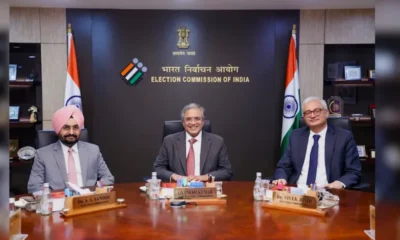
Two election commissioners complained against senior poll officer, RTI reveals
-
 India News4 hours ago
Om Prakash Mathur sworn in as Keralam Governor
-
 India News4 hours ago
PM Modi to inaugurate Rs 169-crore RBI data centre in Odisha on October 25
-
 India News3 hours ago
Delhi High Court rejects Neha Bora’s plea against peace bond notice
-
 India News2 hours ago
MEA responds after ITBP chief flags ongoing face-offs with China in Arunachal
