The house was filled with Bharat Mata Ki Jai as the PM ended his speech. Buoyed by his popularity, the members of US Congress queued up around PM Modi asking him for an autograph and clicking selfies.
Prime Minister Narendra Modi addressed the most anticipated Joint Sitting of the US Congress at around 1:45 am IST.
PM Modi spoke on a series of topics ranging from India-US partnership, India’s democracy, women empowerment, technology semi-conductor, Russia-Ukraine conflict, terrorism and many more.
The Prime Minister received a warm reception with the chants of Modi Modi that echoed the chamber hall of the US Capitol as PM Modi entered inside to deliver his historic speech.
PM Modi started his speech with a Namaskar, he said it was always an honour to address the US Congress and was an exceptional privilege for him to have got the opportunity to address it twice and extended his deepest gratitude to the 1.4 billion Indians.
The Prime Minister thanked the members of the US Congress for gathering to celebrate the bond between India’s democracy and the USA’s democracy.
Paying tribute to Mahatma Gandhi and Martin Luther King Jr, he remembered many who worked for the cause of equality, liberty and justice.
Speaking on India’s diversity, PM Modi said India has more than 2500 political parties, with around 20 ruling different states, it has 22 languages officially and thousands of dialects but still it speak united.
He also did not let go the chance of taking Indian traditional cuisine global, saying in every 100 miles in India, the cuisine changes, from dosa to aloo paratha(South to North) and from Srikhand to Sandesh (West to East).
The Prime Minister also cleared India’s stand on the Russia-Ukraine conflict resonating his not era of war stand, he said this is not an era of war, but of dialogue and diplomacy and the world must come together to do all it can in the best possible way to stop the bloodshed and human suffering happening due to this war.
VIDEO | “As I have said directly and publicly, this is not an era of war, but it is one of dialogue and diplomacy,” says PM Modi on Russia-Ukraine conflict while addressing joint session of US Congress.#PMModiUSVisitpic.twitter.com/qGoy3tzTb0
PM Modi also sent a strong message on terrorism, he said it is an enemy of the humanity and there cannot be an excuse when it comes to deal with it.
Stressing on eradicating terrorism, the PM said radicalism and terrorism still is a big challenge faced by the world posing a great danger and the world should overcome all the forces working to support it.
Prime Minister Modi said when he first visited the US after taking charge as the PM in 2014, India ranked 10th in the world economy and today it stands as the 5th largest economy.
He further said India is soon going to become the 3rd largest economic nation in the world.
He also spoke on a series of different topics such as women empowerment in India, youth and technology, smartphone users in India, India’s mass Covid-19 vaccination drive, Ayushman Bharat Yojana, Digital Payments System etc.
PM Modi said the world grows when India grows.
Speaking about India-US partnership he said, it is one of India’s largest defence trade partner, India-US share partnership in semiconductor, defence, space, technology, science, education, start-ups, healthcare and many more.
PM said he could speak endless about the partnership between India and the US in different sectors.
Prime Minister Narendra Modi concluded his speech with Jai Hind and Long Live India-US friendship.
WATCH | PM Modi receives thunderous applause from House members as he concludes his speech at joint session of US Congress.#PMModiUSVisitpic.twitter.com/QeATZUZvIj
The house was filled with Bharat Mata Ki Jai as the PM ended his speech. Buoyed by his popularity, the members of US Congress queued up around PM Modi asking him for an autograph and clicking selfies.
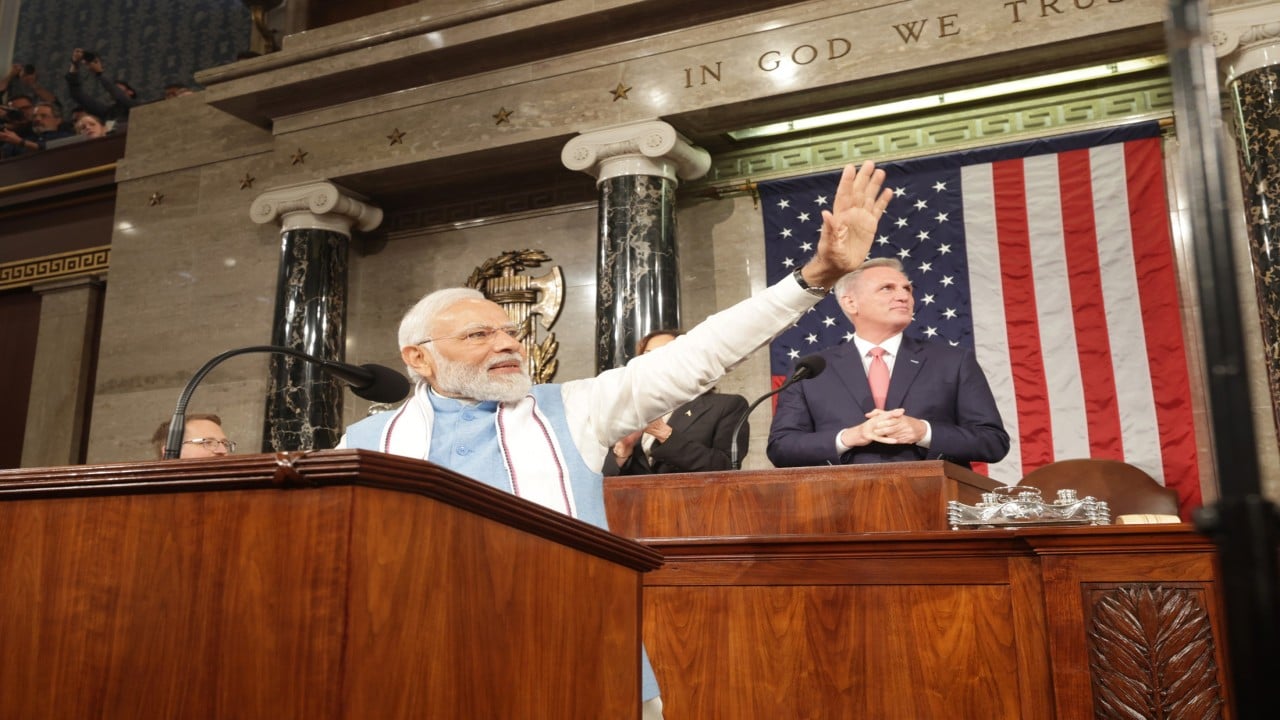
PHOTOS | Members of the House line up for autograph and selfie with PM Modi after his speech at the joint session of Congress.#PMModiUSVisitpic.twitter.com/YNceTuw8y7
The Prime Minister landed in the US on June 21 for his maiden State visit.
PM Modi held a parlay of meetings with business heads, community leaders, scholars, experts, people from the Indian diaspora and and others.
PM Modi also headed the global celebration of the 9th International Yoga Day on June 21 at the United Nations Headquarters in New York, which witnessed the participation of 180 nationals.
Earlier on June 22, Prime Minister Modi was called on US President Joe Biden and First Lady Jill Biden at the White House where the leaders of the world’s largest and oldest democracy exchanged a bunch of gifts.
Later in the day, PM Modi was accorded a grand ceremonial welcome with a 19-gun salute and marching bands at the White House by President Biden and First Lady Jill Biden.
In the welcome ceremony on the lawns of White House, apart from the President and the First Lady, senior US delegation headed by US Vice President Kamala Harris were present.
The Indian delegation, who has accompanied the PM in his visit to the US, was also present which included External Affairs Minister S Jaishankar, NSA Ajit Doval, Indian Ambassador to the US Taranjeet Singh Sandhu and others.
The White House Lawns also welcomed almost 7000 Indian-American people
Later Prime Minister Narendra Modi and President Joe Biden held a bilateral meet discussing on various issues for the India-US’ interest and issues and challenges concerning the world.
Trump approves nearly $9 billion weapons sales to Israel, UAE and other allies amid Iran tensions
The US has fast-tracked nearly $9 billion in weapons sales to Israel, UAE and other allies as tensions linked to the Iran conflict continue despite a fragile ceasefire.
The United States has approved nearly $9 billion worth of weapons sales to key Middle Eastern allies, including Israel and the United Arab Emirates, amid ongoing tensions linked to the Iran conflict.
The decision, cleared by the administration of Donald Trump, includes expedited military transfers to Israel, the UAE, Qatar, and Kuwait. The approvals were granted under an emergency provision, allowing authorities to bypass the usual congressional review process.
Emergency clearance amid ongoing conflict
Officials said the move was necessary due to the evolving security situation in the region, particularly as the conflict involving Iran continues despite a fragile ceasefire. The war, which began earlier in 2026, has heightened instability across West Asia.
US Secretary of State Marco Rubio invoked emergency powers to fast-track the deals, citing urgent defence requirements for allied nations.
What the arms package includes
The approved package includes a mix of advanced defence systems and precision weapons:
Patriot missile defence replenishments worth over $4 billion for Qatar
Precision-guided weapon systems for multiple countries
Integrated battle command systems for Kuwait
Additional advanced weapons support for Israel and the UAE
The total value of these deals is estimated at over $8.6 billion, often rounded to nearly $9 billion.
Timing linked to iran war
The approval comes nearly nine weeks into the conflict involving the US, Israel, and Iran, with tensions still high despite a ceasefire that has been in place for several weeks.
Analysts note that the move signals continued US military backing for its regional allies, particularly in strengthening air defence and precision strike capabilities during uncertain conditions.
Criticism and concerns
The decision to bypass congressional oversight has drawn criticism from some quarters, particularly over transparency and the broader implications of increasing arms supplies in a conflict-prone region.
US President Donald Trump and Russian President Vladimir Putin held a phone conversation lasting more than 90 minutes, focusing on escalating tensions in the Middle East and the ongoing war in Ukraine.
According to official statements, the discussion was described as “frank and businesslike,” with both leaders addressing key global security concerns. A major part of the conversation centred on the situation involving Iran and developments in the Persian Gulf.
Putin supported Trump’s decision to extend the ceasefire related to Iran, suggesting that continued restraint could create space for negotiations and help stabilise the region. However, he also issued a strong warning, stating that renewed military action by the United States or Israel could lead to “extremely damaging consequences” not only for Iran but for the wider international community.
Ukraine conflict also discussed
The leaders also discussed the ongoing war in Ukraine, which has continued for several years since Russia’s invasion in 2022. During the call, there were indications of potential efforts toward a temporary ceasefire, although no final agreement has been confirmed.
Reports suggest that the idea of a short-term pause in hostilities was explored, possibly linked to upcoming symbolic dates, but significant differences between the parties remain unresolved.
Focus on diplomacy amid global tensions
The call highlights ongoing diplomatic engagement between Washington and Moscow at a time of heightened geopolitical tensions involving both the Middle East and Eastern Europe.
While both sides acknowledged the importance of dialogue, the situation on the ground in both conflict zones remains complex, with no immediate resolution in sight.
U.S. President Donald Trump has rejected a proposal from Iran aimed at easing ongoing tensions, signaling a continued deadlock between the two countries.
The proposal reportedly included steps linked to easing restrictions around the Strait of Hormuz, a key global oil route. However, the United States declined the offer, maintaining that any agreement must address concerns related to Iran’s nuclear programme.
Washington has made it clear that resolving nuclear issues remains a priority and that partial measures without broader commitments will not be accepted.
Nuclear issue remains central
The U.S. position continues to focus on preventing Iran from advancing its nuclear capabilities. Officials believe that without a comprehensive agreement, temporary arrangements could delay a long-term resolution.
The rejection of the proposal indicates that negotiations remain stalled, with both sides holding firm on key demands.
Iran issues warning
Following the rejection, Iranian officials have issued strong statements, indicating readiness to respond if pressure from the U.S. continues.
Reports suggest that Iran has asserted its military preparedness, warning that any escalation could lead to serious consequences. The remarks reflect growing tensions as diplomatic efforts struggle to produce results.
Rising geopolitical tension
The situation remains volatile, with both countries engaged in a prolonged standoff. Measures such as restrictions on trade routes and strategic pressure points continue to impact the broader region.
The Strait of Hormuz remains a critical factor in the conflict, given its importance for global energy supplies.
Outlook uncertain
With no immediate breakthrough in sight, tensions between the United States and Iran are expected to persist. The lack of agreement on key issues, particularly the nuclear programme, continues to hinder progress toward de-escalation.
APN News is today the most watched and the most credible and respected news channel in India. APN has been at the forefront of every single news revolution. The channel is being recognized for its in-depth, analytical reportage and hard hitting discussions on burning issues; without any bias or vested interests.