English हिन्दी
Connect with us

Latest world news

Qatar Emir to attend GCC summit in Kuwait this week

Published

on

Qatar Emir to attend GCC summit in Kuwait this week
May lead to crisis resolution if Saudi Arabia participates

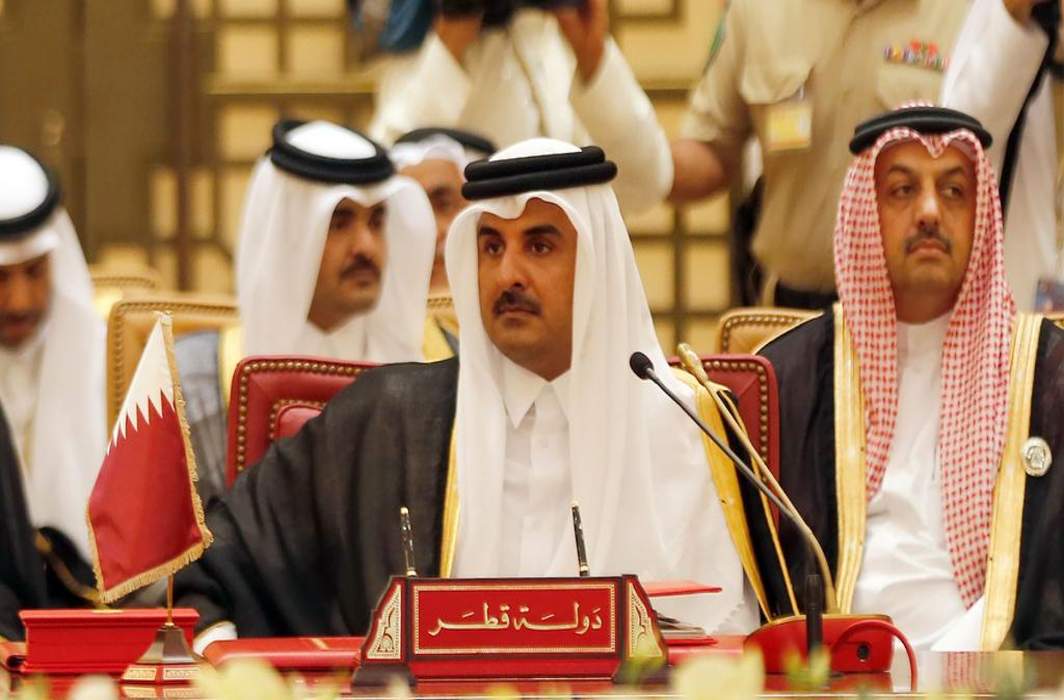
The diplomatic thaw in Middle East seems to be in the offing. Having faced six months of blockade by Saudi led quartet Qatari Emir Sheikh Tamim bin Hamad Al Thani will attend 38th  Gulf Cooperation Council (GCC) summit in Kuwait later this week.

Qatar’s foreign minister Sheikh Mohammed bin Abdulrahman Al Thani announced on Sunday that Emir has accepted Kuwait’s invitation to attend the two-day summit beginning on Tuesday.

According to Doha based Aljazeera, the foreign minister said, “I will attend the ministerial council tomorrow and the emir will attend the summit.” He was speaking at a forum.  “It is important that the GCC system remains alive,” he said.

The emir of Kuwait Sheikh Sabah Al Ahmad Al Sabah was the first Arab leader who tried to mediate for resolving Qatar crisis involving diplomatic impasse.

Last week, Kuwait had invited all six GCC member states. It is still not clear if all other leaders would attend the summit.

The GCC, established in 1981, the early years of Iraq-Iran war (1980-88), is a political and economic alliance of Bahrain, Kuwait, Oman, Qatar, Saudi Arabia and the United Arab Emirates (UAE). The recent Qatar crisis has created ruptures with a debate if GCC will survive due to ongoing tension in the region.

On June 5 this year, Saudi Arabia, Bahrain, UAE and Egypt had suddenly severed diplomatic, air, sea and land route ties with Qatar. They accused Qatar of supporting “terrorism”, maintaining cordial relations with Iran and meddling in the internal affairs of their countries.

Qatar strongly denied all allegations. Doha maintains there is no legitimate justification for the blockade calling it “a violation of its sovereignty”.

Saudi Arabia had also appealed to “all brotherly nations” to join the blockading countries. Kuwait and Oman did not join the quartet. Instead Kuwait, with US support, tried to mediate for resolving the crisis.

In the third week of June, Saudi Arabia led quartet put forwarded 13-point charter of demands asking Qatar, among others, to cut its ties with Iran, close down new Turkish army base in its territory and shut its Aljazeera news network.

In August, Qatari foreign minister visited Tehran and both countries decided to send their ambassadors to each other’s capitals. Qatar had called its Ambassador along with Saudi Arabia after violent protest against Saudi Embassy in Tehran in January 2016 after Mina tragedy during Hajj.

In October, Kuwait’s emir warned of the potential collapse of the Gulf Cooperation Council if the crisis continues.

He was quoted saying, “Contrary to our wishes and hopes, the Gulf crisis has the potential of escalating; therefore, all of us must be fully aware of its potential consequences.” “Any escalation will bring with it an outright call for regional and international intervention, which will destroy the security of the Gulf and its people.”

At the end of October, Qatar’s Emir sheikh Tamim bin Hamad, during an interview with US based CBS News, had accused Saudi Arabia of seeking “regime change” in his country. He had also asserted that he will not bow to pressure and country’s independence and sovereignty is a “red line”.

Bahrain, which is enjoying Saudi army’s support in suppressing its pro-democratic opposition since 2011, had indicated in late October that its king Hamad bin Issa Al-Khalifa will not attend GCC summit if attended by Qatar unless Doha “correct its approach”.

Meanwhile, Marwan Kabalan, director of policy analysis at the Doha Institute has told Al Jazeera about the imminent danger of a GCC collapse.

He said, “The emir of Kuwait knows very well that if the crisis runs for long, we’re going to see two blocks within the GCC. One is led by Saudi Arabia, the Emirates and Bahrain, and the other will actually have Qatar, Oman and to a lesser extent, probably Kuwait. So we’ll be having then two GCCs, rather than one.”

“Qatar has made it clear many times, by the emir of Qatar and by other Qatari officials, that they cannot accept a total surrender. They want a negotiation. They want mutual concessions by all sides, actually, to solve the crisis,” added Kabalan.

The GCC is the only pan-Arab alliance active with its leaders meeting twice a year. In December the leaders meet in the member states (in rotation) and once in Riyadh, the headquarters of the body.

The official Saudi Press Agency (SPA), does not carry any information on who will, if any, will represent Saudi Arabia in the GCC summit in Kuwait till 11.30 Monday morning (local time). Kuwaiti News Agency (KUNA) also  does not carry any news story telling the names of countries participating in the pre-summit ministerial meeting on Monday.

However, most of the Arab news websites carried story about participation of Qatar’s Emir in the summit.

However, Gulf News reports that GCC summit’s fate and level of representation will most likely depend on the outcome of the foreign ministers’ meeting on Monday.

Latest world news

Sheikh Hasina says she would love to return home but only under legitimate Bangladesh government

Sheikh Hasina, ousted from power in 2024, says she will remain in India and not return to Bangladesh unless free and fair elections allow the Awami League to participate.

Published

on

Sheikh Hasina

Former Bangladesh Prime Minister Sheikh Hasina has said she will remain in India and not return to her country under any government formed after elections that exclude her party, the Awami League. Speaking from her exile in New Delhi, the 78-year-old leader described the ban on her party as “unjust and self-defeating”.

Hasina fled to India in August 2024 after a student-led uprising that resulted in her ouster. An interim government headed by Nobel laureate Muhammad Yunus has since been in charge, with general elections scheduled for February next year.

“The next government must have electoral legitimacy. Millions of people support the Awami League, so as things stand, they will not vote,” she said in written responses to media. “You cannot disenfranchise millions if you want a political system that works.”

Hope for Awami League’s return to polls

Bangladesh’s Election Commission suspended the Awami League’s registration in May, citing national security and ongoing war crimes investigations against senior party figures. The Nobel laureate-led government also banned all party activities earlier this year.

Hasina said her party is not asking supporters to vote for other parties and still hopes “common sense will prevail” so that the Awami League can contest the election. However, she did not reveal if any communication is ongoing with authorities in Dhaka regarding the issue.

The Awami League and the Bangladesh Nationalist Party (BNP) have dominated the country’s political landscape for decades. The BNP is expected to benefit from the ruling’s absence in the upcoming vote.

Hasina faces war crimes charges

Hasina, credited with driving Bangladesh’s economic growth but accused of human rights violations during her long tenure, is facing charges of crimes against humanity for the violent crackdown on protests in 2024. A verdict from Bangladesh’s International Crimes Tribunal is expected on November 13.

According to UN estimates, up to 1,400 people were killed and thousands injured during the unrest, primarily from gunfire by security forces. Prosecutors also allege she oversaw enforced disappearances and torture of opposition activists through secret detention centres.

Rejecting the allegations, Hasina said, “These proceedings are a politically motivated charade. They’ve been brought by kangaroo courts, with guilty verdicts a foregone conclusion.”

“I live freely in Delhi, but would love to return”

Despite her exile, Hasina remains hopeful that her party will play a role in Bangladesh’s future politics. “It’s not about me or my family,” she said, adding that her son Sajeeb Wazed, based in Washington, could lead if asked.

Hasina, who lost most of her family in the 1975 military coup, said she lives “freely in Delhi” but remains vigilant due to her family’s violent past. She was recently spotted taking a stroll in Lodhi Garden with her security team, acknowledging locals who recognised her.

“I would of course love to go home, so long as the government there was legitimate, the constitution was being upheld, and law and order genuinely prevailed,” she said.

Continue Reading

Latest world news

Donald Trump says US to finalise trade deal with India soon

Donald Trump, during his South Korea visit, revealed that the US and India are close to finalising a trade agreement after months of negotiations, highlighting his strong relationship with PM Narendra Modi.

Published

on

Modi trump

Former US President Donald Trump has announced that a long-pending trade agreement between the United States and India will soon be signed, indicating a breakthrough after months of stalled discussions.

Trump praises ties with Prime Minister Modi

Speaking during his visit to South Korea, Trump said, “I’m doing a trade deal with India and have great respect and love for Prime Minister Narendra Modi… we have a great relationship.” His comments suggest that the long-awaited trade pact between the two major economies is nearing completion.

Talks see progress after months of delay

Negotiations for the deal had been delayed due to disagreements over issues such as India’s import of discounted Russian oil, high reciprocal tariffs imposed by the US, and India’s restrictions on access to its dairy and agriculture markets. Reports last week indicated progress on two of the three contentious points.

The US reportedly agreed to lower tariffs to 16 per cent—down from the earlier 50 per cent—after India consented to scale back purchases of Russian oil. This development followed a phone conversation between Trump and Prime Minister Modi, though neither side publicly confirmed the details.

Continue Reading

Latest world news

Lawrence Bishnoi gang kills Indian-origin industrialist in Canada, fires at singer’s home

Indian-origin industrialist Darshan Singh Sahasi was shot dead outside his home in Abbotsford, Canada, while the Lawrence Bishnoi gang also claimed responsibility for firing at Punjabi singer Channi Nattan’s house.

Published

on

Lawrence Vishnoia

The Lawrence Bishnoi gang has once again made headlines after claiming responsibility for the killing of Indian-origin industrialist Darshan Singh Sahasi in Abbotsford, British Columbia, and for firing shots outside Punjabi singer Channi Nattan’s house.

Industrialist killed outside home

According to reports, Darshan Singh Sahasi, 68, was gunned down outside his home on Monday morning. Preliminary investigation revealed that the shooter had been waiting near Sahasi’s car parked outside his residence. As soon as he got into his vehicle, the assailant opened fire and fled the scene.

Sahasi was found critically injured when police arrived, but despite emergency efforts, he succumbed to his wounds. Authorities imposed precautionary lockdowns in three nearby schools under “shelter-in-place” protocols; no students were harmed.

Gang member Goldy Dhillon took to social media to claim responsibility for the killing, alleging that Sahasi was involved in a drug-related business and had refused to pay extortion money.

A self-made entrepreneur

Sahasi, the president of Canam International—a well-known textile recycling firm—moved to Canada in 1991. He began his journey with small jobs before transforming a struggling textile unit into a successful global business. Known for his philanthropy, Sahasi’s death has left the Punjabi community in Abbotsford in shock. Community leaders have urged authorities to take swift action to ensure the safety of Indian-origin residents in Canada.

Firing outside singer’s residence

In another incident, shots were fired outside the residence of Punjabi singer Channi Nattan. Goldy Dhillon also claimed responsibility for this act, stating it was a warning over Nattan’s growing association with another singer, Sardar Khera. The gang clarified that it held no personal grudge against Nattan but cautioned that any artist collaborating with Khera would face consequences.

The gang’s growing international reach

The Lawrence Bishnoi gang, designated as a terrorist organization by Canada, reportedly controls a network of over 700 shooters across multiple countries. The group has been linked to high-profile cases, including the killing of singer-turned-politician Sidhu Moosewala and threats against Bollywood actor Salman Khan.

Continue Reading

Trending

© Copyright 2022 APNLIVE.com