English हिन्दी
Connect with us

Latest world news

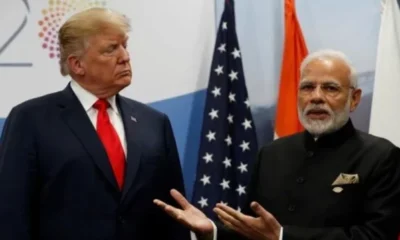
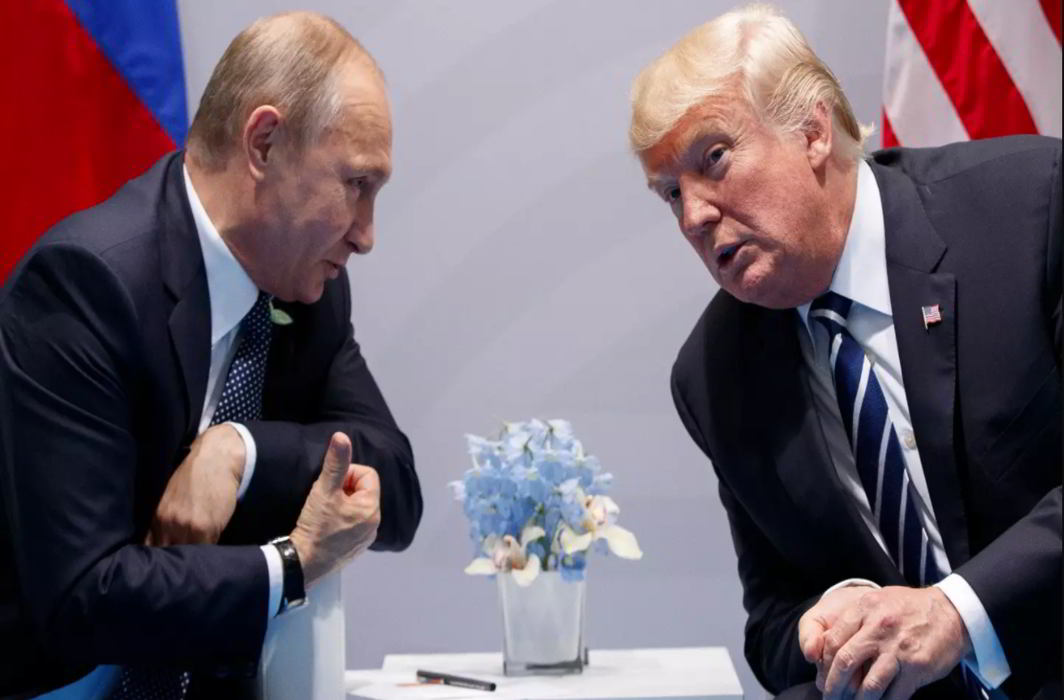
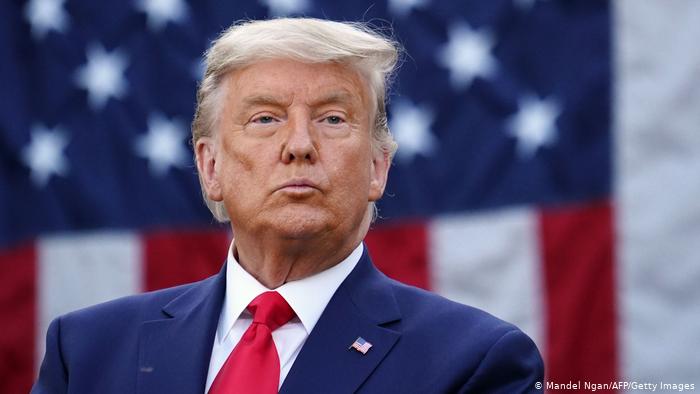
Trump says we’ve lost India, Russia to darkest China after SCO summit

Donald Trump claimed the US has “lost” India and Russia to China following PM Modi’s SCO summit meeting with Xi Jinping and Vladimir Putin in Tianjin.

Published

on

donald trump

US President Donald Trump has sharpened his criticism of India, Russia and China, declaring that Washington has “lost” both New Delhi and Moscow to Beijing’s growing influence. His remarks come in the wake of Prime Minister Narendra Modi’s participation in the Shanghai Cooperation Organisation (SCO) summit in Tianjin, where he met Chinese President Xi Jinping and Russian President Vladimir Putin.

Trump’s social media post

In a post on Truth Social, Trump wrote, “Looks like we’ve lost India and Russia to deepest, darkest China. May they have a long and prosperous future together!” The comment is being seen as his strongest public acknowledgment of the tightening partnership between the three nations.

SCO summit highlights

At the Tianjin summit, leaders of India, Russia and China discussed cooperation in areas including energy and security. The meeting was significant as it marked PM Modi’s first visit to China in seven years, amid lingering tensions since the 2020 Galwan Valley clash. By engaging with both Xi and Putin, Modi underscored India’s pursuit of strategic autonomy rather than aligning with any single bloc.

Tensions in US-India ties

Trump’s latest remarks reflect the cooling of ties with India under his administration. His decision to impose a cumulative 50 per cent tariff on Indian goods — combining reciprocal tariffs and a levy linked to India’s imports of Russian oil — has strained relations further. He has also accused India of disproportionately benefiting from trade with the US and of “financing” Russia’s war in Ukraine by buying discounted Russian crude.

India’s response

External Affairs Minister S. Jaishankar has rejected Washington’s criticism, arguing that the US applies double standards. He pointed out that while India faces scrutiny for its energy trade with Moscow, both China and European countries remain among the largest importers of Russian energy.

Latest world news

Trump rejects Iran’s 7-day peace plan, says deal can come after US polls

US President Donald Trump rejected Iran’s seven-day proposal to end hostilities and indicated that a deal could come after the US midterm elections in November.

Published

on

Donald Trump

US President Donald Trump has rejected Iran’s latest proposal aimed at bringing an end to the ongoing conflict, while indicating that a possible agreement could come after the US midterm elections in November.

Iran had proposed a seven-day framework under which hostilities could be brought to an end, the Strait of Hormuz could be reopened and negotiations over its nuclear programme could resume.

Iran’s seven-day proposal

Iranian Foreign Minister Abbas Araghchi said Tehran had put forward the proposal through intermediaries. Under the plan, the Strait of Hormuz would be reopened by the end of the seventh day if specified conditions were met, while broader nuclear discussions would restart.

The proposal was based largely on an earlier understanding reached between Washington and Tehran, but Iran sought to implement the latest framework much faster. The earlier arrangement had provided a longer period for negotiations.

The Strait of Hormuz is a strategically important waterway for global energy shipments, making its reopening a key element of any effort to ease the wider conflict.

Trump points to US midterm elections

Trump, speaking at the United Nations, showed no indication that he was ready to immediately resume negotiations on the terms proposed by Tehran.

He called for the economic isolation of Iran and said he believed a deal could be reached after the US midterm elections in November. Trump also said Iran was waiting to see how he performed in the midterm elections.

The remarks came as Iranian officials signalled that they remained open to diplomacy and described the UN General Assembly as an opportunity to revive negotiations.

Nuclear talks remain part of Iran proposal

Iran’s latest plan links the easing of hostilities with the resumption of negotiations over its nuclear programme.

The proposal follows the collapse of an earlier US-Iran arrangement. According to reporting on the latest proposal, the new framework is intended to compress the timeline for implementing commitments that had previously been discussed by the two sides.

For now, Trump’s remarks indicate that Washington is not accepting Tehran’s seven-day framework as presented, while Iran continues to put diplomacy and negotiations forward as part of its proposal.

Continue Reading

Latest world news

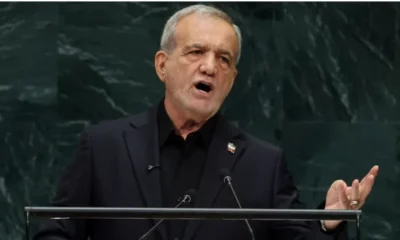
Iranian President Pezeshkian at UN says Iranians have been victims of US terrorism

Iranian President Masoud Pezeshkian said at the UN General Assembly that Iranians had been victims of US terrorism and insisted that Iran had acted in self-defence.

Published

on

Iranian President Masoud Pezeshkian accused the United States of subjecting Iranians to what he described as terrorism while addressing the United Nations General Assembly on Wednesday.

Pezeshkian said Iran had defended itself against attacks and rejected the characterisation of the country as a terrorist actor. His remarks came during a rare wartime appearance at the UN as tensions between Iran and the United States remain high.

Pezeshkian accuses US and Israel of attacks

Speaking at the General Assembly, Pezeshkian said Iranian civilians had been targeted by attacks and described the actions against his country as aggression.

“We have only defended ourselves. We are not terrorists,” he said, according to the report.

Pezeshkian also accused the United States and Israel of attacking Iran, while maintaining that Tehran’s response was an act of self-defence.

The Iranian president displayed photographs of former Supreme Leader Ali Khamenei and more than 150 schoolchildren who, according to his account, were killed during the early days of the conflict.

Iran’s message at the UN

Pezeshkian’s address came against the backdrop of the ongoing conflict between Iran and the United States and heightened tensions in the region.

Iranian officials had indicated ahead of the UN visit that they intended to highlight what Tehran considers attacks against its people and raise concerns over the international response to the conflict.

The Iranian delegation’s visit to New York also comes amid restrictions imposed by the United States on the delegation’s movement and other aspects of its stay, according to reporting ahead of the address.

Pezeshkian says Iran defended itself

Pezeshkian’s central message at the UN was that Iran’s military actions should be viewed as a response to attacks rather than terrorism.

His description of the conflict and the allegations against the United States and Israel represent the Iranian government’s position. They should therefore be attributed to Pezeshkian rather than presented as independently established facts.

Continue Reading

Latest world news

PM Modi’s Canada visit could help wrap trade talks, says Canada PM Mark Carney

Canadian PM Mark Carney said he is looking forward to hosting PM Narendra Modi, with both countries aiming to conclude their ongoing trade negotiations.

Published

on

Canadian Prime Minister Mark Carney has said he is looking forward to hosting Prime Minister Narendra Modi, as India and Canada continue efforts to advance their bilateral relationship and conclude ongoing trade negotiations.

The two countries have been working towards a Comprehensive Economic Partnership Agreement (CEPA), with both sides previously setting a target to conclude the negotiations in 2026.

Carney and Modi have held discussions on strengthening economic ties between India and Canada, including trade and investment. Their engagement has gained momentum following Carney’s visit to India earlier this year.

India-Canada trade talks

India and Canada formally resumed efforts towards a broader trade agreement after a period of strained bilateral ties. The two sides have committed to advancing negotiations on a CEPA covering their economic relationship.

In June, Carney and Modi reviewed progress in bilateral economic cooperation during their meeting on the sidelines of the G7 Summit in France. They expressed satisfaction with the progress in CEPA negotiations and reaffirmed their shared objective of concluding the talks in 2026.

During Carney’s visit to India in March, the two leaders had also agreed to accelerate negotiations on the CEPA and work towards finalising the agreement during 2026.

Modi’s proposed Canada visit

Carney had invited PM Modi to visit Canada in 2026, and the two leaders agreed to remain engaged through diplomatic channels to work towards a mutually convenient date for the visit.

The proposed visit comes as New Delhi and Ottawa seek to build on renewed diplomatic and economic engagement, with trade negotiations remaining a key part of the relationship.

The focus on completing the trade talks comes as both countries look to expand commercial ties and establish a broader economic framework through the proposed CEPA.

Continue Reading

Trending

© Copyright 2022 APNLIVE.com