English हिन्दी
Connect with us

India News

Covid vaccine shortage: Health minister Mansukh Mandaviya says useless statements being made to create panic

On Covid vaccine shortage, Health minister Mansukh Mandaviya accused the state government and said that useless statements being made to create panic among the people. The central government had earlier said it will vaccinate all by end-2021.

Published

on

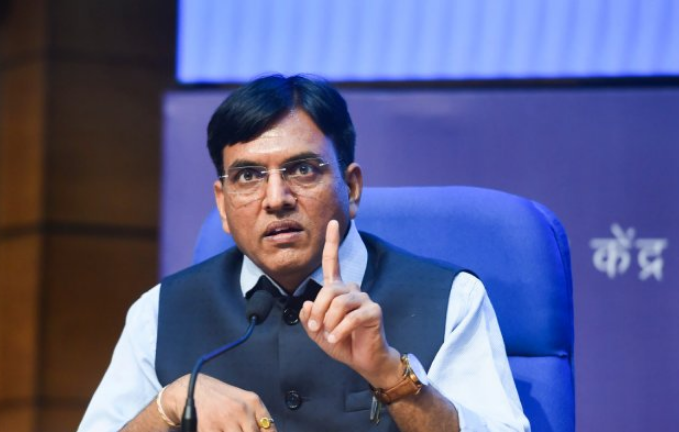
Health minister Mansukh Mandaviya

Amid reports of Covid vaccine shortage from several states, Union Health Minister Mansukh Mandaviya on Wednesday afternoon accused the states for Covid vaccine mismanagement and said that the Centre had been informed of available supplies in advance but the states had failed to plan accordingly.

Mandaviya said states know very well when and in what quantity they will get the doses. He also said useless statements are being made only to create panic among the people. Hitting out at leaders who make statements that create confusion among the people, he said they need to introspect whether they are so far removed from the governance process and related information.

In a six-part Twitter thread in Hindi, Mandaviya said the availability of vaccines can be better understood by an actual analysis of the facts. To enable vaccination through government and private hospitals, Mandaviya said, 11.46 crore vaccine doses were made available to the state governments and union territories in June and this availability has been increased to 13.50 crore in July.

Mandaviya’s tweets come after several states, including Tamil Nadu and Delhi, once again warned the centre that they are running out of doses.

The Centre had informed the states on June 19 about how many doses of the vaccine would be made available to them in July, he said. On June 27 and July 13, the states were informed about the availability of vaccines every day for the first and second fortnight of July.

However, Mandaviya on Wednesday dismissed such claims, declaring that was 13.5 crore in the month of July – up from 11.46 crore in June while the Centre has said 1.54 crore doses were still left with states and private hospitals. As per the CoWin app data, a decline has been recorded in daily average vaccinations – 61.4 lakh in June 21-27 to 41.92 lakh in June 28-July 4.

The central government had earlier said it will vaccinate all by end-2021.
On Monday, Rajasthan, West Bengal and Maharashtra recorded the highest Covid cases which led to the complaints of vaccine shortage. Following which the vaccination were not conducted in at least 25 of Rajasthan’s 33 districts on Monday while the West Bengal was finding it difficult to evenly distribute the doses among its 23 districts.

Read Also: “Never give up!”, manifests Engineer turned blogger, Rachna Singh

In other India News, The BKU leader Rakesh Tikait announced to stage a peaceful protest with 200 farmers outside Parliament during the monsoon session demanding repeal of the contentious farm laws.

India News

Trump lifts additional 25% tariff on India after deal on Russian oil imports

The United States has lifted an extra 25% tariff on Indian goods after India committed to stopping Russian oil imports as part of a new trade agreement.

Published

on

trump

US President Donald Trump has moved to remove an additional 25 percent tariff imposed on Indian goods following a trade agreement between the two countries, according to an executive order signed on Friday.

The extra duty, which had been levied over India’s purchases of Russian oil, will be lifted at 12:01 am Eastern Time on Saturday. The order states that India has committed to stopping the direct or indirect import of oil from the Russian Federation.

The decision comes days after Trump announced a broader trade deal with India, saying Prime Minister Narendra Modi had assured Washington that New Delhi would halt Russian oil purchases amid the ongoing Ukraine war.

As part of the agreement, India has also committed to buying energy products from the United States. The executive order further noted that New Delhi has recently agreed to a framework aimed at expanding defence cooperation between the two countries over the next decade.

Tariff reduction still to be rolled out

While the additional 25 percent tariff is being removed immediately, the wider reduction in so-called reciprocal tariffs is yet to be implemented. Under the agreement, US duties on Indian products are expected to be reduced to 18 percent from the earlier level of 25 percent.

Other provisions of the deal include the removal of tariffs on certain aircraft and aircraft parts. A separate joint statement released by the White House said India intends to purchase goods worth $500 billion from the United States over the next five years. These purchases are expected to include energy products, aircraft and parts, precious metals, technology products and coking coal.

The move marks a sharp decline in US tariff levels on Indian goods, which had stood at as high as 50 percent late last year. The agreement also helps ease months of strain between the two countries over India’s oil imports, which Washington has argued help finance the conflict in Ukraine.

The deal signals a reset in ties between Trump and Prime Minister Modi, whom the US President has previously described as one of his closest friends.

Trade experts have noted that the proposed 18 percent tariff rate could offer Indian exporters a slight advantage in the US market compared to regional competitors facing duties of around 19 to 20 percent.

Continue Reading

India News

Centre reassures farmers as India-US trade deal nears completion

The Centre has assured farmers that the upcoming India-US trade deal will not harm agriculture or dairy, while creating new export opportunities for India.

Published

on

farmer

As India and the United States move closer to finalising a major bilateral trade agreement, the Centre has sought to reassure farmers that their interests remain fully protected. Senior ministers on Wednesday said the proposed pact does not compromise sensitive sectors such as agriculture and dairy, while opening new avenues for Indian exports.

Union Minister for Agriculture and Farmers’ Welfare Shivraj Singh Chouhan dismissed opposition allegations that the deal could adversely affect domestic farmers. Speaking to the media in New Delhi, he said the agreement poses no risk to staple food grains, millets, fruits or dairy products.

“Farmers’ interests are paramount and non-negotiable,” Chouhan said, asserting that the government has ensured no provision allows sudden or disruptive entry of foreign agricultural products into Indian markets. He added that safeguards for both small and large farmers remain firmly in place.

Chouhan underlined that key agricultural commodities continue to be protected and that existing measures shielding Indian farmers from unfair competition will remain unchanged. According to him, the agreement has been shaped under the leadership of Prime Minister Narendra Modi, with a clear focus on development and national interest.

Addressing concerns sparked by a recent social media post from a US official regarding greater access for American farm products, the Agriculture Minister said the matter had already been clarified in Parliament by Commerce Minister Piyush Goyal. He reiterated that India has not opened its markets in a way that would put pressure on domestic producers.

At the same time, the government highlighted potential gains for Indian exports. Reduced tariffs under the agreement are expected to benefit sectors such as rice, spices and textiles. Chouhan pointed out that India already exports rice to multiple countries, including the US, with shipments valued at around Rs 63,000 crore. Increased textile exports, he added, would directly support cotton-growing farmers and allied industries.

External Affairs Minister S Jaishankar also indicated that the trade agreement is now in its final stages. In a post on X following his visit to the United States, he described the negotiations as productive and said the deal would mark a new phase in bilateral relations. He noted progress in areas such as critical minerals, while signalling deeper engagement in defence, energy and strategic cooperation.

Officials view the agreement as part of a broader effort to strengthen India-US economic and strategic ties amid global uncertainty. While detailed provisions are yet to be made public, the Centre has reiterated that farmer welfare remains at the heart of the negotiations.

In an emotional appeal, Chouhan referred to farmers as the nation’s “Annadata” and said serving them was equivalent to worship. He assured that the government would continue to stand firmly with farmers as India charts a new course in its trade relationship with the United States.

Continue Reading

India News

Punjab AAP leader Lucky Oberoi shot dead in daylight attack in Jalandhar

AAP leader Lucky Oberoi was killed in a daylight shooting in Punjab’s Jalandhar after attackers fired multiple bullets at him while he was inside his car.

Published

on

AAP LEADER Lucky oberoi

AAP leader Lucky Oberoi was shot dead in a broad daylight attack in Punjab’s Jalandhar on Friday after unidentified assailants opened fire at him near a gurdwara in the city.

According to initial information, Oberoi was inside his car near the Gurdwara Sahib in the Model Town area when attackers arrived on a two-wheeler and fired multiple rounds at him. Five bullets reportedly hit him during the attack.

He was rushed to a private hospital immediately after the shooting, but doctors declared him dead due to the severity of his injuries.

Attack near gurdwara, police launch investigation

As per preliminary details, Oberoi was parking his vehicle outside the gurdwara when the attackers struck. The shooting triggered panic in the area, prompting an immediate response from the local police.

A police team reached the spot soon after receiving information and has launched an investigation into the incident. Efforts are underway to identify the attackers and determine the motive behind the killing.

Political reactions after killing

Following the incident, Leader of Opposition in the Punjab Legislative Assembly, Partap Singh Bajwa, strongly criticised the state government, alleging a collapse of law and order in Punjab.

In a post on X, Bajwa said the daylight killing of an AAP leader outside a gurdwara reflected the deteriorating security situation in the state. He questioned the government’s ability to protect citizens, claiming that fear and gang violence were gripping Punjab under the current administration.

Background

Lucky Oberoi was associated with the Aam Aadmi Party in Punjab. His wife had earlier contested municipal elections as an AAP candidate but did not win.

Continue Reading

Trending

© Copyright 2022 APNLIVE.com