English हिन्दी
Connect with us

India News

Why do people love to hate?

Published

on

Bengal Riots

[vc_row][vc_column][vc_column_text]Ranjona Banerji

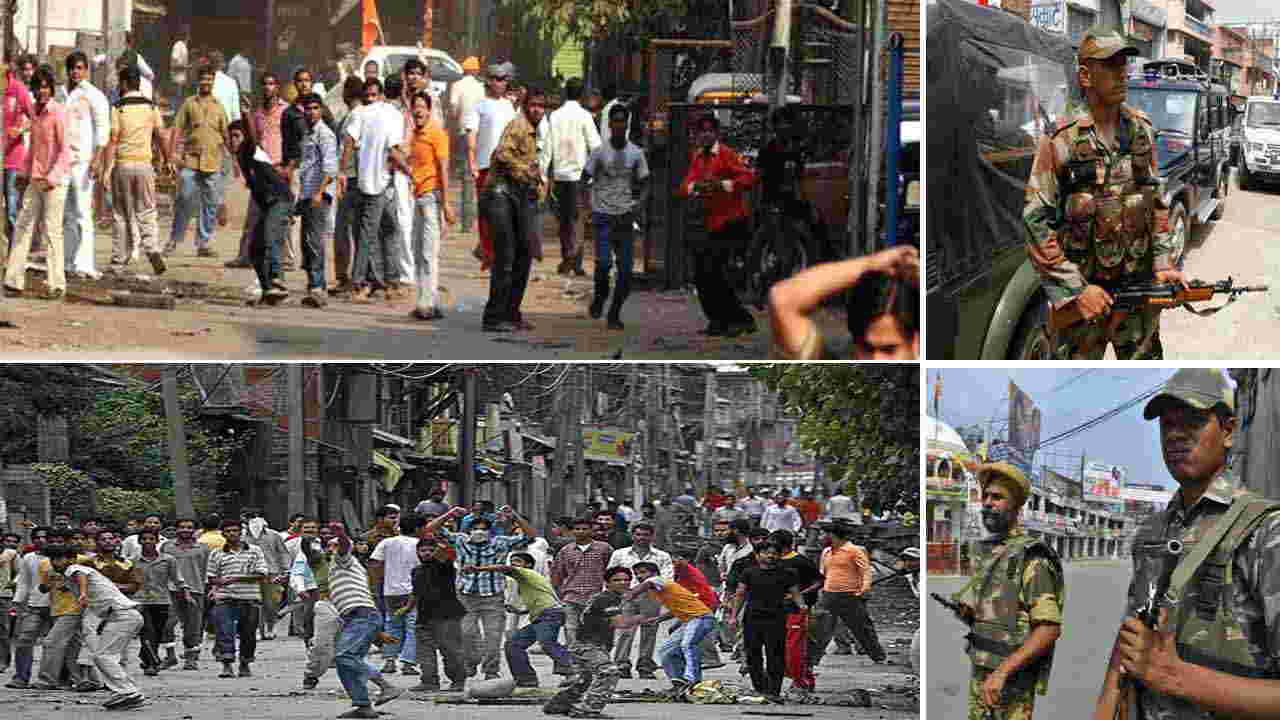
And once again, India is heading towards what journalists of old used to call a “communal tinderbox”. Sectarian hatred, which sadly simmers below the surface across pockets of India, has once again started to find violent expression. This expression is usually related to political patronage – some Hindus feel that majoritarian rule is the answer for India whenever the BJP is in power. And in Bengal, there are claims that Mamata Banerjee’s Muslim appeasement policy has given strength to Islamist feelings in some areas of Bengal. Kerala is also going through some churn between the CPM and the BJP and once again the accusation is that various Islamic groups have free rein there: Hatred growing on hatred to destroy us all.

It is convenient for us to get stuck in the politics of it. That as if, had politicians not existed or did not pit one cause against the other, we would have loved each other desperately. The politics of it allows us to escape from the reality: That there is hatred, there is fear, there is a sense of historical injustice and there is insecurity. Almost all of it is illogical and unreasonable, almost all of it stems from ignorance and bigotry and all of it makes a mockery of our humanity.

History will show us that there is no one answer, there is no easy answer. Anthropologists will point to ancient atavistic impulses. Archaeologists will find old bones with evidence of extreme violence. Sociologists and psychologists will examine chinks in our relationships with others and with ourselves. They will all be correct. There is hatred in us and it will continue.

Do upbringing and experience play a role? Yet there are people who have suffered after the Partition riots and have tried to build bridges and there are those who have suffered and become filled with thoughts of revenge. The way some soldiers who have seen fighting and death become pacifists and others become even more dogged about military solutions to a conflict over all other ones. Does education make a difference? Clearly it does not, when you consider the number of educated terrorists of all political hues. Does being religious make a difference? This is the most tragic of all human beliefs when you consider that most extremist behaviour is justified in the name of religion.

We can accept that this is how we are and move on. Let law and order take each individual case and let the human constructs of evidence and justice deal with the consequences of human iniquity. Small individual steps to offset our human flaws. But this does not work on any grand scale.

The only thing that will make a difference is if law is matched with societal determination. Look at how Germany has tackled its anti-Semitic past. It was not the only nation in Europe which has persecuted Jews. The word “pogrom”, used loosely today for rioting and ethnic cleansing, is a Russian word meaning to “wreak havoc, demolish violently”, was specifically used for attacks on Jews. Across Europe, Jews faced everything from social discrimination to outright violence. Every kind of justification and lie to persecute any minority group today was used then.

But what happened in Nazi Germany with the cruel genocide of 6 million Jews in concentration camps was so bad, so horrific, that it became too much for the collective conscience of the Germans and of much of the world. Germany more than any other nation follows a very strict policy when it comes to anti-Semitism because it is always aware of its past. No solution is perfect but this is the one solution which has stood out as a beacon of hope and so it must.

Racism has not found such an easy solution nor has gender equity. Here in India, apart from the anger with minority religions that some of the majority Hindus have, we have still not managed as a society to acknowledge the terrible damage done to our fellow humans by the strictures of caste. We still look for justifications for dehumanisation, against and above the law of the land.

There is no easy answer and as long as we don’t honestly search for some as a society, we shall continue to be victim to politicians, religious clerics and other vested interests, to those whose power flows from creating and fostering hatred amongst us. We have reached that crossroads yet again. The last time someone tried to appeal to our collective conscience, we killed him. There is no Mahatma Gandhi today. There is only us. And we don’t look pretty.[/vc_column_text][/vc_column][/vc_row]

India News

Centre reassures farmers as India-US trade deal nears completion

The Centre has assured farmers that the upcoming India-US trade deal will not harm agriculture or dairy, while creating new export opportunities for India.

Published

on

farmer

As India and the United States move closer to finalising a major bilateral trade agreement, the Centre has sought to reassure farmers that their interests remain fully protected. Senior ministers on Wednesday said the proposed pact does not compromise sensitive sectors such as agriculture and dairy, while opening new avenues for Indian exports.

Union Minister for Agriculture and Farmers’ Welfare Shivraj Singh Chouhan dismissed opposition allegations that the deal could adversely affect domestic farmers. Speaking to the media in New Delhi, he said the agreement poses no risk to staple food grains, millets, fruits or dairy products.

“Farmers’ interests are paramount and non-negotiable,” Chouhan said, asserting that the government has ensured no provision allows sudden or disruptive entry of foreign agricultural products into Indian markets. He added that safeguards for both small and large farmers remain firmly in place.

Chouhan underlined that key agricultural commodities continue to be protected and that existing measures shielding Indian farmers from unfair competition will remain unchanged. According to him, the agreement has been shaped under the leadership of Prime Minister Narendra Modi, with a clear focus on development and national interest.

Addressing concerns sparked by a recent social media post from a US official regarding greater access for American farm products, the Agriculture Minister said the matter had already been clarified in Parliament by Commerce Minister Piyush Goyal. He reiterated that India has not opened its markets in a way that would put pressure on domestic producers.

At the same time, the government highlighted potential gains for Indian exports. Reduced tariffs under the agreement are expected to benefit sectors such as rice, spices and textiles. Chouhan pointed out that India already exports rice to multiple countries, including the US, with shipments valued at around Rs 63,000 crore. Increased textile exports, he added, would directly support cotton-growing farmers and allied industries.

External Affairs Minister S Jaishankar also indicated that the trade agreement is now in its final stages. In a post on X following his visit to the United States, he described the negotiations as productive and said the deal would mark a new phase in bilateral relations. He noted progress in areas such as critical minerals, while signalling deeper engagement in defence, energy and strategic cooperation.

Officials view the agreement as part of a broader effort to strengthen India-US economic and strategic ties amid global uncertainty. While detailed provisions are yet to be made public, the Centre has reiterated that farmer welfare remains at the heart of the negotiations.

In an emotional appeal, Chouhan referred to farmers as the nation’s “Annadata” and said serving them was equivalent to worship. He assured that the government would continue to stand firmly with farmers as India charts a new course in its trade relationship with the United States.

Continue Reading

India News

Punjab AAP leader Lucky Oberoi shot dead in daylight attack in Jalandhar

AAP leader Lucky Oberoi was killed in a daylight shooting in Punjab’s Jalandhar after attackers fired multiple bullets at him while he was inside his car.

Published

on

AAP LEADER Lucky oberoi

AAP leader Lucky Oberoi was shot dead in a broad daylight attack in Punjab’s Jalandhar on Friday after unidentified assailants opened fire at him near a gurdwara in the city.

According to initial information, Oberoi was inside his car near the Gurdwara Sahib in the Model Town area when attackers arrived on a two-wheeler and fired multiple rounds at him. Five bullets reportedly hit him during the attack.

He was rushed to a private hospital immediately after the shooting, but doctors declared him dead due to the severity of his injuries.

Attack near gurdwara, police launch investigation

As per preliminary details, Oberoi was parking his vehicle outside the gurdwara when the attackers struck. The shooting triggered panic in the area, prompting an immediate response from the local police.

A police team reached the spot soon after receiving information and has launched an investigation into the incident. Efforts are underway to identify the attackers and determine the motive behind the killing.

Political reactions after killing

Following the incident, Leader of Opposition in the Punjab Legislative Assembly, Partap Singh Bajwa, strongly criticised the state government, alleging a collapse of law and order in Punjab.

In a post on X, Bajwa said the daylight killing of an AAP leader outside a gurdwara reflected the deteriorating security situation in the state. He questioned the government’s ability to protect citizens, claiming that fear and gang violence were gripping Punjab under the current administration.

Background

Lucky Oberoi was associated with the Aam Aadmi Party in Punjab. His wife had earlier contested municipal elections as an AAP candidate but did not win.

Continue Reading

India News

Pariksha Pe Charcha 2026: PM Modi to interact with students at 10 am today

PM Modi will address students across India at 10 am today as part of Pariksha Pe Charcha 2026, focusing on stress-free examinations and learning.

Published

on

Pariksha pe charcha

Prime Minister Narendra Modi will interact with students from across the country on Friday at 10 am as part of the annual Pariksha Pe Charcha (PPC) programme. The 2026 edition continues the initiative’s focus on reducing exam-related stress and encouraging students to prioritise learning over pressure.

In a message shared on X, the Prime Minister invited students, parents and teachers to watch Pariksha Pe Charcha 2026, noting that this year’s discussions will cover topics related to examinations, the importance of staying stress-free and maintaining focus on learning. He described the programme as a platform he enjoys, as it allows him to engage directly with young minds from different parts of the country.

Aligned with NEP 2020 vision

The Pariksha Pe Charcha initiative aligns with the National Education Policy 2020, which emphasises holistic development, mental well-being and a supportive learning environment. The programme seeks to transform how examinations are perceived by fostering confidence, positivity and celebrating the exam season as a learning festival rather than a source of anxiety.

According to an official release from the Ministry of Education, the Prime Minister has also shared his views on examinations and student well-being in his book Exam Warriors. Available in multiple languages as well as Braille, the book highlights the importance of self-belief and open conversations around stress so that children can enjoy a balanced and fulfilling childhood.

Student participation in pre-event activities

Conceptualised by the Prime Minister, Pariksha Pe Charcha introduces new and engaging elements every year. In the lead-up to the 2026 edition, several student-focused activities were organised across schools nationwide. These included the Swadeshi Sankalp Daud, a student-led run or walk promoting the spirit of self-reliance, along with quiz and writing competitions conducted at selected Kendriya Vidyalayas on Parakram Diwas.

The Ministry of Education stated that approximately 4.81 crore students participated in these pre-event activities, reflecting the scale and reach of the initiative.

Continue Reading

Trending

© Copyright 2022 APNLIVE.com