English हिन्दी
Connect with us

India News

His Holiness the 14th Dalai Lama: a Nobel Laureate and The Guru of Euphemisms

Published

on

His Holiness the 14th Dalai Lama: a Nobel Laureate and The Guru of Euphemisms
[vc_row][vc_column][vc_column_text]His Holiness the Dalai Lama is mellowed, mild-tempered and content to be just a ‘Son of India’.

~By Dilip Bobb

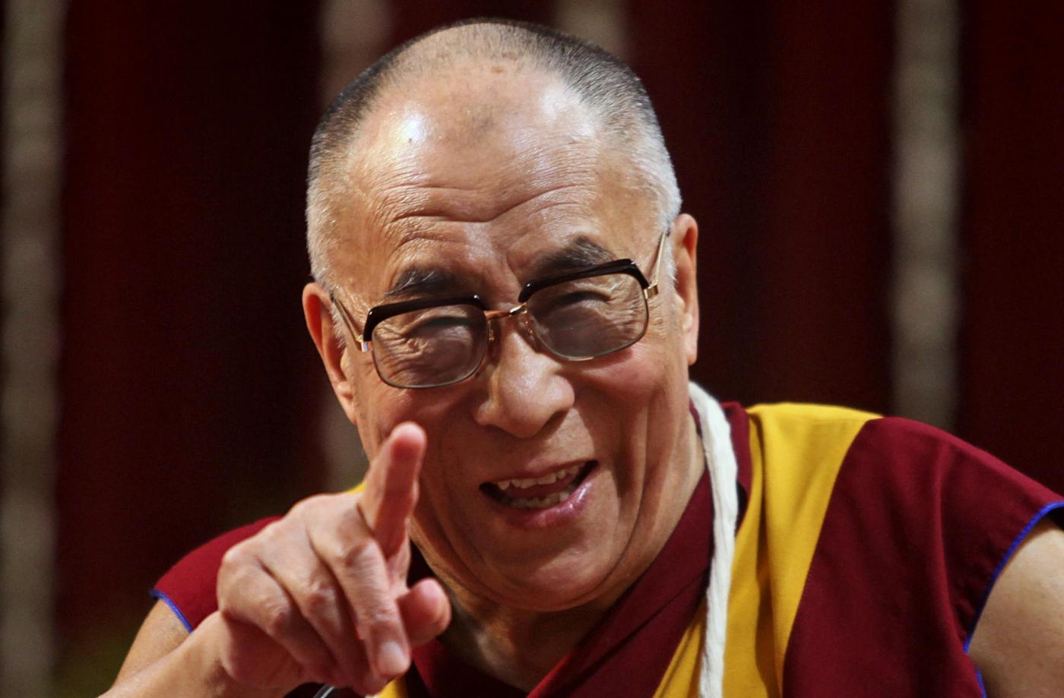
There is something almost childlike about the Dalai Lama which tends to dilute the gravity and importance of the words he is speaking. He tends to break out into a giggling fit whenever he detours into one of his humorous asides, which is fairly often. He will grab the arm of the person sitting next to him and you almost expect him to start throwing high fives with those sharing the dais. It would not seem out of place. For all his stature as a Nobel Laureate and the 14th Dalia Lama, the prefix of His Holiness, and the respect, even reverence, with which he is greeted by everyone, from commoner to celebrity, he exudes an earthy, infectious charm that is both endearing and astute.  Yesterday, watching him speak at the Rajendra Mathur Memorial Lecture organised by the Editors Guild of India, the Tibetan spiritual leader’s quirky characteristics and choice of words, replete with harmless homilies, is perhaps a persona he has been forced to assume. It is one that makes him the guru of euphemisms.

For all his elevated spiritual status and enviable global profile, the Dalai Lama knows he walks a political and diplomatic tightrope every day of his life. His presence in India is a constant source of friction between New Delhi and Beijing and India often uses him as a tool, giving him permission to visit areas that it knows will act like a red flag to the bull in the China shop. His recent visit to the Tawang monastery in Arunachal Pradesh is a prime example. On New Delhi’s part, it was deliberate provocation and sent the Chinese ballistic, with dire warnings and reminders of China’s military prowess. Yet, at yesterdays lecture, meant to be on the media and ethics, HH mentioned the Tawang visit only to emphasise the fact that he was growing old and that his ‘creaking knees’ had given him problems, which was why he opted to sit and deliver his lecture.  He was equally at pains to remind the audience – a mix of journalists, Tibetan groupies, and diplomats from various missions in Delhi – that he was now ‘retired’ and had no official or political role.

Having made the point, from then on, it was vintage Dalai Lama, mixing bromides with borderline politics, chiding and yet praising the media, and right through, knowing he is a guest, albeit an honoured one, of the Indian government, giving fulsome praise to Indian democracy and its stabilizing influence in the region.  He started by glancing down at the dignitaries seated in the front row – senior retired Indian diplomats and ex National Security Advisors — and greeted them with a cheery ‘hello, lots of  old friends’, adding that ‘this looks like a reunion.’’ These were people who had dealt with him in their official capacity so the bonhomie was explainable. His lecture, as is his wont, wanders from the topic listed, but if you listen closely enough, there are always hidden gems. The venue of the lecture gave him cause for some diversions. It was at the Nehru Memorial, which was where India’s first prime minister stayed while in office. HH mentioned the numerous times he had visited Nehru and their discussion about China, hinting that they did not always part in a friendly manner.  “Prime Minister Jawaharlal Nehru laid the foundation for the welfare of Tibetans in exile in India. It is only in India that all the major religious traditions exist side by side. Sometimes problems takes place, not unusual as so many varieties of traditions live here. But it is here alone that all live in full freedom,” he said. The euphemism was not lost. “Some problems’’ was his way of downplaying worrisome trends in favour of the bigger picture.

So was the case with his views on the media, where he remarked, almost as an afterthought, that “propaganda makes things complicated”, and that the media is to blame for the ‘sharp rhetoric’. He had delivered a short speech by his standards – maybe his health and his 82 year old body was to blame — after which he threw the floor open to questions, with, inevitably, the first one being on the face off between New Delhi and Beijing. His criticism of the media being responsible for the heated rhetoric was spot on, and suggests that his mind is as sharp as ever, and that he does indeed watch a lot of television news.  The other questions on China also showed why he is the guru of euphemisms. He praised President Xi Jinping for his fight against corruption, but then drew some blood by remarking that he could not stay in a place where there was no freedom (Tibet), and preferred the ‘heat of India.’ Right through the event, he kept referring to himself as a  “Son of India”, well aware that his speech, in a room full of journalists, would be given widespread coverage.

Yet, what the lecture and Q and A session suggested was that we could be seeing the last of the man who has served as an inspiration for resistance movements across the world, and the start of another – a return to the Dalai Lama’s original role – purely as a spiritual leader. He made it clear that there was no urgency to select the next Dalai Lama and indicated that the process of finding his successor, who might as well be a woman, will begin in the next two to three years. More important was his assertion that the next Dalai Lama may not have a political role to play in future and that China should not worry about his role or that of his successors.  There is no longer a wolf in sheep’s clothing. There is only the sheep.[/vc_column_text][/vc_column][/vc_row]

India News

India and Russia vow to walk together against terrorism, reaffirm strategic partnership

PM Modi and President Putin reaffirm India-Russia unity against terrorism, deepen energy and trade cooperation, and discuss peace efforts amid the Ukraine conflict.

Published

on

Prime Minister Narendra Modi and Russian President Vladimir Putin on Friday underlined that India and Russia “walk together in the fight against terrorism,” reinforcing a decades-old strategic partnership that remains steady amid global geopolitical churn. The leaders issued the joint statement following talks at Hyderabad House in Delhi, where they also announced steps to boost trade, economic cooperation, and energy collaboration.

India-Russia stand firm on counter-terror cooperation

PM Modi described President Putin as a “dear friend” and highlighted Moscow’s consistent support to India on counter-terror efforts. Russia had earlier strongly condemned the terror attack in Jammu and Kashmir’s Pahalgam, allegedly linked to Pakistan-based Jaish-e-Mohammed, and reiterated solidarity with India’s fight against terrorism in all forms.

The joint remarks emphasized that the bilateral friendship, rooted in trust and mutual respect, has remained resilient for decades despite global challenges.

Focus on energy, trade and use of national currencies

A key highlight of the engagement was Russia reaffirming “uninterrupted shipments” of fuel to India. PM Modi expressed gratitude for Russia’s commitment, noting energy cooperation as a crucial pillar of the relationship. While he did not specifically mention oil purchases, given ongoing Western pressure, he emphasised cooperation in civil nuclear and clean energy.

The two countries also discussed expanding economic ties, including a possible free trade agreement. President Putin said bilateral trade was being targeted to reach USD 100 billion, and acknowledged progress toward using national currencies for payments — a remark expected to draw global attention.

Putin shares peace plan insights on Ukraine conflict

Putin briefed the Prime Minister on Russia’s perspective for a peaceful resolution to the ongoing Ukraine war and appreciated India’s continued role as a “champion of peace.” PM Modi reiterated India’s consistent position on dialogue and diplomacy.

Agreements across jobs, health, shipping and minerals

Officials exchanged multiple agreements covering employment mobility, health, shipping, chemicals and cooperation in critical minerals — further broadening the strategic footprint of the partnership.

Continue Reading

India News

RBI cuts repo rate to 5.25%, paving the way for cheaper loans

The RBI has cut the repo rate to 5.25%, aiming to support growth as inflation softens. The central bank also raised GDP projections and announced liquidity-boosting measures.

Published

on

Reserve Bank of India

The Reserve Bank of India (RBI) reduced the key repo rate by 25 basis points to 5.25% on Thursday, signalling relief for borrowers as banks are expected to offer lower EMIs on home and vehicle loans. Governor Sanjay Malhotra announced the move after the conclusion of the three-day Monetary Policy Committee (MPC) meeting.

RBI prioritises growth as inflation eases

Malhotra said the decision was unanimous, with the central bank choosing to focus on supporting economic momentum despite concerns over a weak rupee. The repo rate was earlier cut in June from 6% to 5.5% amid easing inflation trends.

The RBI now projects Consumer Price Index (CPI) inflation at 2% for FY2025-26, significantly softer than earlier estimates. For the first quarter of FY2026-27, inflation is expected at 3.9%, lower than the previous projection. The governor noted that rising precious metal prices may contribute to the headline CPI, but overall risks to inflation remain balanced.

GDP outlook strengthened

In a strong upward revision, the central bank increased the GDP forecast for the current financial year to 7.3%, previously estimated at 6.8%. Growth for the October–December quarter has also been revised to 6.7%.

The last quarter registered a six-quarter high expansion of 8.2%, reflecting resilient demand and steady credit flow.

“The growth-inflation balance continues to offer policy space,” Malhotra said, reiterating that the RBI’s stance remains neutral.

Other key decisions

Alongside the repo rate cut, the RBI announced adjustments to key policy corridors:

  • Standing Deposit Facility (SDF): 5%
  • Marginal Standing Facility (MSF): 5.5%

To improve liquidity and strengthen monetary transmission, the RBI will conduct forex swaps and purchase ₹1 lakh crore worth of government bonds through Open Market Operations (OMO).

RBI reviews a challenging year

Reflecting on 2025, Malhotra said the year delivered strong growth and moderate inflation even as global trade and geopolitical uncertainties persisted. He added that bank credit and retail lending remained healthy, providing support to the economy.

Continue Reading

India News

IndiGo flight chaos deepens as over 500 services cancelled, passengers stranded for hours

Over 500 IndiGo flights were cancelled nationwide, leaving passengers stranded without food, clarity or their luggage as airports struggled to manage the disruption.

Published

on

IndiGo flight

India’s largest airline continued to face massive operational breakdowns, triggering frustration among travellers at major airports across the country. From piles of unattended suitcases to passengers waiting over 12 hours without food or clarity, the disruption stretched into its fourth consecutive day.

Long delays, no communication leave passengers anguished

Several travellers at Delhi airport described the situation as “mental torture”, as thousands of unclaimed suitcases lay scattered across the terminal. Many slept on the floor, while others expressed anger over the lack of communication from airline staff.

One flier said he had been waiting for over 12 hours without any explanation: “Every time they say one-hour or two-hour delays. We were going to a wedding but don’t even have our luggage.”

A passenger in Hyderabad recounted a similar ordeal, saying the flight was delayed indefinitely with no food, water, or updates from the airline. At the airport, some travellers blocked an Air India flight in protest over the lack of arrangements.

Goa and Chennai airports also witnessed tense moments. Videos from Goa showed fliers shouting at IndiGo staff as police attempted to calm the situation. At Chennai, CISF denied entry to IndiGo passengers due to heavy congestion.

Major metro airports impacted; cascading cancellations nationwide

Flight cancellations and delays were reported across multiple airports:

  • Over 200 flights were cancelled in Delhi
  • More than 100 each in Mumbai and Bengaluru
  • Around 90 in Hyderabad
  • Dozens more in Pune, Vishakhapatnam, Chennai and Bhopal

Pune airport stated that parking bay congestion worsened the situation, as several IndiGo aircraft remained grounded due to lack of crew. Other airlines continued operations without disruption.

Airport authorities said they had mobilised additional manpower for crowd control and passenger support.

IndiGo admits planning lapses, says more cancellations expected

The airline acknowledged a “misjudgment” in assessing crew requirements under revised night-duty norms, which it said created planning gaps. Winter weather and airport congestion further aggravated the crisis.

IndiGo informed the aviation ministry and DGCA that some regulatory changes—such as the shift in night-duty timings and a cap on night landings—have been rolled back temporarily to stabilise operations.

The airline warned that cancellations may continue for another two to three days, and from December 8, schedules will be trimmed to prevent further disruption.

In a message to employees, CEO Pieter Elbers said restoring punctuality would not be an “easy target”.

Airline issues apology amid nationwide frustration

In a late-night statement, IndiGo apologised to customers and industry partners, acknowledging the widespread inconvenience caused by the disruptions. The airline said all teams were working with authorities to bring operations back to normal.

Continue Reading

Trending

© Copyright 2022 APNLIVE.com