English हिन्दी
Connect with us

India News

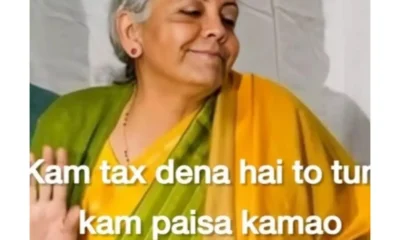
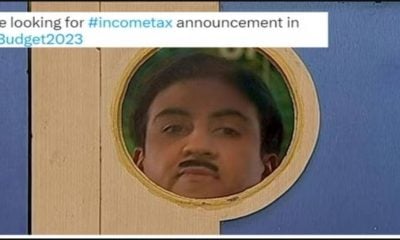
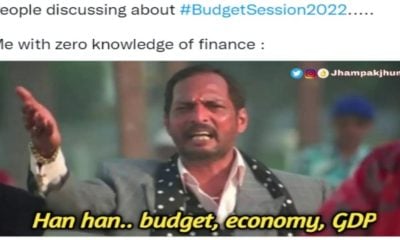
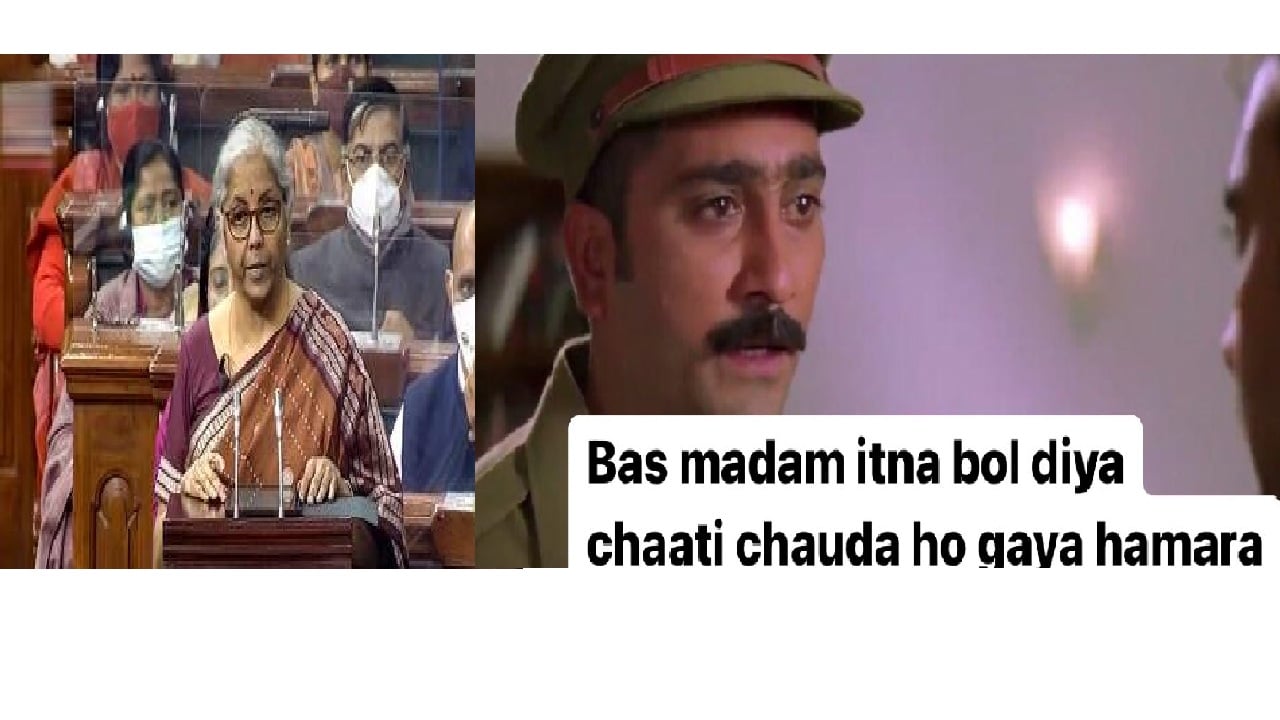
Budget 2022: Memes take over internet as Finance Minister Nirmala Sitharaman presents Union Budget, tweeple say taxpayers ko bas thanks mila

Apart from this, what broke the heart of people who invested in cryptocurrency was that from now on there will 30 per cent tax deduction on cryptocurrency as soon as this was announced.

Published

on

sitharaman memes

Finance Minister Nirmala Sitharaman presented the Union Budget 2022 today on Tuesday, February 1. As soon as she started delivering the speech, tweeple started sharing memes. And, it wouldn’t be wrong to say that on the B-day, memers had a field day. In this year’s budget, salaried class people were expecting the government to give some relaxation to them in the income tax slabs. However, they got nothing in their hand.

Apart from this, what broke the heart of people who invested in cryptocurrency was that from now on there will 30 per cent tax deduction on cryptocurrency as soon as this was announced. Social media users started sharing memes. The memes were all about middle-class people’s expectations and what they got in real life, commerce students still not getting what was in the budget, and of course the cryptocurrency.

One of the users wrote shared a tweet in which he wrote what middle-class people asked and what they got from Finance Minister.

Middle Class: “Anything for taxpayersReceipt, ma’am”
Speaking head in silhouetteNirmala Sitharaman: “Yeah, thanks for paying taxes.
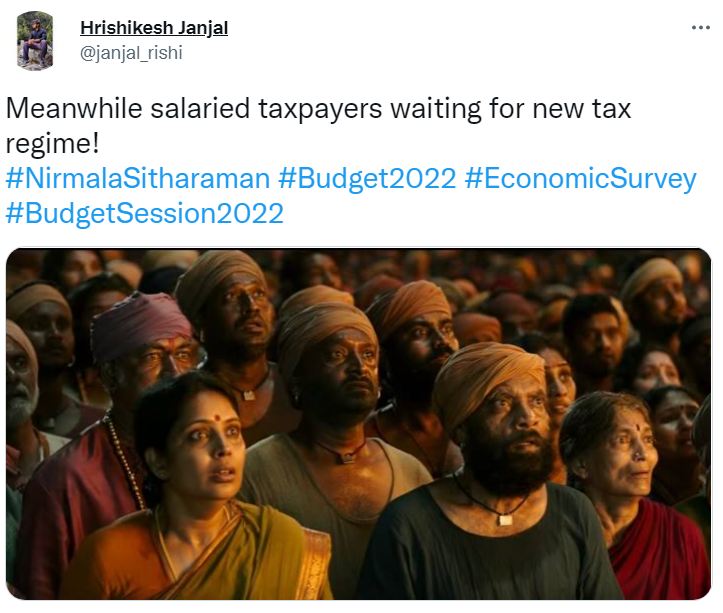
Another user wrote that middle-class people will be having full dhak dhak in their heart now.

Yet another wrote that middle-class logo ko apni kismat ke baare me ache se pata hai.

What middle class is likely to get tomorrow in Budget 2022

*A thank you note for honesty *

In other news, presenting the budget, the Finance Minister announced various schemes for women and children and highlighted the Government’s push for empowering them via boosters which will improve their intellectual, social and economic growth.

https://www.youtube.com/watch?v=aJDnroqtefw

India News

GRAP IV enforced in Delhi amid severe pollution: What remains open and what shuts down

Delhi has enforced GRAP IV after AQI stayed in the severe category, leading to school closures, vehicle restrictions and a ban on construction activities.

Published

on

Delhi-Pollution-Nov

Delhi has moved to the strictest stage of its anti-pollution framework with the implementation of Stage IV of the Graded Response Action Plan (GRAP), as air quality in the national capital continues to remain in the severe category. The emergency measures have been enforced by the Commission for Air Quality Management (CAQM) to curb hazardous winter pollution levels.

The decision comes after the Air Quality Index (AQI) repeatedly crossed the severe threshold, driven by a mix of stagnant weather conditions, vehicular emissions, firecracker residue and stubble burning in neighbouring regions.

Schools and offices face major restrictions

Physical classes for students from nursery to Class 5 have been completely suspended, with learning shifting online. Earlier, parents were given the option to choose between online and offline modes, but that flexibility has now been withdrawn.

For Classes 6 to 9 and Class 11, schools are operating in a hybrid mode, allowing students to attend classes online if they choose.

Both government and private offices have been directed to function with only 50 per cent staff present on-site. The remaining workforce must work from home. Authorities have also urged private employers to allow flexible working hours wherever possible.

Vehicle entry and fuel rules tightened

From December 18, only Bharat Stage-VI (BS-VI) compliant vehicles are permitted to enter Delhi. All non-BS-VI vehicles are effectively barred from the city during this period.

In addition, vehicles without a valid Pollution Under Control (PUC) certificate will not be allowed to refuel at petrol pumps. Automated camera systems installed at fuel stations will identify and flag non-compliant vehicles.

Construction, demolition and tandoors halted

All construction and demolition activities have been suspended, including large linear public infrastructure projects such as highways, roads, flyovers, power transmission lines, pipelines and telecom works.

Restaurants and eateries have also been instructed to stop using coal and firewood-based tandoors. Only electric or gas-operated tandoors are permitted, with strict enforcement mandated.

What continues to operate under GRAP IV

Despite the restrictions, essential services and key transport systems remain functional.

  • Public transport, including Delhi Metro and DTC buses, continues to operate, with residents encouraged to rely on these modes.
  • LNG, CNG, electric and BS-VI diesel trucks are allowed to enter the city.
  • Airports and railway stations across the country remain operational, subject to visibility conditions.
  • Emergency and essential services such as hospitals, fire services, electricity, water supply, sanitation, disaster management and municipal services are fully exempted.
  • Departments involved in air pollution monitoring, control and enforcement are also excluded from the restrictions.

Authorities have appealed to residents to cooperate with the measures, stressing that the restrictions are necessary to prevent further deterioration in air quality during the peak winter pollution period.

Continue Reading

India News

Delhi pollution: Environment minister apologises, blames AAP as AQI stays very poor

Delhi Environment Minister Manjinder Singh Sirsa apologised for pollution but blamed AAP for the crisis, saying air quality cannot be fixed in months as AQI remains very poor.

Published

on

Delhi Environment Minister Manjinder Singh Sirsa on Tuesday apologised to residents for the city’s worsening air quality but squarely blamed the Aam Aadmi Party (AAP) for the pollution crisis, saying the problem could not be resolved within months.

Calling pollution a “disease” inherited from the previous dispensation, Sirsa said it was “impossible for any elected government to reduce AQI in 9–10 months”. He claimed the BJP-led government was working to address the issue and asserted that the air quality index (AQI) had shown daily improvement.

“I apologise for the pollution in Delhi,” the minister said, adding that the present government was doing “better work” compared to what he termed the “dishonest” AAP administration.

Air quality remains very poor across the city

Sirsa’s remarks came as Delhi continued to reel under very poor air quality conditions, though the situation improved marginally from the “severe” category that prevailed between December 13 and 15.

According to official pollution monitoring data, Delhi’s overall AQI stood at 381. Wazipur recorded the highest AQI at 434, followed by Jahangirpuri at 430. Anand Vihar and Ashok Vihar also remained in the severe category.

In November, the capital had experienced prolonged spells of severe pollution, with AQI levels staying in that range from November 11 to 26.

Political blame game intensifies

The pollution crisis has triggered a sharp political face-off between the ruling BJP and the opposition AAP. AAP leader Saurabh Bhardwaj questioned why Prime Minister Narendra Modi had not addressed the issue publicly, while the Congress demanded an immediate discussion on air pollution in the Lok Sabha.

The controversy escalated further after Singapore issued an advisory for its citizens in India over Delhi’s air quality. Bhardwaj shared the advisory on social media, calling it an “international embarrassment”.

Responding to this, Delhi BJP spokesperson Praveen Shankar Kapoor said such advisories were routine whenever pollution levels rise. He also took a swipe at the AAP, recalling that during earlier years, some foreign governments had reduced posting durations for their staff in Delhi and designated the city as a “no family station”.

Meanwhile, Punjab Chief Minister and senior AAP leader Bhagwant Mann rejected allegations that his state was contributing to Delhi’s pollution. He said the AQI in Punjab cities ranged between 70 and 100, significantly lower than that of the national capital, and urged the Centre to stop blaming Punjab.

Continue Reading

India News

Rahul Gandhi Attacks Centre over G RAM G bill, calls it an attack on MGNREGA’s core principles

Rahul Gandhi has strongly opposed the G RAM G bill, accusing the Modi government of undermining MGNREGA and shifting the financial burden of rural employment schemes onto states.

Published

on

Rahul-Gandhi

Congress MP and Leader of the Opposition Rahul Gandhi on Monday sharpened his attack on the Centre over the introduction of the G RAM G bill in the Lok Sabha, alleging that the proposed law weakens the foundations of the Mahatma Gandhi National Rural Employment Guarantee Act (MGNREGA) and undermines the rights of the rural poor.

The bill, formally titled the Viksit Bharat Guarantee for Rozgar and Ajeevika Mission (Gramin) Bill, 2025, has been brought in to replace MGNREGA, which was enacted in 2005 under the UPA government.

Reacting to the move, Rahul Gandhi described the legislation as an “insult to the ideals of Mahatma Gandhi” and accused the Narendra Modi-led government of attempting to dismantle a scheme that guarantees livelihood security to millions of rural households.

Rahul Gandhi’s sharp criticism of the G RAM G bill

In a post on X, Gandhi alleged that Prime Minister Modi has consistently opposed the ideas associated with Mahatma Gandhi and has been trying to weaken MGNREGA since coming to power in 2014. He asserted that the Congress would oppose any attempt to dilute or dismantle the employment guarantee framework.

“Modiji has a deep hatred for two things – the ideas of Mahatma Gandhi and the rights of the poor,” Gandhi said, calling MGNREGA a living embodiment of Gandhi’s vision of village self-rule. He also highlighted the role of the scheme as an economic shield for rural India, particularly during the COVID period.

According to Gandhi, the Centre is now “determined to wipe out MGNREGA completely” by replacing it with a new framework that centralises power and alters the funding structure.

Opposition protests in Parliament

The introduction of the G RAM G bill triggered protests from several opposition MPs inside and outside Parliament. Congress MPs, including Priyanka Gandhi Vadra and Shashi Tharoor, raised objections to key provisions of the bill, particularly the removal of Mahatma Gandhi’s name from the scheme.

Opposition leaders argued that MGNREGA is rooted in the right to employment, decentralised decision-making by villages, and a funding structure where the Centre bears the full wage cost and most of the material expenses.

How G RAM G differs from MGNREGA

Rahul Gandhi pointed out that under MGNREGA, the Centre pays 100 per cent of wages for unskilled workers and 75 per cent of material costs, ensuring steady employment based on demand.

The new G RAM G bill proposes a shift to normative funding, under which states will have to bear 40 per cent of the overall costs. Gandhi claimed this would reduce work availability once budgets are exhausted or during crop harvest seasons, leaving rural workers without employment for extended periods.

The funding ratio for northeastern and Himalayan states has been set at 90:10, while union territories will be fully funded by the Centre. Of the estimated annual expenditure of Rs 1.51 lakh crore, the central government’s share is projected at Rs 95,692 crore.

Leaders from several opposition parties, including those from a key BJP ally, have also expressed concerns over the increased financial burden on states.

Government’s defence of the bill

Government sources have maintained that the G RAM G bill aligns with the broader ‘Viksit Bharat 2047’ vision. According to them, the shift from a demand-based to a normative funding model brings the scheme in line with budgeting practices followed for other central government programmes.

However, the sharp political pushback indicates that the replacement of MGNREGA is set to remain a major flashpoint in Parliament in the coming days.

Continue Reading

Trending

© Copyright 2022 APNLIVE.com

Left Menu Icon