English हिन्दी
Connect with us

Latest world news

US efforts fail to convince Saudi rulers for direct talks with Qatar

Published

on

Tillerson Thani

[vc_row][vc_column][vc_column_text]Tillerson participates in Saudi Arabia-Iraq Coordination meeting in Riyadh

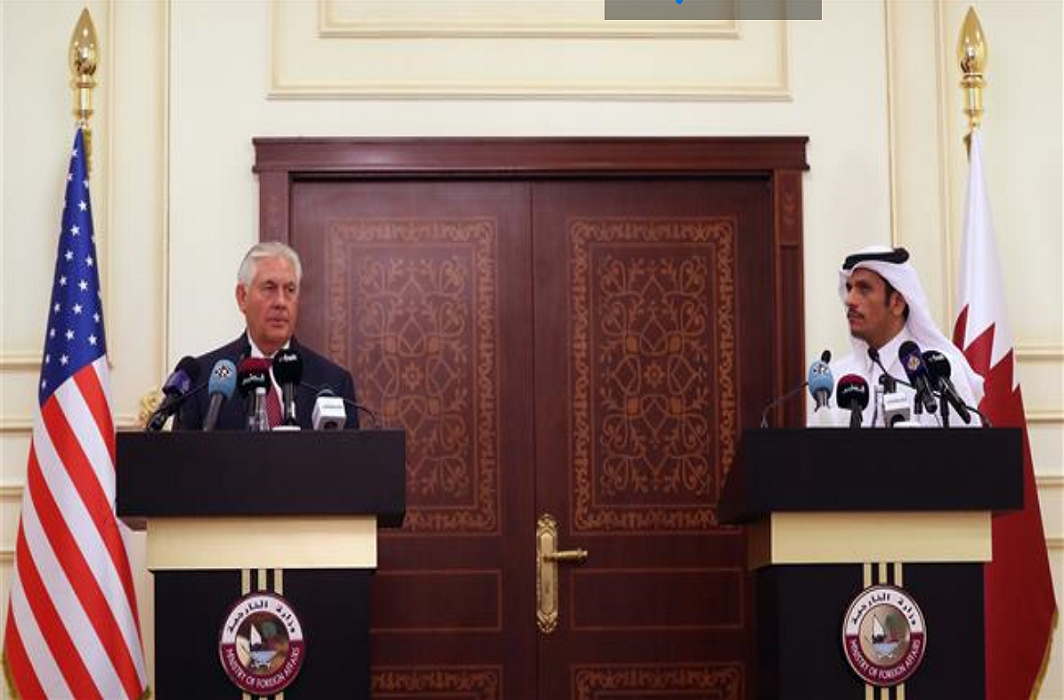
The US mediation efforts have failed to convince Saudi rulers to begin direct talks for resolving Qatar crisis. This was clearly indicated by Secretary of State Rex Tillerson on Sunday while addressing a joint press conference with his Qatari counterpart Sheikh Mohammed bin Abdulrahman Al Thani in Doha.

After spending a day in Riyadh, Tillerson said, “We cannot force talks upon people who are not ready to talk.” He further said, “In my meetings with [Saudi] Crown Prince Mohammed bin Salman, I asked him to please engage in dialogue, [but] there is not a strong indication that parties are ready to talk yet.”

Tillerson also met Saudi King Salman bin Abdulaziz Al-Saud and discussed the bilateral and regional issues.

This was Tillerson’s second visit to the region as part of US diplomacy for resolving the Qatar crisis. He said that he is not hopeful that Saudi Arabia is willing to enter discussion to resolve the crisis.

Tillerson who also met Qatari emir Sheikh Tamim bin Hamad Al-Thani expressed concern about the effect of the crisis on the regional security.

“It’s very important for the GCC to continue to pursue unity. It is most effective when it is unified and none of us can afford to let this dispute linger. We ask that everyone minimises the rhetoric and de-escalate the tensions and take steps to do so,” Tillerson said.

Earlier on Thursday Tillerson told Bloomberg, “There seems to be a real unwillingness on the part of some of the parties to want to engage… It’s up to the leadership of the quartet when they want to engage with Qatar because Qatar has been very clear – they’re ready to engage.”

However, Qatar’s foreign minister Sheikh Mohammed bin Abdulrahman Al Thani reaffirmed commitment to dialogue and emphasised the need for the crisis to be resolved. He said that Saudi led group was not ready “to tackle with dialogue the reasons for this crisis.”

He expressed frustration over the behaviour of the four blockading countries. He said, “These countries have resorted to undiplomatic tactics that have nothing to do with modern diplomatic lessons, and this is no good.” 

He was equally concerned about the unity among Gulf Cooperation Council (GCC). “The GCC is quite important for the collective security and we feel sorry that the GCC will be the victim of the crisis against the state of Qatar,” he said.

He was also of the view that the lingering crisis has affected the collective security of the GCC member states.

Saudi Arabia, UAE, Egypt and Bahrain had suddenly cut diplomatic ties with Qatar on June 5 and imposed land, air and sea blockade. Saudi Arabia appealed “all brotherly countries” to sever ties with Doha. Kuwait and Oman did not follow Riyadh.

Saudi Arabia has accused Doha of financing “terrorism” and maintaining close ties with its regional rival Iran. However, Qatar denies the allegations.

After the crisis began, Iran has started supplying daily needs to the tiny oil rich country. Tehran also allowed Qatar Airways to use its air space for reaching Central Asia and European countries.

Meanwhile, Lieutenant General Jeffrey Harrigian of US Air Force Central Command, has on Sunday said, “There are no diplomatic issues that are impacting our ability to operate every day from here in our counter-ISIS missions”. Their Command Control headquarters is located just outside Doha at Al-Udeid airbase.   

While in Riyadh, Tillerson also participated in the inaugural meeting of the Saudi Arabia-Iraq Coordination Committee, along with Saudi King Salman and Iraqi PM Haider al-Abadi. Iraq and Saudi Arabia have long been regional rivals.

This is again considered to be aimed to minimise widening Iranian influence in the region. In post 2003 era, Iran and Iraq have emerged to be the best friends.

Iranian military advisors have played important role in Baghdad’s fight against Daesh (IS). Baghdad has, time and again, expressed suspicion on US intentions while fighting IS as US jets were caught on camera throwing arms for the IS terrorist in Iraq.[/vc_column_text][/vc_column][/vc_row]

Latest world news

Khaleda son Tarique Rahman arrives to rapturous welcome in Bangladesh

Tarique Rahman returned to Bangladesh after 17 years and, in his first speech, invoked Martin Luther King while outlining what he called a plan for the country’s future.

Published

on

Khalida Zia son

Bangladesh Nationalist Party (BNP) acting chairman Tarique Rahman, who returned to Bangladesh on Thursday after 17 years in exile, outlined his political vision in his first public address, drawing a comparison with American civil rights leader Martin Luther King Jr.’s famous “I have a dream” speech.

Addressing a massive gathering in Dhaka, Rahman said that just as Martin Luther King spoke of a dream, he wished to speak of a concrete plan for Bangladesh. He referred to the country as “Beloved Bangladesh” and thanked party leaders, workers and citizens who stood by the BNP during his absence.

Rahman, the son of former President Ziaur Rahman and former Prime Minister Khaleda Zia, said that his plan would succeed only with public support and urged citizens to participate actively in nation-building.

Parallels drawn with 1971 and 2024 movements

In his speech, Rahman linked the 1971 Liberation War with the 2024 uprising against the government of former Prime Minister Sheikh Hasina. He said those who lost their lives in these movements should be honoured by building the country they had envisioned.

“We liberated Bangladesh in 1971, and we liberated it again in 2024,” he said, adding that the events of 2024 were about defending the country’s independence and sovereignty. He stressed the need to “repay the blood debt of the martyrs” through responsible governance.

Emphasis on tolerance, safety and economic rights

Touching upon Bangladesh’s social fabric, Rahman said the country belongs to everyone, irrespective of religion or geography, and underlined the importance of tolerance. He spoke about creating a safe environment where women, men and children can move freely without fear.

He also said the BNP would focus on peace, political reform and strengthening the economy. Referring to student leader Sharif Osman Hadi, Rahman said he had dreamt of a democratic Bangladesh and promised justice in connection with his killing, along with restoring people’s economic rights.

Call to youth and visit to Khaleda Zia

Rahman called upon the younger generation to take responsibility for development and stability, stressing that collective effort would be crucial to implementing his plan for Bangladesh.

After the address, he left to visit his ailing mother, Khaleda Zia, who is undergoing treatment at Evercare Hospital.

Rahman has been living in exile since 2008 following convictions in multiple corruption cases, which he has described as politically motivated. He has also alleged that the previous government attempted to assassinate him through torture.

With the Awami League barred from contesting elections, the political landscape has narrowed significantly. The BNP now holds a dominant position, and Rahman’s return has added fresh momentum and uncertainty to Bangladesh’s political future.

Continue Reading

Latest world news

Tarique Rahman returns to Dhaka after 17 years, massive crowd greets BNP leader

Tarique Rahman returned to Bangladesh after more than 17 years in exile, with thousands of BNP supporters gathering in Dhaka to welcome the party’s acting chairman.

Published

on

Tariq Rahman

Thousands of people poured onto the streets of Dhaka on Thursday as Bangladesh Nationalist Party (BNP) acting chairman Tarique Rahman returned to the country after more than 17 years in self-imposed exile in the United Kingdom. Rahman, who is the son of former prime minister Khaleda Zia, landed in the capital along with his wife Zubaida Rahman and daughter Zaima Rahman.

Supporters and party leaders marched from the Banani Airport Road towards Dhaka airport to welcome him, turning the stretch into a sea of BNP flags and slogans. Rahman was later escorted in a bulletproof vehicle as part of heightened security arrangements for his high-profile return.

Bulletproof convoy and reception in Purbachal

After arriving at the airport, Rahman was received by senior BNP leaders before heading to a large reception organised in the Purbachal area. Party workers and leaders lined both sides of the road to greet him during the journey. According to party expectations, a very large gathering assembled at the venue, where Rahman was scheduled to address supporters.

BNP leaders said only Rahman would speak at the event, while other senior figures remained present on the stage. His return is being closely watched as he has emerged as a key political figure ahead of Bangladesh’s upcoming general elections.

Visit to ailing mother and family residence

Following the public address, Rahman was expected to visit Evercare Hospital to meet his mother, former prime minister Khaleda Zia, who has been undergoing treatment there for over a month. After the hospital visit, the family was scheduled to go to Firoza, the Zia family residence in Gulshan.

Security across Dhaka was tightened during Rahman’s movement, with police deploying additional forces to prevent any untoward incident amid recent political tensions in the country.

Political backdrop of the return

Rahman’s return comes at a time when the BNP is seen to be gaining political ground following the ouster of former prime minister Sheikh Hasina in a student-led uprising last year. Surveys conducted in December indicate the BNP could secure the largest number of seats in the upcoming parliamentary elections, while other parties, including Islamist groups, are also in the fray.

Alongside political developments, personal reasons have also played a role in Rahman’s decision to return, particularly his mother’s prolonged illness, which party sources describe as a key factor behind the move.

Continue Reading

Latest world news

Bangladesh student leader killing sparks allegation against Yunus-led interim government over February polls

The killing of Bangladesh student leader Sharif Osman Hadi has led to protests and serious allegations against the Yunus-led interim government over the February national election.

Published

on

The killing of Bangladesh student leader Sharif Osman Hadi has triggered sharp political allegations, with his family accusing elements within the Muhammad Yunus-led interim government of attempting to derail the country’s upcoming national election scheduled for February.

Sharif Osman Hadi, spokesperson of Inquilab Moncho — a cultural platform that emerged from the July 2024 uprising — was shot at close range in Dhaka on December 12. He was later airlifted to Singapore for advanced treatment, where he succumbed to his injuries on December 18. His death led to violent protests in parts of the capital, including attacks on offices of newspapers and cultural organisations.

Brother alleges political motive behind killing

At a protest gathering in Shahbagh, Sharif Osman Hadi’s brother, Sharif Omar Hadi, accused a section of the interim government of orchestrating the killing to disrupt the election process.

“You had Osman Hadi killed, and now you are trying to foil the election by using this as an issue,” Omar said while addressing protesters. He claimed that his brother was firm on holding the national election by February and did not align himself with any agency or “foreign masters”.

Omar demanded a swift and transparent trial, warning that delays would damage the election environment. He alleged that the authorities have failed to show any visible progress in the investigation so far.

“If justice for Osman Hadi is not delivered, you too will be compelled to flee Bangladesh one day,” Omar said, drawing an apparent reference to former Prime Minister Sheikh Hasina, who left the country following last year’s nationwide protests that resulted in a change of regime.

Claims of wider conspiracy surface

Leaders of Inquilab Moncho also alleged that the killing was part of a broader conspiracy to undermine the gains of the July uprising and weaken Bangladesh’s sovereignty. They claimed that international intelligence agencies and their local collaborators were involved in the murder.

The group demanded that the government identify and present the accused through an investigation meeting international standards within a fixed timeframe. They warned that protests would intensify if their demands were not met.

Protesters said demonstrations would continue until justice is delivered for Sharif Osman Hadi.

Protest plans and political developments

Leaders of Inquilab Moncho announced that they would not hold any programmes on December 25, the day when Bangladesh Nationalist Party’s acting chairman Tarique Rahman is scheduled to return to the country. They expressed hope that Rahman would extend solidarity to their movement demanding justice.

The allegations and ongoing protests have added to political tensions in Bangladesh as the interim government faces growing scrutiny ahead of the proposed February election.

Continue Reading

Trending

© Copyright 2022 APNLIVE.com