
Latest world news
Vision 2030: Saudi Crown Prince Unveils Dream City Project

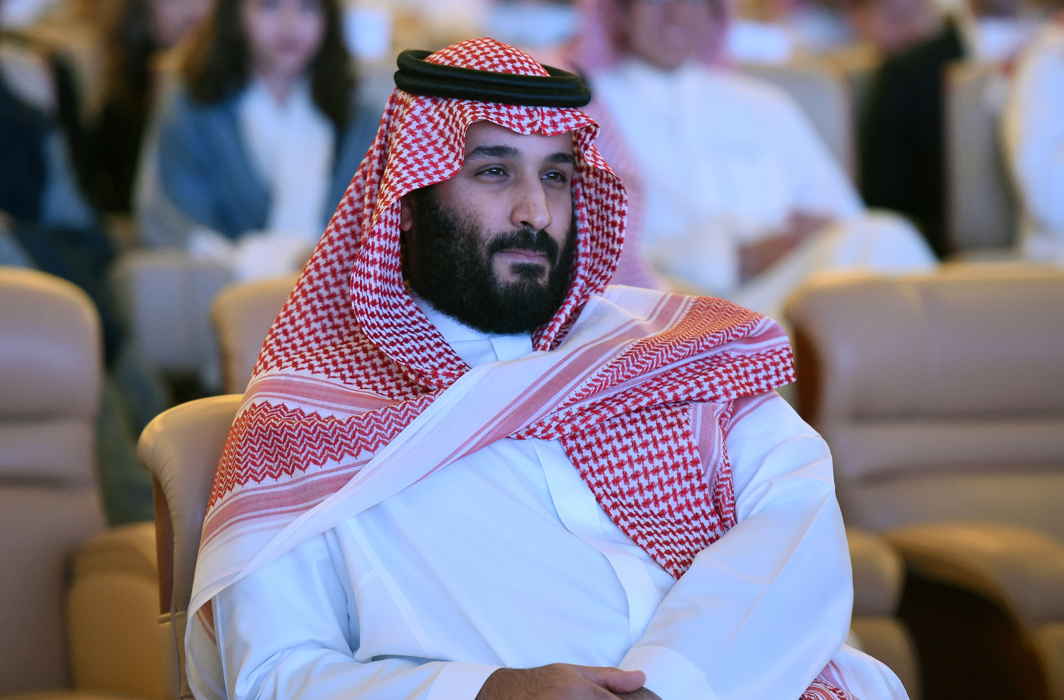
[vc_row][vc_column][vc_column_text]This place is not for conventional people
Pushing ahead his Vision 2030, Saudi Crown Prince Mohammed bin Salman has unveiled plan to float the $500 billion mega-city on financial markets alongside oil giant Saudi Aramco. This is part of kingdom’s drive to diversify away from oil.
According to Arab News, the 26,500-square km business and industrial zone, named Neom, will extend into Jordan and Egypt. The Crown Prince chose to unveil the mega plan at a three-day Future Investment Initiative, conference being held in Riyadh on Wednesday. Nearly 4,000 delegates from around the world have participated in the conference.
Earlier on Tuesday Crown Prince Mohammed bin Salman had pledged to destroy “extremist ideologies” and return to a moderate Islam that is open to all religions.
The daily considered to be the mouthpiece of the Kingdom said, “The surprise announcement is the latest — and most extraordinary — in a slate of privatization programs led by the floating of oil giant Saudi Aramco. The sales are designed to boost the Saudi economy and create jobs for millions of young people.”
To be situated adjacent to Red Sea and the Gulf of Aqaba and near maritime trade routes of Suez Canal, the proposed mega city will serve as a gateway to the proposed King Salman Bridge, which will link Egypt and Saudi Arabia.
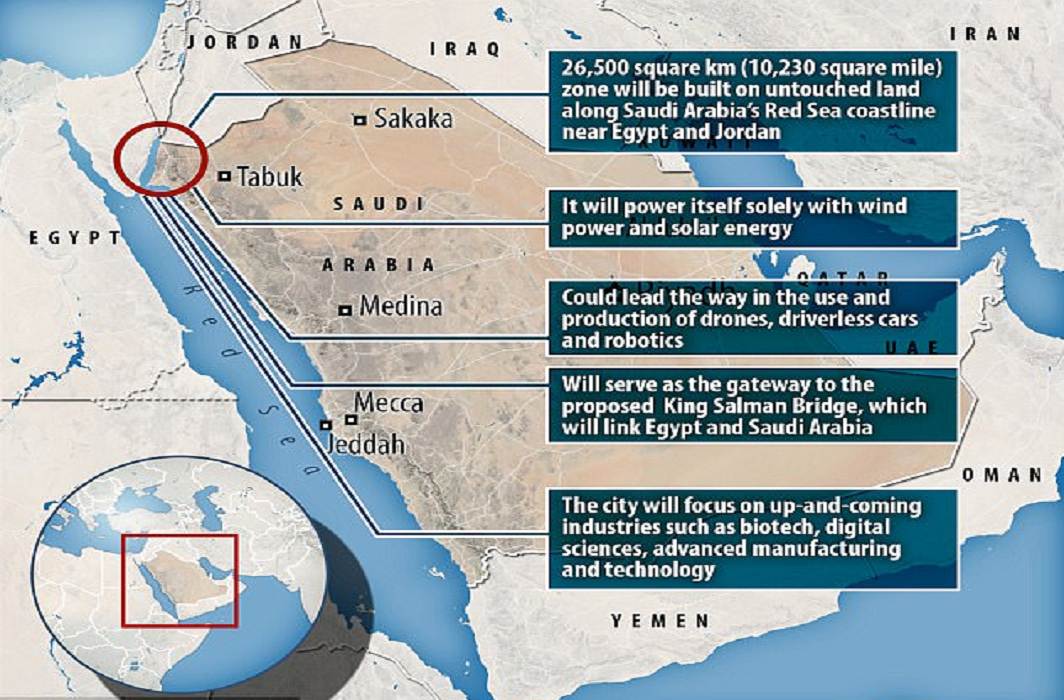
Neom will be independent of Saudi regulation and will adopt a “separate regulatory framework.” The Crown Prince was quoted saying, “This place is not for conventional people or conventional companies. This will be a place for the dreamers of the world.”
The mega city will be fully owned by Saudi Arabia’s sovereign Public Investment Fund (PIF) until its listing, and will attract investments from companies in renewable energy, biotechnology, advanced manufacturing and entertainment.
Attracting foreign investors the Crown Prince said, “Without a doubt, at the end of the day Neom will be floated in the markets. The first zone floated in the public markets. It’s as if you float the city of New York.”
“It won’t be listed in the markets until the idea is mature enough,” he said. “It might be after 2030, it might be before, but the idea and the strategy is to float it eventually.”
One of the Saudi media outlets says that the project was part of the Vision 2030 plan to overhaul the economy of Saudi Arabia, OPEC’s largest producer, and provide jobs for an overwhelmingly young population amid a global oil price decline since 2014.
Earlier in August this year Saudi Arabia had unveiled an enormous tourism project spanning more than 160 kms of the Red Sea coastline that will include transformation of 50 untouched islands into “an exquisite luxury tourism destination”.[/vc_column_text][/vc_column][/vc_row]







Latest world news
Magnitude 7 earthquake strikes Russia’s Kamchatka Peninsula
A magnitude 7 earthquake struck Russia’s Kamchatka Peninsula region on Friday. The initial report placed the earthquake at a depth of 140 kilometres.


Latest world news
S Jaishankar says India is a natural option for Russia amid Europe tensions
External Affairs Minister S Jaishankar said India remained a natural option for Russia as Moscow increasingly turned towards Asia amid strained relations with Europe. He highlighted the continuity of India-Russia ties and their significance for the balance of power in Asia.

Latest world news
Putin praises PM Modi, says he has very good ideas on Ukraine war
Russian President Vladimir Putin has praised Prime Minister Narendra Modi for repeatedly raising the need to end the Ukraine war, describing his ideas for a settlement as “very good”.


Election Commission orders voter roll revision in 17 states, UTs

Actor Imran Khan asked to leave India after CJP protest

Delhi Police offers 11-person limit for CJP’s Connaught Place protest

Mallikarjun Kharge’s ‘Your Friends’ jab at Rahul Gandhi over congress exits

Delhi deploys 25,000 personnel, installs CCTV cameras ahead of CJP march

Magnitude 7 earthquake strikes Russia’s Kamchatka Peninsula
Delhi deploys 25,000 personnel, installs CCTV cameras ahead of CJP march
Mallikarjun Kharge’s ‘Your Friends’ jab at Rahul Gandhi over congress exits
Delhi Police offers 11-person limit for CJP’s Connaught Place protest
Actor Imran Khan asked to leave India after CJP protest

Afghan Men Try To Hang With The Jet Engine Of The Aircraft in Kabul- Afghanistan News – Kabul News
Trending Top 10 News: 10000 Crore Fine on Flipkart, Apple to Launch Unique Feature, Hdfc Bank Job Ad

Trending Top 10 News: Nokia 6310, Apple sales, Bachpan ka Pyar Video Kid, Dainik Bhaskar IT Raid

Trending Top 10 News: Canada bans Indian flights, Rain in Delhi NCR, AIMIM Twitter hacked, Raj Kundra case

Trending Top 10 News: Shein India, Apple New Service, Pocket Oxygen, Oppo Launched New Phone
-
 India News22 hours ago
Election Commission orders voter roll revision in 17 states, UTs
-
 India News22 hours ago
Actor Imran Khan asked to leave India after CJP protest
-
 India News21 hours ago
Delhi Police offers 11-person limit for CJP’s Connaught Place protest
-
 India News9 hours ago
Mallikarjun Kharge’s ‘Your Friends’ jab at Rahul Gandhi over congress exits
-
 India News9 hours ago
Delhi deploys 25,000 personnel, installs CCTV cameras ahead of CJP march
-
 Latest world news9 hours ago
Magnitude 7 earthquake strikes Russia’s Kamchatka Peninsula
