English हिन्दी
Connect with us

Latest Politics News

Delhi court sends Mohammed Zubair to four-day police custody for allegedly hurting religious sentiments

The Twitter handle Hanuman Bhakt had only three followers until Monday evening but had increased to over 400 on Monday night.

Published

on

Mohammed Zubair

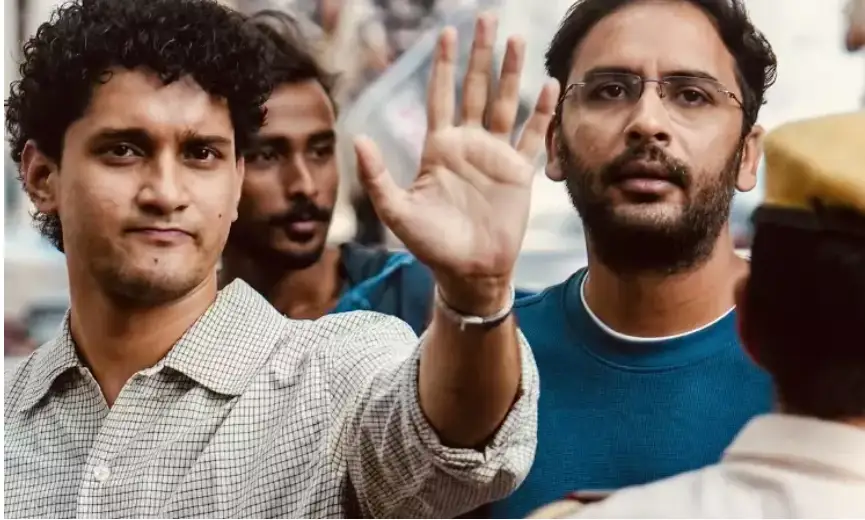
A Delhi court on Tuesday ordered the 4-day police custody to Alt News co-founder Mohammed Zubair, a day after he was arrested under the charges of hurting religious sentiments for a tweet that he had posted in March 2018.

Presenting him in Patiala House Court on Tuesday, the Delhi Police sought a 5-day custody of the Alt News journalist but court granted a 4-day police custody.

Appearing for Zubair, Advocate Vrinda Grover argued that the AltNews co-founder was being maliciously targeted and that the entire case borders on absurdity.

To this, the prosecution argued that Zubair’s deliberate act of outraging religious sentiments was on record and therefore his police remand was required. The prosecution also said the police need to recover Zubair’s laptop and other devices that were used to post the alleged objectionable tweet.

The Delhi police also told the court that Zubair allegedly used controversial tweets to hurt religious feelings in an effort to get fame.

Arun Kumar, Delhi Police Sub-Inspector, said Zubair has been arrested after a handle named Hanuman Bhakt raised objections on his 2018 tweet.

Zubair’s 2018 tweet shows a hotel signboard with the name Honeymoon Hotel repainted to Hanuman Hotel. Social media users pointed out that the image Zubair had posted is from a 1983 Hindi film.

According to the police, the 2018 tweet posted by Zubair had led to a Twitter storm with hate speeches, detrimental to communal harmony.

Following his arrest, Zubair was presented before a Delhi court late Monday night but the court denied the bail and granted 1-day custody to Delhi Police.

On Monday evening, the cyber cell unit of Delhi Police arrested the Alt News fact checker Mohammed Zubair for allegedly hurting the religious sentiments and promoting enmity by Delhi Police following a complaint by anonymous social media user who referred to a tweet from 2018.

The Twitter handle Hanuman Bhakt had only three followers until Monday evening but had increased to over 400 on Monday night.

Zubair has been charged under IPC sections 153-A (promoting enmity between different groups) and 295-A (malicious acts, intended to outrage religious feelings).

India News

Rahul Gandhi Attacks Centre over G RAM G bill, calls it an attack on MGNREGA’s core principles

Rahul Gandhi has strongly opposed the G RAM G bill, accusing the Modi government of undermining MGNREGA and shifting the financial burden of rural employment schemes onto states.

Published

on

Rahul-Gandhi

Congress MP and Leader of the Opposition Rahul Gandhi on Monday sharpened his attack on the Centre over the introduction of the G RAM G bill in the Lok Sabha, alleging that the proposed law weakens the foundations of the Mahatma Gandhi National Rural Employment Guarantee Act (MGNREGA) and undermines the rights of the rural poor.

The bill, formally titled the Viksit Bharat Guarantee for Rozgar and Ajeevika Mission (Gramin) Bill, 2025, has been brought in to replace MGNREGA, which was enacted in 2005 under the UPA government.

Reacting to the move, Rahul Gandhi described the legislation as an “insult to the ideals of Mahatma Gandhi” and accused the Narendra Modi-led government of attempting to dismantle a scheme that guarantees livelihood security to millions of rural households.

Rahul Gandhi’s sharp criticism of the G RAM G bill

In a post on X, Gandhi alleged that Prime Minister Modi has consistently opposed the ideas associated with Mahatma Gandhi and has been trying to weaken MGNREGA since coming to power in 2014. He asserted that the Congress would oppose any attempt to dilute or dismantle the employment guarantee framework.

“Modiji has a deep hatred for two things – the ideas of Mahatma Gandhi and the rights of the poor,” Gandhi said, calling MGNREGA a living embodiment of Gandhi’s vision of village self-rule. He also highlighted the role of the scheme as an economic shield for rural India, particularly during the COVID period.

According to Gandhi, the Centre is now “determined to wipe out MGNREGA completely” by replacing it with a new framework that centralises power and alters the funding structure.

Opposition protests in Parliament

The introduction of the G RAM G bill triggered protests from several opposition MPs inside and outside Parliament. Congress MPs, including Priyanka Gandhi Vadra and Shashi Tharoor, raised objections to key provisions of the bill, particularly the removal of Mahatma Gandhi’s name from the scheme.

Opposition leaders argued that MGNREGA is rooted in the right to employment, decentralised decision-making by villages, and a funding structure where the Centre bears the full wage cost and most of the material expenses.

How G RAM G differs from MGNREGA

Rahul Gandhi pointed out that under MGNREGA, the Centre pays 100 per cent of wages for unskilled workers and 75 per cent of material costs, ensuring steady employment based on demand.

The new G RAM G bill proposes a shift to normative funding, under which states will have to bear 40 per cent of the overall costs. Gandhi claimed this would reduce work availability once budgets are exhausted or during crop harvest seasons, leaving rural workers without employment for extended periods.

The funding ratio for northeastern and Himalayan states has been set at 90:10, while union territories will be fully funded by the Centre. Of the estimated annual expenditure of Rs 1.51 lakh crore, the central government’s share is projected at Rs 95,692 crore.

Leaders from several opposition parties, including those from a key BJP ally, have also expressed concerns over the increased financial burden on states.

Government’s defence of the bill

Government sources have maintained that the G RAM G bill aligns with the broader ‘Viksit Bharat 2047’ vision. According to them, the shift from a demand-based to a normative funding model brings the scheme in line with budgeting practices followed for other central government programmes.

However, the sharp political pushback indicates that the replacement of MGNREGA is set to remain a major flashpoint in Parliament in the coming days.

Continue Reading

India News

Bengal draft voter list revision removes 58 lakh names, triggers political row ahead of polls

The draft voter list published after West Bengal’s Special Intensive Revision shows 58 lakh names deleted, setting off a political storm ahead of the Assembly elections.

Published

on

mamta banerjee

The release of West Bengal’s draft voter list following the Special Intensive Revision (SIR) has set off a fresh political controversy, with 58 lakh names found missing from the rolls. The development comes months ahead of the Assembly elections and has sharpened the ongoing debate between the ruling Trinamool Congress and the opposition BJP.

According to the draft list, 24 lakh voters have been marked as deceased, 19 lakh as relocated, 12 lakh as missing and around 1.3 lakh as duplicate entries. The exercise aims to eliminate duplication and errors from the electoral database and marks the completion of the first phase of SIR, which was last conducted in the state in 2002.

Objection window opens, final list due in February

With the draft list now published, voters whose names have been excluded can file objections and seek corrections. The Election Commission is expected to address these claims before releasing the final voter list in February next year. The announcement of the West Bengal Assembly elections is likely only after the final list is made public.

Trinamool calls deletions injustice, sets up help booths

The Trinamool Congress has strongly objected to the scale of deletions. Party MP Saugata Roy described the removal of 58 lakh names as an injustice and alleged that legitimate voters were being targeted. He said the party has set up voter assistance booths to help people submit forms for re-inclusion of their names.

Chief Minister Mamata Banerjee has also opposed the SIR exercise, accusing the Centre and the Election Commission of attempting to strike off the names of eligible voters ahead of the polls. At a recent rally in Krishnanagar, she urged people to protest if their names were deleted from the rolls.

BJP defends SIR, targets Trinamool vote bank claims

The BJP has defended the revision exercise, accusing the Trinamool Congress of trying to shield illegal and fake voters. Leader of the Opposition in the Assembly Suvendu Adhikari claimed the Chief Minister’s opposition stemmed from fears of losing power as deceased, duplicate and illegal names were being removed from the voter list.

Earlier, Trinamool had also targeted the Election Commission over reports of Booth Level Officers facing extreme work pressure during the exercise. With the draft list now out, the political confrontation over SIR is expected to intensify further in the run-up to the elections.

Continue Reading

India News

Omar Abdullah distances INDIA bloc from Congress’s vote chori campaign

Omar Abdullah has clarified that the INDIA opposition bloc is not linked to the Congress’s ‘vote chori’ campaign, saying each party is free to set its own agenda.

Published

on

Jammu and Kashmir Chief Minister and National Conference leader Omar Abdullah has drawn a clear line between the INDIA opposition bloc and the Congress’s ongoing ‘vote chori’ campaign, stating that the alliance has no role in the issue being raised by the grand old party.

Speaking to the media, Abdullah said every political party within the alliance is free to decide its own priorities. He underlined that the Congress has chosen to focus on alleged irregularities linked to voter lists and electoral processes, while other parties may pursue different agendas.

According to Abdullah, the INDIA bloc as a collective is not associated with the ‘vote chori’ narrative. He added that no party within the alliance should dictate what issues another constituent should raise in public discourse.

The remarks came days after the Congress organised a large rally in the national capital to intensify its campaign. The party has alleged that the Election Commission is working in favour of the BJP to influence electoral outcomes. Both the poll body and the ruling party have rejected these claims.

INDIA bloc cohesion under scrutiny

Abdullah’s comments have gained significance as they follow his recent observation that the INDIA bloc is currently on “life support”. That remark, made during an interaction at a leadership summit in Delhi, triggered mixed reactions from alliance partners.

At the event, Abdullah had said the opposition grouping revives intermittently but struggles to maintain momentum, especially after electoral setbacks. He also pointed to the Bihar political developments, suggesting that decisions taken by the alliance may have contributed to Nitish Kumar returning to the NDA fold. He further cited the inability to accommodate the Hemant Soren-led Jharkhand Mukti Morcha in Bihar seat-sharing talks as a missed opportunity.

Allies respond to Omar Abdullah’s remarks

Reactions from within the INDIA bloc reflected differing views on Abdullah’s assessment. RJD leader Manoj Jha termed the remarks “rushed” and said responsibility for strengthening the alliance lies with all constituents, including Abdullah himself.

CPI general secretary D Raja called for introspection among alliance partners, questioning the lack of coordination despite the stated objective of defeating the BJP and safeguarding democratic values.

Samajwadi Party MP Rajeev Rai disagreed with the “life support” analogy, saying electoral defeats are part of politics and should not demoralise opposition forces. He cautioned that internal pessimism only serves the BJP’s interests.

BJP targets opposition unity

The BJP seized on the comments to attack the opposition bloc’s unity. Senior leader Shahnawaz Hussain dismissed the INDIA alliance as defunct, claiming it lost relevance after the Lok Sabha elections and lacks leadership and a clear policy direction.

Abdullah’s latest clarification on the ‘vote chori’ campaign reinforces the visible differences within the opposition alliance, even as its constituents continue to debate strategy and coordination ahead of future political battles.

Continue Reading

Trending

© Copyright 2022 APNLIVE.com