English हिन्दी
Connect with us

India News

Google Doodle honors Har Govind Khorana – biochemist who deciphered DNA

Published

on

Google Doodle honors Har Govind Khorana – biochemist who deciphered DNA

In 1968, Khorana was awarded the Nobel Prize in Physiology or Medicine along with fellow scientists Robert W Holley and Marshall W Nirenberg.

Google on Tuesday honored Indian-American scientist Har Gobind Khorana with an illustration on google doodle on the 96th birth anniversary of the noble laureate well known for his work on DNA and the construction of the first synthetic gene.

Born in a village in Raipur of British India in 1922, Khorana was the youngest of five children of a village clerk. He went to the United Kingdom to pursue PhD after the completion of his bachelors and masters degree from Lahore. During his tenure, working under Professor Vladimir Prelog in Zurich for one year, Khorana became an expert on chemical synthesis of nucleic acids and proteins.

Having graduated from the University of Punjab in India in 1945, Khorana later undertook courses at the University of Liverpool and University of Cambridge. The Indo-American scientist began work on his Nobel winning contribution to the field of medicine after he moved to Canada in 1952 and started working at the University of Columbia. Later the Nobel laureate moved to United States and continued his research work at the University of Wisconsin.

At the University of Wisconsin, Khorana worked on his research work with fellow scientists Marshall W Nirenberg and Robert W Holley from 1952 to 1960 was granted American citizenship in 1966. Khorana made his second scientific breakthrough with the construction of the first synthetic gene in 1972 – soon after his fellow scientist Nirenberg discovered the first phase of the genetic code.

In 1968, Khorana was awarded the Nobel Prize in Physiology or Medicine along with Robert W Holley and Marshall W Nirenberg for “their interpretation of the genetic code and its function in protein synthesis”. He was also awarded the National Medal of Science for his iconic work in the field of genetics.

According to the biography of Khorana, he was married to Swiss national Esther Elizabeth Sibler – on whom the biography showered praises for bringing a “consistent sense of purpose … at a time when he felt out of place everywhere and at home nowhere”.

The legendary biochemist passed away on November 9, 2011.

India News

Mallikarjun Kharge seeks all-party meeting with PM Modi on delimitation

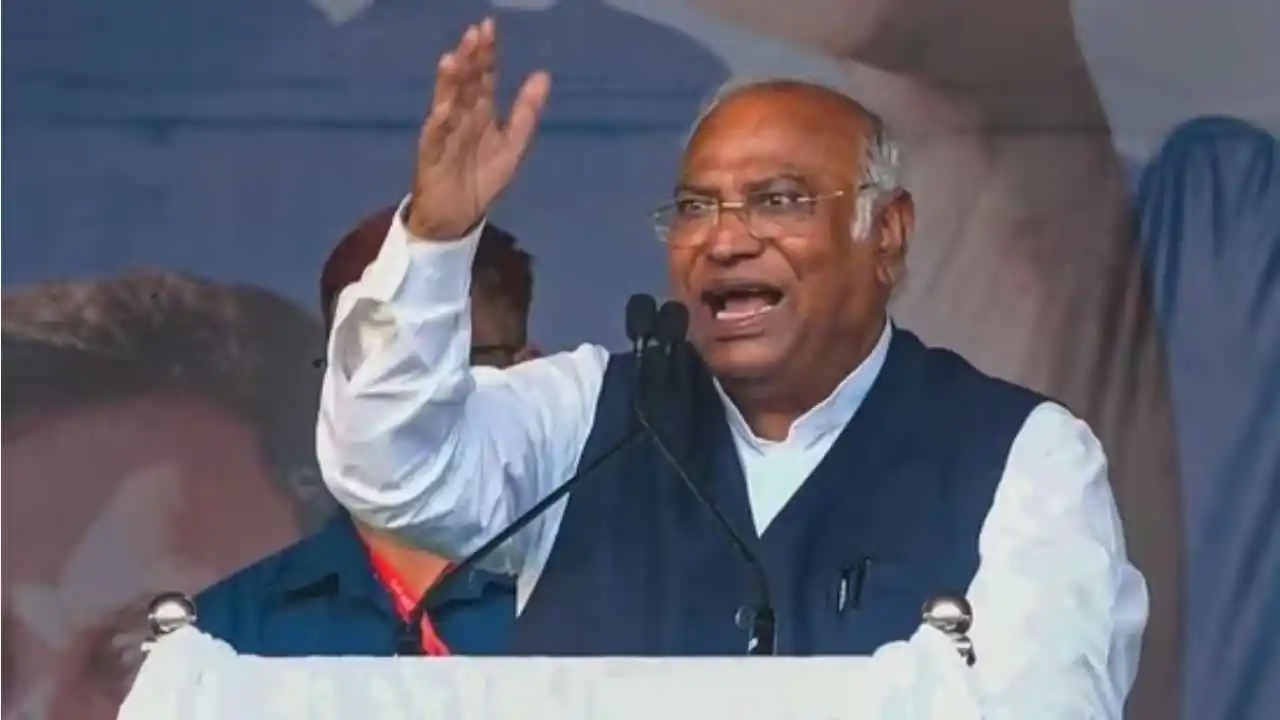
Congress president Mallikarjun Kharge has written to Prime Minister Narendra Modi for the fourth time, seeking an all-party meeting on delimitation. He also flagged the 64-day delay in proroguing Parliament’s Monsoon Session.

Published

on

Congress president Mallikarjun Kharge has renewed his demand for an all-party meeting with Prime Minister Narendra Modi to discuss the government’s proposed delimitation exercise, arguing that political parties must have adequate time to examine the proposals before they are finalised for consideration in Parliament.

In a letter to the prime minister on Friday, October 16, Kharge also raised concerns over what he described as an unprecedented delay in formally proroguing Parliament’s Monsoon Session. He said 64 days had passed since the session was adjourned sine die on August 13, while both Houses were yet to be prorogued.

Kharge seeks wider consultations on delimitation

Kharge said he had first written to Modi on April 11, requesting an all-party meeting before the government introduced a constitutional amendment bill concerning delimitation.

According to the Congress president, the government did not convene the requested meeting before making the bills public late on April 14 and calling a special session of Parliament on April 16.

The constitutional amendment bill on delimitation subsequently failed to secure the required two-thirds majority in the Lok Sabha on April 17.

Kharge said he had again written to the prime minister on July 16 and August 27, reiterating his demand for consultations. In his latest letter, he made the request for the fourth time, asking the government to discuss its revised proposals with political parties before finalising them for parliamentary consideration.

The Congress chief stressed that political parties should receive sufficient time to discuss the proposals among themselves and with other stakeholders.

He also cautioned the government against attempting to push through another far-reaching constitutional amendment without adequate deliberation.

Congress raises concern over Parliament session

Apart from delimitation, Kharge highlighted the delay in proroguing the Monsoon Session, which was adjourned sine die on August 13.

He described the 64-day gap as unprecedented and linked the issue to concerns about possible government plans to bring fresh delimitation proposals before Parliament.

Prorogation formally ends a parliamentary session. Kharge’s letter raised the issue while urging the government to ensure wider political consultation before proceeding with any new legislative proposals.

Jairam Ramesh shares Kharge’s letter

Congress general secretary for communications Jairam Ramesh also drew attention to the letter by sharing it on X.

Ramesh said Kharge had written to Modi about the delay in proroguing the Monsoon Session and the possibility of further government moves on delimitation.

The Congress’s latest demand centres on securing time for political parties to examine the government’s proposals before they are finalised for consideration in Parliament.

Continue Reading

India News

Abhijeet Dipke detained ahead of CJP’s national flag march in Delhi

Cockroach Janta Party founder Abhijeet Dipke was detained by Delhi Police on October 16, 2026, shortly before a planned national flag march. The proposed rally followed the judicial custody of two CJP members who had waved the Tricolour at Jantar Mantar.
Published

on

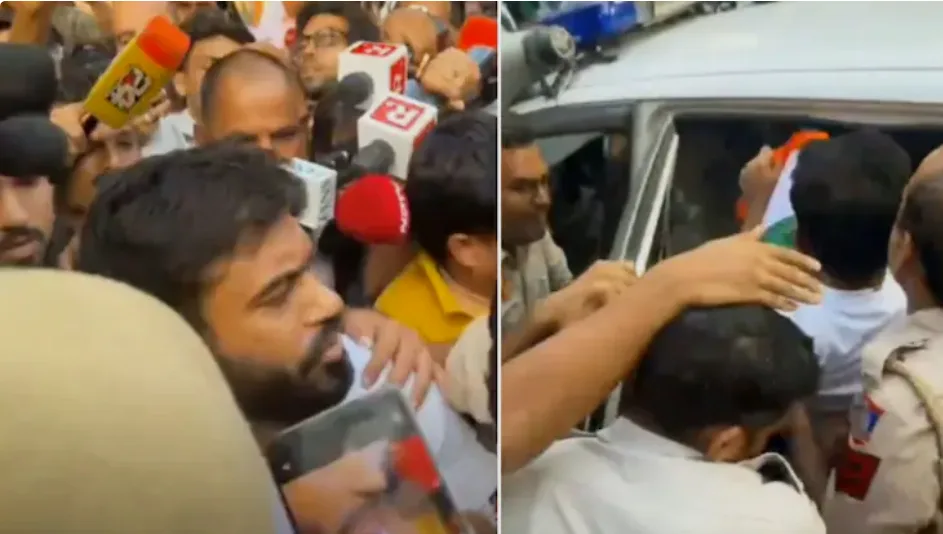
Cockroach Janta Party (CJP) founder Abhijeet Dipke was detained by Delhi Police on Friday, October 16, shortly before he was due to participate in a planned national flag march in the capital.

According to the report, police personnel reached Dipke’s residence and detained him just minutes before the proposed ‘Lehra Do Tiranga’ rally. The march was planned in Delhi amid tensions over restrictions on demonstrations and the detention of CJP members.

The latest detention marks the second time Dipke has been detained within a week. He was previously detained after arriving at Delhi’s airport from Mumbai for a protest against Chief Election Commissioner Gyanesh Kumar over allegations of manipulation during the Special Intensive Revision (SIR) of electoral rolls.

Why was the national flag march planned?

One of the main triggers for the planned march was the judicial custody of two CJP members, Saurav Das and Ashutosh Ranka.

The two were sent to five-day judicial custody after entering Jantar Mantar while waving the national flag on October 13. The incident occurred a day after the historic protest site was denotified as a protest location, according to the report.

The proposed march was called ‘Lehra Do Tiranga’. CJP planned the rally amid its continuing opposition to Chief Election Commissioner Gyanesh Kumar over alleged electoral irregularities.

The allegations concerning voter-list manipulation remain allegations and should not be presented as established findings.

Police had issued a notice before the detention

Before detaining Dipke, Delhi Police personnel visited his residence and served him a notice advising him against holding the proposed march.

The notice was issued under Section 163 of the Bharatiya Nagarik Suraksha Sanhita (BNSS), according to the report. It stated that prohibitory orders were in force in the Connaught Place area.

The notice also cited the absence of permission from the New Delhi Municipal Council (NDMC) for the proposed Tiranga Yatra. It warned that proceeding with the march despite the restrictions would be considered a violation of the law.

The detention came amid heightened attention to the proposed gathering in central Delhi and the dispute over whether the planned march could proceed under the prevailing restrictions.

A second detention in a week

Dipke’s latest detention followed his earlier detention at Delhi airport after he arrived from Mumbai for a planned protest over the SIR exercise and allegations concerning voter-list manipulation.

The latest episode adds to the ongoing confrontation between CJP and the authorities over its proposed demonstrations. The immediate context for the October 16 march was the judicial custody of two party members following their appearance at Jantar Mantar with the national flag.

The report does not establish that the allegations of electoral manipulation are proven, nor does it provide a final judicial determination of the dispute surrounding the planned march.

Continue Reading

India News

Delhi deploys 25,000 personnel, installs CCTV cameras ahead of CJP march

More than 25,000 police and paramilitary personnel have been deployed in Delhi ahead of the CJP’s planned protest march at Connaught Place. Authorities have also imposed restrictions and stepped up CCTV surveillance.
Published

on

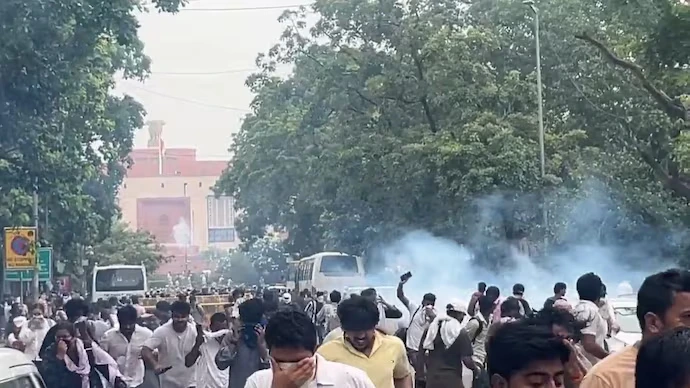
Delhi has stepped up security ahead of a planned protest march by the Cockroach Janta Party (CJP), with more than 25,000 police and paramilitary personnel deployed and additional surveillance measures introduced in parts of the national capital.

The planned “Lehra Do Tiranga” march is scheduled to take place at Central Park in Connaught Place on Friday, October 16. Authorities have also imposed prohibitory orders in Connaught Place and surrounding areas as part of the security arrangements.

Security tightened across Connaught Place

The security arrangements include the deployment of police and paramilitary personnel, along with the installation of additional CCTV cameras at Central Park and Rajiv Chowk Metro Station.

Prohibitory orders have been imposed under Section 163 of the Bharatiya Nagarik Suraksha Sanhita (BNSS) in Connaught Place and nearby areas. Central Park is also scheduled to remain closed for two days, with authorities advising the public to avoid the area during the arrangements.

A high-level meeting chaired by Delhi Police Commissioner Anurag Kumar, attended by senior police officers, was held on Thursday to review preparations ahead of the planned demonstration.

Why CJP is planning the march

The CJP has called the march to protest the arrest of its leaders Saurav Das and Ashutosh Ranka and to demand the resignation of Chief Election Commissioner Gyanesh Kumar over alleged irregularities in voter rolls.

The party’s protest is centred on its allegations concerning the electoral roll revision process. These are the protesters’ claims and should not be treated as independently established findings.

With Jantar Mantar no longer designated as a protest site, Central Park in Connaught Place has emerged as the proposed location for the fresh demonstration. The protest has also received support from the Aam Aadmi Party and the All India Students’ Association, according to the report.

Traders raise concerns over business disruptions

The heightened security measures have also prompted concerns among traders in the area.

Traders at Palika Bazaar have expressed concern about disruptions during the festive season, pointing to losses associated with previous protests. The concerns reflect the potential impact of repeated demonstrations and security restrictions on commercial activity in central Delhi.

Delhi Police has said it will facilitate peaceful demonstrators selectively while maintaining public order and protecting property.

Continue Reading

Trending

© Copyright 2022 APNLIVE.com